Mobile woman Ashley LaBounty indicted federally over $2.2 million in alleged COVID-19 relief fraud
A Mobile woman faces federal charges alleging she conspired to obtain more than $2.2 million from COVID-19 relief programs, including $1.1 million in PPP loans and an additional $36,000 from a separate pandemic fund.
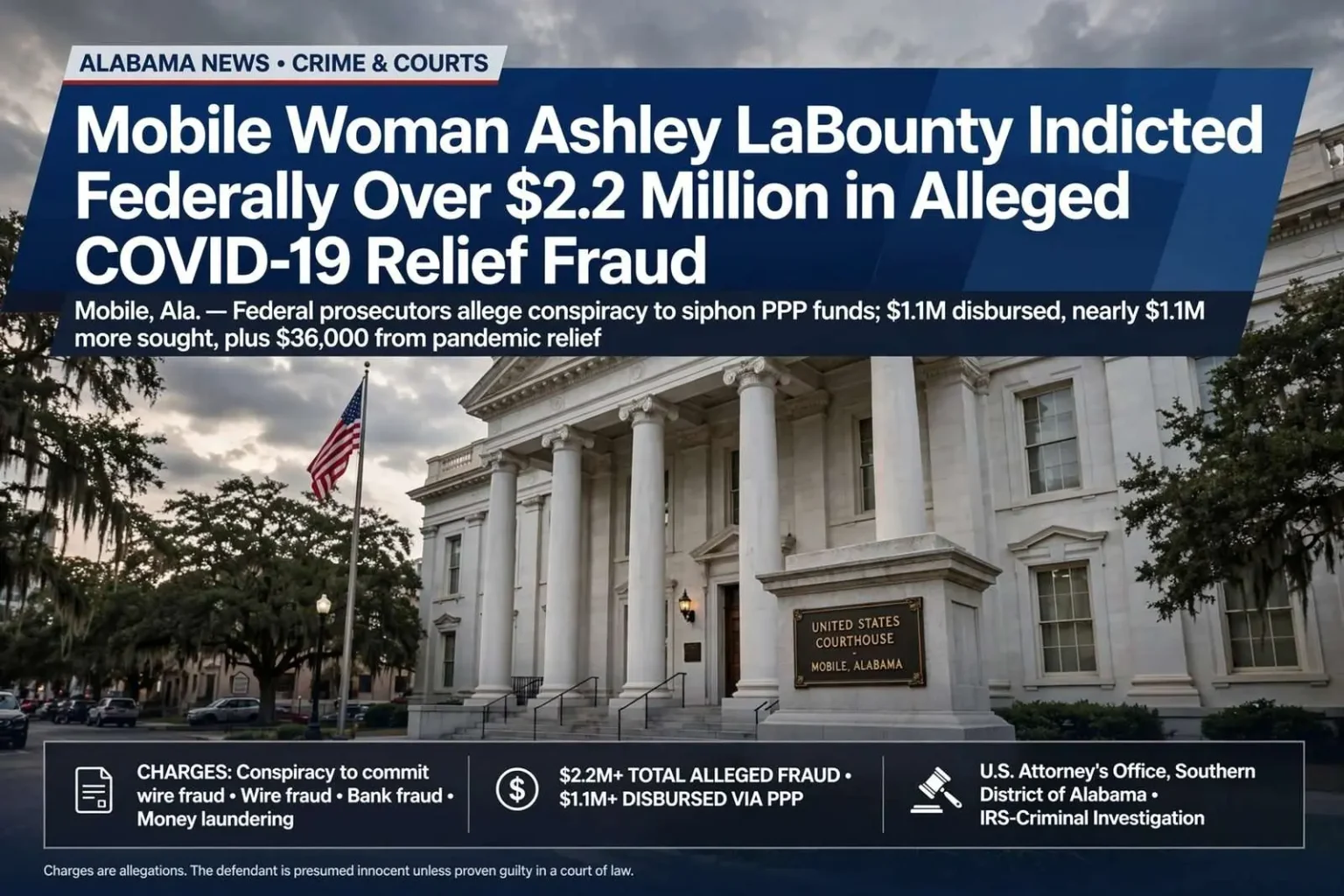
MOBILE, Ala. — A Mobile woman has been indicted in federal court on charges that she conspired with others to siphon more than $2.2 million from COVID-19 relief programs, with prosecutors alleging she personally received or attempted to obtain more than $1.1 million in Paycheck Protection Program loan proceeds and roughly $36,000 from a separate pandemic-era relief fund.
According to the indictment, Ashley LaBounty is accused of lying on loan applications in order to obtain PPP funds intended to keep small businesses and their workers on payroll during the early months of the pandemic. Federal prosecutors say she and unnamed co-conspirators submitted the fraudulent applications, that more than $1.1 million was actually disbursed to her, and that she attempted to obtain nearly $1.1 million more through PPP loans processed by a different bank.
The case was developed by the U.S. Attorney’s Office for the Southern District of Alabama and the Internal Revenue Service – Criminal Investigation, which has handled a large share of pandemic-fraud cases across the country. The indictment was returned by a federal grand jury sitting in Mobile, the seat of the district that covers the southern portion of the state from Mobile and Baldwin counties east to the wiregrass region.
What the charges allege
The indictment contains multiple counts, including conspiracy to commit wire fraud, wire fraud, bank fraud, and money-laundering-related charges. Each of the wire-fraud counts is tied to a specific loan application or disbursement, and the bank-fraud counts are tied to the institutions that processed the PPP applications. The most serious charge carries a statutory maximum penalty of 30 years in federal prison if the defendant is convicted, along with potential fines, restitution, and a term of supervised release.
Federal sentencing, however, would be determined under the U.S. Sentencing Guidelines by the judge who presides over the case, and any final sentence would depend on the specific conduct found at trial or admitted in a plea, as well as factors such as the actual loss amount, the number of victims, and the defendant’s prior record.
Although the indictment itself was returned earlier and made public this week, the conduct it describes is part of a wave of pandemic-relief prosecutions that federal authorities say produced the largest fraud-investigation effort in U.S. history. The Paycheck Protection Program, created by the CARES Act in March 2020 and administered by the Small Business Administration, ultimately approved more than 11 million loans worth roughly $800 billion. Investigators have alleged that a small but consequential share of those funds went to applicants who falsified payroll figures, employee counts, or the very existence of the businesses they claimed to run.
How the PPP worked, and how the alleged scheme fits
Under the original PPP framework, qualifying small businesses could borrow up to 2.5 times their average monthly payroll costs, with a hard cap that was raised during the program’s life. The loans were issued through banks and other SBA-approved lenders, and the proceeds had to be used for approved expenses such as payroll, rent, mortgage interest, and utilities. If a borrower spent at least 60 percent of the loan on payroll during the covered period and met other conditions, the loan could be forgiven, converting what looked like debt into a grant.
Because the program was rolled out under intense time pressure in the spring of 2020, with lenders required to process applications in days rather than the months such reviews would normally take, the SBA’s standard underwriting was compressed. That urgency, the U.S. Department of Justice has argued in many similar cases, opened the door to fraudulent applications that included fake payroll registers, fictitious tax filings, and shell companies that existed largely on paper. Once a loan was funded, prosecutors say, the money was quickly moved through personal and business accounts, often to buy real estate, vehicles, or personal items unrelated to any operating business.
In the Mobile case, prosecutors say LaBounty’s applications were processed by at least two different banks, and that the schemes were coordinated with at least one other person. The indictment describes nearly $1.1 million in additional PPP funds that were applied for through a second bank but, according to the government’s allegations, were not ultimately disbursed because of intervening review. Separately, the indictment alleges that LaBounty received $36,000 from a different COVID-19 relief program, an amount that suggests the smaller Economic Injury Disaster Loan program or a similar state-administered pandemic assistance fund. That figure is dwarfed by the PPP totals but is treated in the indictment as a separate stream of fraudulent proceeds.
What investigators and prosecutors have said
Federal prosecutors in Alabama and around the country have repeatedly stressed that the cases they bring are intended both to punish individual defendants and to deter similar schemes. The DOJ has said that pandemic-relief fraud, regardless of the dollar amount, harms taxpayers directly because the money diverted was supposed to flow to genuine small businesses trying to keep employees on the books during a public health emergency.
IRS-Criminal Investigation, the agency that worked on this case alongside the U.S. Attorney’s Office, has been a central player in pandemic-fraud enforcement. IRS-CI has said publicly that the volume of referrals it has received from the SBA, banks, and the public has been historically large, and that the cases it accepts for investigation typically involve either very high dollar amounts, organized schemes, or specific aggravating factors such as the use of shell entities.
Officials have not, as of the most recent filings, said publicly when LaBounty was arrested or whether she had been taken into custody before the indictment was unsealed. Federal court records in the Southern District of Alabama typically reflect the date of an initial appearance, the date of any detention hearing, and the date any indictment is returned. Anyone indicted in federal court is presumed innocent unless and until proven guilty beyond a reasonable doubt, and the allegations in an indictment represent the government’s theory of the case rather than findings of fact.
What happens next in court
Cases like this one usually proceed through a series of well-defined steps. After an indictment is returned, a federal judge arraigns the defendant, who is asked to enter a plea to each count. If the defendant pleads not guilty, the case moves into a discovery phase in which prosecutors turn over the evidence they intend to use at trial and the defense reviews it. The parties may then file motions to suppress evidence, dismiss counts, or resolve other pretrial issues, and a judge will often hold a status conference to set a schedule for the remaining work.
Many federal criminal cases end with a plea agreement rather than a trial. The Southern District of Alabama, like other federal districts, has plea rates in criminal cases that are well above 90 percent, in part because of the volume of evidence prosecutors typically compile and the sentencing leverage that comes from having an indictment returned. If a defendant pleads guilty, the case proceeds to sentencing, where the judge weighs the U.S. Sentencing Guidelines and the factors in 18 U.S.C. § 3553(a) before imposing a term of imprisonment, a fine, restitution, and supervised release. If the case goes to trial, a federal jury must reach a unanimous verdict, and any acquittals are final; any convictions would then be subject to sentencing at a later date.
For the alleged victims of the alleged scheme — the lenders, the Small Business Administration, and ultimately the taxpayers who fund the program — restitution is a standard element of any sentence imposed in a fraud conviction. A restitution order in a case of this size can itself be substantial, and federal prosecutors often seek a money judgment in the indictment itself so that the government can begin collection efforts immediately upon conviction, even if the defendant appeals.
Why the case matters in Mobile
Mobile is the largest city on Alabama’s Gulf Coast and the seat of Mobile County, and the Southern District of Alabama’s main courthouse sits in the city’s federal building. Cases brought in Mobile often draw regional attention not only because of the people involved but because the courthouse is the venue for federal prosecutions that touch every county in the district. The presence of a port, a large healthcare sector, and a base of small businesses that depend on federal contracting means that pandemic-era relief programs had real significance for the local economy, and that allegations of fraud in those programs are treated as serious by local federal authorities.
Federal prosecutors have also used cases like this one to highlight the volume of pandemic-fraud enforcement work that has come out of the Southern District. In the months after the public health emergency ended, the U.S. Attorney’s Office joined a national sweep that included several indictments charging Mobile-area and Baldwin-area residents with PPP fraud, and at least some of those cases involved defendants who had been previously charged in connection with other financial crimes. The pattern of those prosecutions suggests that federal authorities in the district are willing to bring cases even when the dollar amounts, while significant, are not the largest in the national pandemic-fraud docket.
How to read the allegations
An indictment is a charging document, not a finding of fact. The grand jury that returned it was asked only whether there was probable cause to believe the crimes charged had been committed and that the defendant committed them, which is a much lower standard than the proof beyond a reasonable doubt required at trial. The case as it now exists in court will be tested in pretrial motions, in plea negotiations if any occur, and at trial if the matter is not resolved before then. Until those steps play out, the indictment’s allegations remain the government’s theory of the case rather than a definitive account of what took place.
Anyone with information about pandemic-relief fraud can report it to the National Center for Disaster Fraud, which was set up by the Department of Justice in 2020 to consolidate pandemic-fraud tips, or to the SBA Office of Inspector General, which investigates the program directly. Reports submitted through those channels have, in many cases, led to indictments in districts across the country, including several in the Gulf South.
LaBounty’s case is now on the docket of the U.S. District Court for the Southern District of Alabama. No trial date has been publicly set as of the most recent filings, and the case is expected to be scheduled for an arraignment and pretrial conference in the coming weeks.