Mobile murder case leads investigators to $1 million PPP fraud scheme
A Mobile murder investigation led federal agents to a Saraland woman's $1 million Paycheck Protection Program fraud scheme, which prosecutors say funneled loans to convicted felons who submitted falsified financial documents.
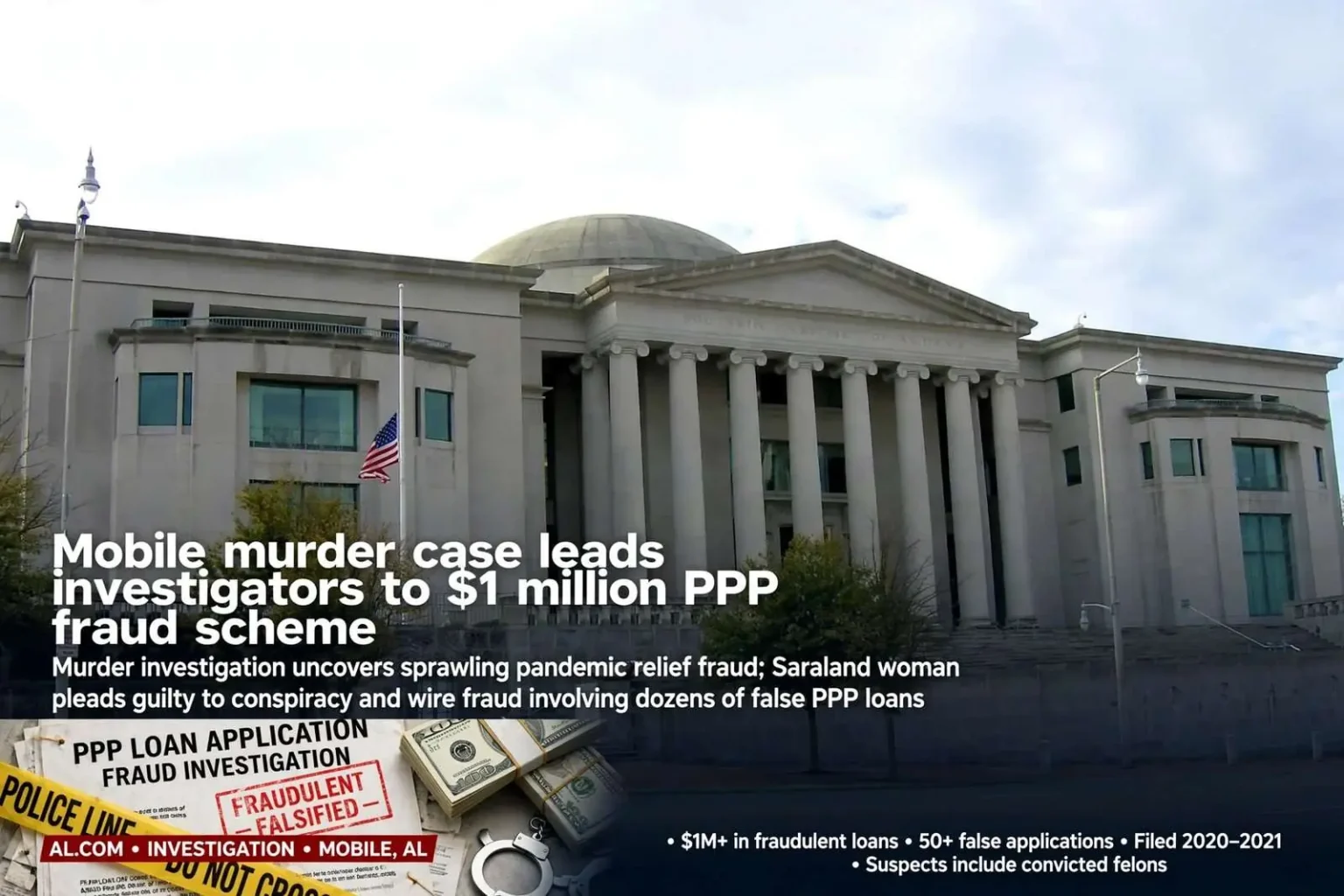
A murder investigation in Mobile has led federal authorities to a sprawling pandemic relief fraud scheme that prosecutors say funneled more than $1 million in fraudulent Paycheck Protection Program funds to convicted felons and other applicants who were not eligible for the money.
At the center of the case is Corine Campbell, 37, of Saraland, who pleaded guilty earlier this month in U.S. District Court for the Southern District of Alabama to conspiracy and wire fraud charges. According to court records, Campbell prepared and filed as many as 50 false PPP loan applications between May 2020 and September 2021, personally pocketing roughly $200,000 from the scheme. The Paycheck Protection Program was created by Congress in 2020 to provide emergency loans to small businesses struggling through the COVID-19 pandemic, with the loans eligible for forgiveness if used properly.
Campbell entered her guilty plea on Dec. 13 and faces sentencing in April. Her charges carry a maximum penalty of 20 years in prison and a fine of up to $250,000, though her plea agreement includes the possibility of a reduced sentence if she continues cooperating with investigators pursuing others connected to the operation.
The case first came to the attention of federal investigators after an unrelated violent crime. Demetrius Richardson, 42, was arrested by Mobile police on April 19 in connection with the April 10 shooting death of Dewon Donaldson on Ann Street. While reviewing Richardson’s background, investigators found he had received a $20,830 PPP loan through Prestamos CDFI, a lender based in Phoenix, Arizona.
That loan application relied on a fabricated Schedule C tax filing and falsified Navy Federal Credit Union bank statements, according to the criminal complaint. The application claimed Richardson earned $108,099 in 2019, despite the fact that he had been incarcerated from 2006 until August 2020 and reported no income that year to the Internal Revenue Service. Navy Federal later determined the submitted bank statements had actually been generated in September 2020, well after the period they were supposed to represent.
Investigators say Campbell helped Richardson submit the fraudulent application on April 15 — five days after Donaldson’s killing and four days before Richardson’s arrest — and filed additional paperwork on his behalf on April 28, after he was already in custody facing a murder charge. Richardson paid Campbell $8,000 in two installments in May for her help, a fee arrangement prosecutors say is itself prohibited under program rules.
The Richardson case opened the door to a wider probe. Investigators say it led them to Leroy Vidal Jackson, another beneficiary of Campbell’s operation. Court and press records show Jackson was convicted in 2005 for running the Mobile-based Gorilla Records crack cocaine trafficking ring and served nearly 15 years in federal custody before his release in March 2021.
Just eight days after leaving prison, on March 25, 2021, Jackson obtained a $20,832 PPP loan despite having no legitimate business income during the qualifying period. The application falsely claimed he was earning $8,333 a month as the sole proprietor of a landscaping business, with total business income listed at $106,788. Investigators noted that the falsified Navy Federal bank statement used to support Jackson’s application was nearly identical to the one submitted for Richardson, down to an identical account balance of $10,044.77 for the same date range.
Homeland Security investigators executed a search warrant at Campbell’s Saraland home on Sept. 9, seizing her cellphone. Text messages and WhatsApp conversations recovered from the device allegedly document communications between Campbell and Jackson discussing the scheme in detail.
During that search, agents also found a pistol in one of Campbell’s drawers. Because she is a convicted felon, she was additionally charged with possession of a firearm by a restricted person.
According to Small Business Administration records, Campbell obtained three PPP loans of her own. She received $9,040 in February 2021 for a janitorial business, $11,222 in May 2020 for what was listed as miscellaneous financial investment activities, and $15,208 in January 2021 for a tax preparation business. State business license records tie two companies to her name: Impressionable Tax Services LLC, formed in March 2018, and My Helping Hand, formed in May 2021, which describes its mission as helping families with food, clothing, bill payments and counseling.
A fourth defendant, Tyanna Latoya Vionne Earl, 28, pleaded guilty in November in U.S. District Court to a conspiracy charge for her role in helping Richardson move funds obtained through the scheme.
Pandemic-related fraud remains a major focus for federal law enforcement nationwide. The U.S. Secret Service announced in December that it had named a new National Pandemic Fraud Recovery Coordinator to oversee investigations into relief-program fraud. Officials estimate that as much as $100 billion in pandemic relief funds may have been fraudulently obtained since the programs launched, with roughly $2.3 billion recovered so far.
About the Paycheck Protection Program
The PPP was created by the CARES Act in March 2020 and run by the U.S. Small Business Administration through private lenders. It stopped accepting new applications on May 31, 2021. In 2022, Congress extended the statute of limitations for PPP fraud to 10 years, giving prosecutors more time to bring cases like this one.