Gulf Shores’ EPIC Program Turns Baldwin County Students Into Business Owners
The EPIC student program, run by area chambers of commerce, is teaching Baldwin County teens to launch and run their own businesses.
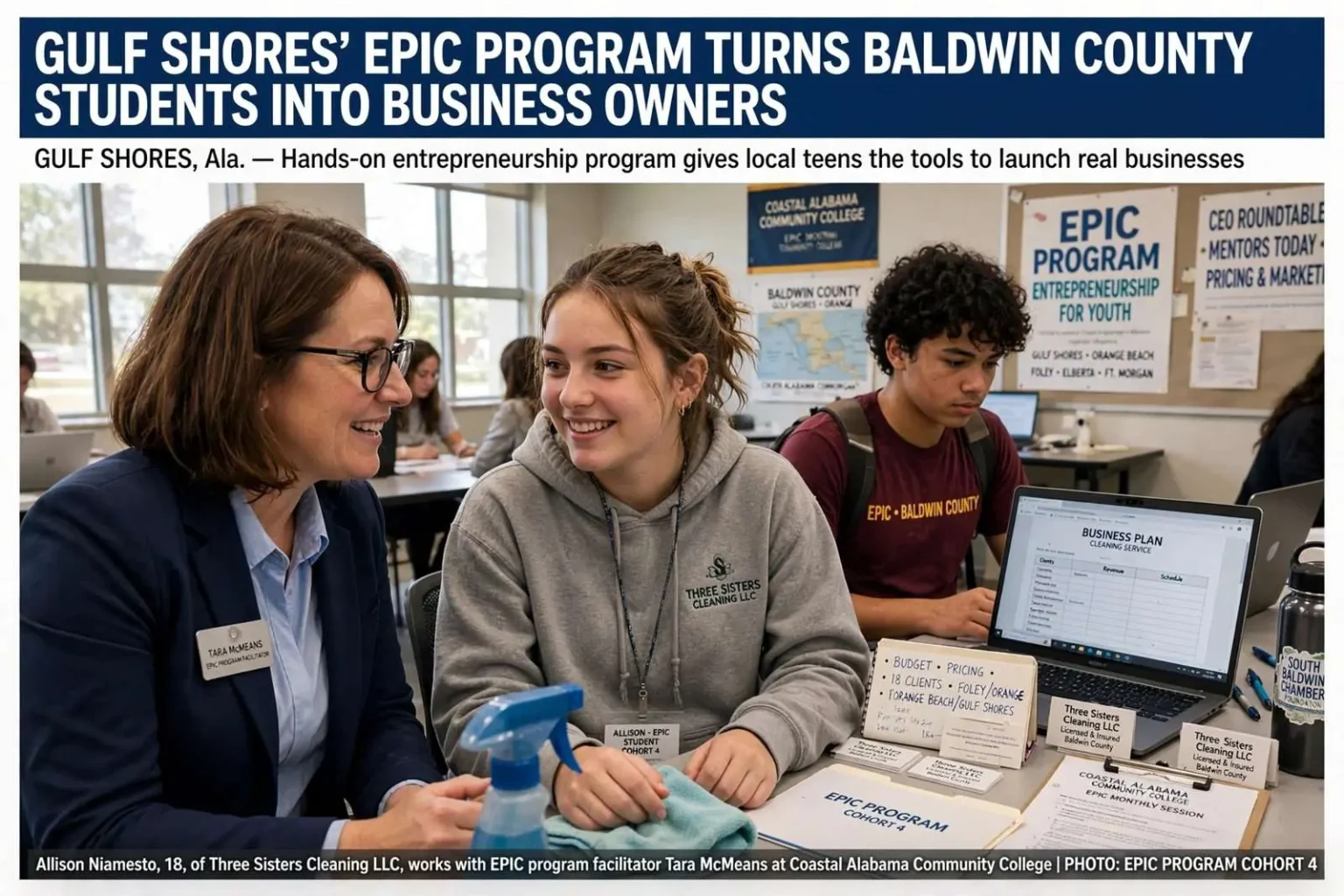
GULF SHORES, Ala. — The same day Gulf Shores celebrated the opening of its new high school, Tara McMeans addressed the city council about a different kind of milestone: a program that’s teaching Baldwin County teenagers how to run real businesses.
The EPIC student program, now entering its fourth year, is a partnership between the Coastal Alabama Business Chamber and the South Baldwin Chamber Foundation, facilitated by McMeans and other area business leaders. It provides middle and high school students — from public, private, city and homeschool backgrounds — with the tools to launch and run their own ventures through monthly hands-on sessions at Coastal Alabama Community College, an online curriculum, a “CEO Roundtable” with local business owners, and ongoing mentorship.
A Program Built on Real Businesses
The program’s clearest success story is Allison Niamesto, an 18-year-old graduate who launched Three Sisters Cleaning LLC in April after going through EPIC. Her business has grown to serve 18 full-time, recurring clients across five Baldwin County cities.
According to program facilitators, every student business launched since EPIC began remains in operation today, contributing to local economies in Gulf Shores, Orange Beach, Foley, Elberta and Fort Morgan. That track record is the program’s central selling point: these are not classroom simulations, but registered ventures with real customers, real revenue and real consequences for the young owners behind them.
How the Program Works
Students move through the program on a schedule designed to fit around their regular schooling. Monthly hands-on sessions at Coastal Alabama Community College give cohorts a consistent place to meet, work through curriculum and hear from people who run businesses along the Alabama Gulf Coast for a living.
An online curriculum carries the coursework between sessions, covering the fundamentals of turning an idea into an operating company. The “CEO Roundtable” pairs students with local business owners who have faced the same questions the students are now confronting — pricing, customers, insurance, time management — and ongoing mentorship keeps each venture moving after the formal sessions end.
Why Baldwin County Schools Partner In
The program’s open enrollment across public, private, city and homeschool backgrounds sets it apart from entrepreneurship coursework tied to a single school. A student in Gulf Shores city schools, a homeschooler in Foley and a private school student in Orange Beach can sit in the same cohort, which facilitators say mirrors the way business actually works across South Baldwin County’s interconnected communities.
For the chambers behind it, EPIC is an investment in the next generation of local business owners — the young people who will, in a decade or two, be running the service companies, retail shops and tourism-dependent enterprises that anchor the economy from Fort Morgan to the Florida line.
Funding the Next Cohort
The program relies on community sponsorships, which start at $50 and fund meetings and seed investment for student-led businesses. Applications for the next cohort are due Aug. 15, with materials available through the South Baldwin Chamber Foundation.
Facilitators said the combination of modest sponsorship dollars and student initiative is what makes the model work: seed money turns ideas into launch-ready ventures, and the students’ own work carries the businesses from there.
The Council Meeting Moment
McMeans’ appearance before the Gulf Shores City Council came on the same day the city cut the ribbon on its new high school, a coincidence that framed the program’s pitch neatly. One milestone was about buildings; the other was about what happens to the students inside them after graduation.
The timing underscored the argument EPIC makes to civic leaders across South Baldwin County: that preparing teenagers to create their own livelihoods is infrastructure of a different kind, and one that pays dividends in communities that want their young people to stay, work and build locally rather than leave for opportunities elsewhere.
Three Sisters Cleaning: A Case Study
Allison Niamesto’s Three Sisters Cleaning LLC illustrates what the pipeline looks like when it works end to end. She entered EPIC, worked through the sessions and mentorship, and launched her cleaning company in April, shortly after completing the program.
In the months since, the business has grown to 18 full-time, recurring clients spread across five Baldwin County cities. Recurring residential and commercial cleaning work is a competitive field on the Gulf Coast, where new households and rental properties come online constantly, and a young owner who can hold clients across that many municipalities has demonstrated the operational follow-through the program is designed to teach.
Her result is also the kind of outcome sponsors are told their dollars fund: a legal, operating, taxpaying business created by an 18-year-old who might otherwise have had no structured path into entrepreneurship.
The Chamber Partnership
The dual-chamber structure of EPIC is central to its reach. The Coastal Alabama Business Chamber, serving the Gulf Shores and Orange Beach area, and the South Baldwin Chamber Foundation, tied to the Foley-area business community, each bring networks of owners, mentors and sponsors from their respective ends of the county.
That reach is what allows the program to pull facilitators and Roundtable guests from across South Baldwin’s business community — tourism operators, service companies, restaurateurs and professional firms — rather than depending on a single organization’s contact list. It also gives the student businesses, which now operate in Gulf Shores, Orange Beach, Foley, Elberta and Fort Morgan, a built-in audience of potential customers and advisors.
Coastal Alabama Community College’s role as host rounds out the structure, providing neutral, classroom-ready space for the monthly sessions and, symbolically, a first taste of a college campus for middle and high school students who may be considering their own next steps.
The partnership also spreads the load of running a program like this. A single organization would struggle to supply monthly facilitators, Roundtable guests, mentors and seed funding on its own; split between two chambers and hosted by the college, EPIC draws each piece from the partner best positioned to provide it. McMeans and the other facilitators — business leaders volunteering their time — are the human thread connecting all of it, and their continuity across four cohorts is part of why the student businesses have stayed open.
What Students Actually Learn
The curriculum’s spine is the sequence of turning an idea into a functioning company: validating that customers exist and will pay, forming the business properly, pricing services, marketing, managing money, and delivering on commitments over time. The online modules handle the theory; the monthly sessions and mentors handle the reality.
Facilitators emphasize that the ventures students build are theirs — they choose the business, make the decisions and own the outcomes. The program’s role is to shorten the distance between a teenager’s idea and a registered LLC with its first paying clients, and its four-year record of launched businesses still in operation is offered as evidence that the approach holds up after the applause fades.
Applying and Sponsoring
For families interested in the next cohort, the timeline is concrete: applications are due Aug. 15, and materials are available through the South Baldwin Chamber Foundation. Middle and high school students from across Baldwin County — whether enrolled in public schools, private schools, city schools or homeschooled — are eligible, and no business experience is presumed at the door.
For businesses and individuals who want to back the program, sponsorships start at $50. The money funds the program’s meetings and provides seed investment for student-led businesses, meaning a sponsor’s contribution moves directly into the costs of launching and operating teenage ventures.
Facilitators point prospective sponsors to the program’s results as the return on that investment: every student business launched since EPIC began is still running, serving clients in five South Baldwin County communities and putting young owners through the full experience of business ownership years before most of their peers hold a first job.
The Broader Push for Youth Entrepreneurship
EPIC belongs to a wider effort across Baldwin County and the Gulf Coast to give students hands-on economic education, from school-based programs to chamber initiatives. The appeal for local leaders is straightforward: the coastal economy runs on small business, tourism services and trades, and students who learn to run a company at 16 or 17 enter adulthood with skills that transfer to any career they choose.
The program’s location in South Baldwin also reflects where that economy lives. The service and tourism businesses that dominate from Fort Morgan through Gulf Shores, Orange Beach and Foley are exactly the kinds of ventures teenagers can start small and grow — cleaning companies like Niamesto’s, landscaping, online retail — which makes the county’s southern end the natural home base for a program teaching students to launch them.
The program’s fourth year is also a statement about durability. Programs for teenagers often launch with energy and fade without institutional support; EPIC’s continued operation across four cohorts reflects the commitment of the two chambers, the college that hosts it and the business leaders like McMeans who volunteer their time to facilitate it.
As Gulf Shores celebrated a new high school building on the day McMeans spoke, the program she described represents the complementary piece: not where students learn, but what they are able to build with what they learn. Applications for the next cohort are due Aug. 15 through the South Baldwin Chamber Foundation, with sponsorships starting at $50.