Evergreen Drug Investigation Nets Two More Arrests, Pushing Operation Cold Summer Total to 14
Evergreen Police arrested Theo Cobb and Adrianna Stewart on multiple trafficking charges after a Friday morning raid, part of an ongoing investigation that has now led to 14 arrests since it began.
The Evergreen Police Department arrested two people this week in connection with a monthslong drug investigation, adding to a growing list of trafficking-related charges tied to the department’s ongoing crackdown. The latest arrests bring Operation Cold Summer’s total to 14 and show no sign that investigators are finished working through the targets developed over the course of the operation.
Search Warrant Leads to New Charges
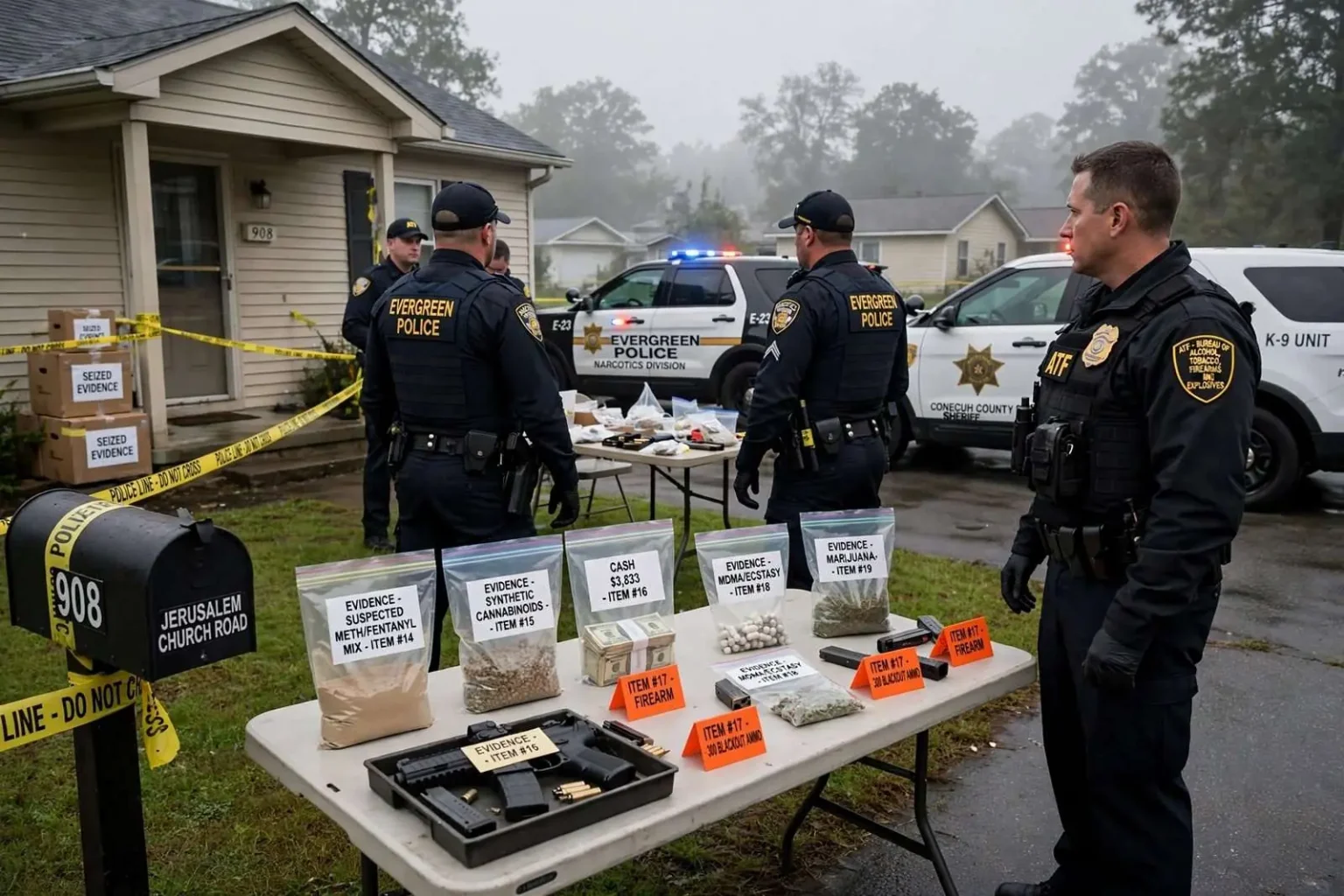
Evergreen PD’s Narcotics Division, along with the department’s Investigations and Patrol divisions, served a search warrant early Friday morning at a home in the 900 block of Jerusalem Church Road as part of the department’s ongoing Operation Cold Summer investigation. Two people are now facing multiple charges as a result of the raid, which turned up a range of suspected controlled substances along with a firearm and cash.
Theo Cobb, 39, was charged with trafficking fentanyl, trafficking synthetic cannabinoids, trafficking methamphetamine, first-degree unlawful possession of marijuana, unlawful possession with intent to distribute crack cocaine, unlawful possession of MDMA, unlawful possession of drug paraphernalia, being a certain person forbidden to possess a firearm, and chemical endangerment of a child. The stack of charges spans nearly every category of Alabama’s drug statutes and reflects the variety of substances officers say they found inside the home.
Adrianna Stewart, 32, was charged with chemical endangerment of a child and second-degree unlawful possession of marijuana, a set of counts that indicates officers believed a child was exposed to drugs in the residence.
Police said officers seized synthetic cannabinoids, a methamphetamine and fentanyl mixture, marijuana, crack cocaine, MDMA/ecstasy, ammunition described as “300 Blackout,” an AR-pistol, and $3,833 in cash during the search. The rifle-caliber ammunition and pistol, taken together with Cobb’s forbidden-person charge, underscore how frequently guns now surface in Alabama drug raids, and the cash seizure gives prosecutors an exhibit supporting their distribution theory.
Bond Set for Both Suspects
Both Cobb and Stewart were booked into the Conecuh County Jail following their arrests. Stewart is being held on an $18,000 bond, while Cobb is held on a significantly higher $1,668,000 bond, reflecting the trafficking-level quantities involved in the case. Bond amounts of that scale are reserved for defendants facing multiple trafficking counts, and judges set them high when the combination of charges suggests a defendant could face decades in prison if convicted.
The Conecuh County EMS, the Conecuh County Sheriff’s Office and the federal Bureau of Alcohol, Tobacco, Firearms and Explosives assisted Evergreen police in executing Friday’s search warrant. EMS crews stand by at drug warrants because of the danger of fentanyl exposure and the medical risks of overdoses during a raid, while sheriff’s deputies and ATF agents provide manpower and federal firearm expertise.
Investigation Now Spans 14 Arrests
Evergreen police said Operation Cold Summer has now resulted in 14 arrests tied to drug trafficking, drug distribution and several related charges, a pace that has made the initiative the most visible enforcement campaign the small city’s department has run in recent memory. Investigators have described the operation as intelligence-driven, built on complaints from residents, tips and surveillance work rather than a single flashpoint.
The cumulative effect of a dozen arrests over a matter of weeks does more than fill the county jail, according to officers familiar with such operations. Each seizure removes product from the street, each cash seizure dries up working capital for dealers, and each arrest produces statements and evidence that point investigators toward the next name on the list. That chaining effect is the reason operations like Cold Summer keep producing arrests after the initial warrant rounds conclude.
Evergreen’s Battle With the I-65 Corridor
Evergreen, the county seat of Conecuh County, sits directly along Interstate 65 roughly halfway between Montgomery and Mobile, a position that has made the city of a few thousand residents a persistent waypoint in the drug traffic moving along Alabama’s main north-south artery. Traffickers moving product between the Gulf Coast ports and the population centers to the north pass through the area daily, and small-city police departments along the corridor have long reported that their communities absorb problems far out of proportion to their size.
Local departments in that position typically cannot match the manpower or budgets of agencies in Mobile or Montgomery, which is why operations like Cold Summer lean heavily on partnerships. The ATF’s involvement brings federal firearm charges into play for defendants like Cobb, who face a forbidden-person count on top of the state drug charges. The Conecuh County Sheriff’s Office covers the rural stretches around the city, and EMS presence at warrants has become standard practice statewide as fentanyl has made every drug raid a potential medical emergency.
The charges themselves illustrate how Alabama law addresses the modern drug market. Trafficking statutes are triggered by weight thresholds rather than intent to sell, so a single bag of methamphetamine mixed with fentanyl can generate a trafficking count. Synthetic cannabinoids — lab-produced chemicals sprayed on plant material and sold under street names — carry their own trafficking provisions. And the chemical endangerment statute, which Cobb and Stewart are both charged under, treats the presence of drugs within reach of a child as a felony even when no child is injured, a law prosecutors across the state have used aggressively since its adoption.
What the Charges Mean Going Forward
Cobb’s nine charges will move through the Conecuh County court system alongside whatever federal authorities decide to do with the firearm allegation. Defendants charged as certain persons forbidden to possess a firearm can face federal indictment when ATF agents find the underlying record supports it, and federal prosecution often follows state arrests in operations like this one. His $1,668,000 bond effectively guarantees he will remain in custody while those decisions are made.
Stewart’s case will turn on the evidence supporting the chemical endangerment count, which requires the state to prove a child was exposed to the environment officers documented inside the home. Second-degree marijuana possession, by contrast, is among the lower-level counts Alabama prosecutors handle, and outcomes there depend heavily on the quantity recovered and any prior record.
For the neighborhoods around Jerusalem Church Road and the rest of Evergreen, the operation’s most immediate effect is a quieter stretch of street. Residents who called in complaints over the months before the raid told officers that traffic at the home had become a nightly concern, the kind of slow-building neighborhood pressure that most often triggers a drug investigation in small Alabama cities.
Police have not said whether Operation Cold Summer is complete, and the running count of 14 arrests suggests investigators are still working their list. Departments that run these campaigns typically conclude them with a public summary of seizures and charges, but Evergreen officials have continued announcing arrests as they occur rather than waiting for a single capstone announcement — a rolling accounting that keeps the operation’s name in front of the community and, investigators hope, in front of the people still dealing drugs in Conecuh County.
Anyone with information about drug activity in the Evergreen area is encouraged to contact the Evergreen Police Department, where investigators say tips — whether phoned in, delivered in person or left anonymously — form the starting point for the search warrants that operations like Cold Summer are built on.
How Small-City Drug Operations Come Together
Operations like Cold Summer rarely begin with a raid. They begin, investigators say, with a pattern: repeated complaints about traffic at a particular address, overdoses logged by EMS, small buys worked by a narcotics officer over weeks, and the slow accumulation of probable cause that eventually persuades a judge to sign a search warrant. By the time a warrant squad rolls up to a home before dawn, the paperwork behind the operation may already be months old.
The multi-division approach Evergreen used — narcotics investigators, general detectives and patrol officers all assigned to the warrant — is a necessity in a department of its size. Patrol officers secure the perimeter and handle the people inside, investigators manage the search and the evidence, and narcotics personnel bring the case knowledge that tells them where to look and what they are looking at. Small Alabama departments that attempt drug operations without that coordination routinely see cases weakened by chain-of-custody problems.
The presence of ATF agents also signals a deliberate choice. Federal firearm charges carry sentencing exposure that state courts often cannot match, and prosecutors use the overlap to ensure that defendants found with guns face consequences from whichever system moves first. That local-federal teamwork has become a fixture of enforcement across south Alabama’s smaller cities, where the state attorney general’s office, U.S. attorney’s office and county sheriffs routinely share cases.
The Human Cost Behind the Charges
Two of the charges in Friday’s case — chemical endangerment of a child against both defendants — exist because of the environment officers found, not because any child was harmed directly. Alabama’s legislature passed the chemical endangerment law to address homes where drugs are made, stored or used within reach of children, and it has become one of the most commonly filed felony charges in drug raids statewide. Officers who document drugs, scales, cash and firearms in a home where a child lives are required by law to treat the child’s exposure as a crime in itself.
The methamphetamine-fentanyl mixture recovered in the raid is another sign of the times. Poisoning deaths linked to fentanyl have climbed across Alabama in recent years as the synthetic opioid has worked its way into methamphetamine, cocaine and counterfeit pills, and officers now treat every white powder, pressed pill and crystal as a potential lethal exposure. That reality is why EMS stood by at Friday’s warrant, and why departments statewide have issued naloxone to their patrol officers.
As the cases against Cobb and Stewart work through the courts, Evergreen police say the focus of Operation Cold Summer stays the same: shutting down the trafficking networks that have used the city’s position along I-65 as a waypoint, one warrant at a time.