Expectant mothers in Monroeville face longer drives after Monroe County Hospital ends labor and delivery
Monroe County Hospital in Monroeville, Alabama will end labor and delivery services, forcing expectant mothers to travel farther to give birth.
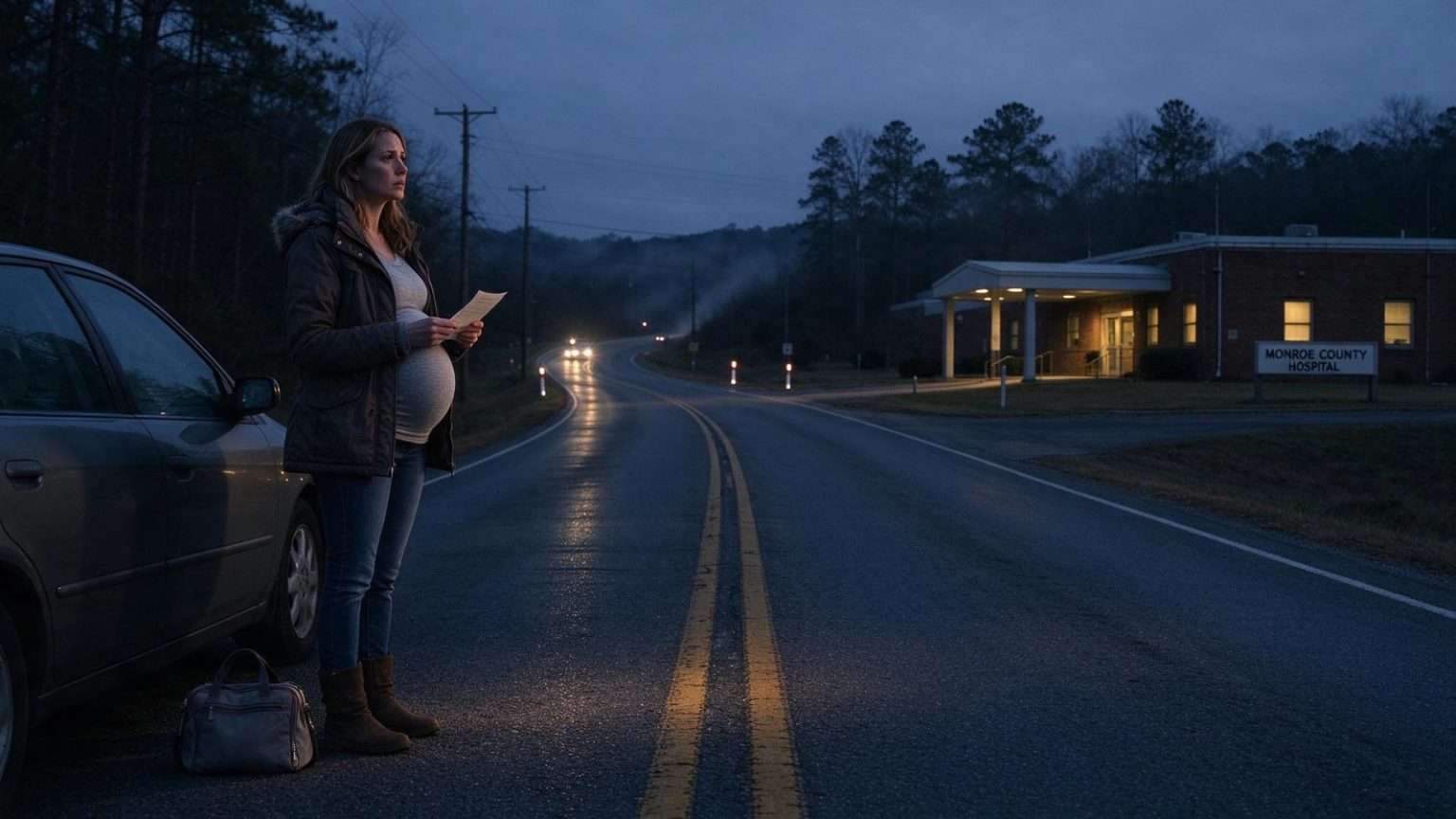
MONROEVILLE, Ala. — Expectant mothers in Monroe County are scrambling to make new birth plans after Monroe County Hospital announced it will end labor and delivery services. The hospital said it plans to close the department because of physician shortages.
After Nov. 15, the nearest hospital offering labor and delivery is about 45 minutes away in Grove Hill, administrators said.
The announcement turns a routine part of small-town life into a logistics problem for dozens of families. In rural Alabama, the local hospital’s obstetrics unit is often the assumption around which every pregnancy is planned — prenatal visits close to home, a delivery room ten minutes from the front door, follow-up care in the same building. Removing that option does not just relocate a delivery; it reshapes work schedules, childcare arrangements for older children, and the planning that surrounds every due date.
Alisha Bowen, who is 28 weeks pregnant and had planned to deliver at Monroe County Hospital, said she learned a few weeks ago that would no longer be possible. “I should be picking out cribs, not doctors,” she said.
She is due in late December and is now considering delivering at University Hospital in Mobile, about an hour and a half from her Monroeville home.
Bowen’s situation captures the arithmetic every affected family now faces. A drive that long in ordinary conditions becomes a different proposition in labor — and in December, it can mean interstate travel with the year’s first cold snaps and holiday traffic in the mix. Families in her position must weigh the distance against due dates that do not schedule themselves, and some will face the question of relocating temporarily near the delivering hospital in the final weeks of pregnancy, a burden unheard of for previous generations of Monroe County mothers.
Her quote has traveled well beyond Monroe County because it captures the closure in a single sentence. The weeks she describes — the ones that should be filled with cribs and car seats and nursery paint — have instead been filled with referrals, insurance calls and highway decisions, and every family affected by the Nov. 15 date is living some version of the same displaced expectation.
Belinda Dorrance, a registered nurse who worked at the hospital for 40 years before retiring in December, said the closure will affect many families. “The relationship between an expectant mom and her delivering physician is so special,” she said.
Four decades of nursing in one small hospital means Dorrance watched generations of Monroe County families come through the same doors — mothers who returned with their own daughters, physicians whose names became part of family stories. The continuity she describes is what a labor and delivery unit provides beyond the clinical care itself, and it is the part of the service that cannot simply be transferred down the road.
Her timing makes the announcement all the more striking. Having retired in December after 40 years, Dorrance is watching the department she helped staff prepare to close within a year of her departure — and she speaks about it with the perspective of someone who has seen what the unit meant at 3 a.m. on a winter night, when a laboring mother arrived and everything she needed was already in the building. That institutional memory is exactly what disappears when a rural obstetrics unit does: the nurses, the routines, the knowledge of two generations of local families.
Monroe County Hospital serves a county of small towns and rural communities spread across the rolling timber country between the Alabama and Conecuh river basins. A hospital of its size operates on narrow margins in the best of years, and every service line it maintains — from obstetrics to surgery to emergency care — competes for the same scarce pool of rural physicians. That scarcity is the stated reason for the closure, and it is the reason the board’s recruitment search will not be quick.
A pattern repeated across rural Alabama
Hospital administrators are referring expectant mothers to other facilities, some as far away as Montgomery, and the city of Monroeville has said it will work with the hospital to help where it can.
The referrals spread the burden across a wide map. Grove Hill, about 45 minutes southwest, becomes the closest option, but families referred toward Montgomery face drives of well over an hour, and Mobile — with its university hospital and full range of specialized services — sits an hour and a half away for Monroeville residents. Each family’s decision will depend on insurance, physician availability, the risk profile of the pregnancy and simple practicality, but every option now involves distance that local delivery never did.
The closure fits a pattern that rural health researchers have tracked across Alabama and the nation for years. Rural obstetrics units are among the first services hospitals cut when physician recruitment fails, because the specialty requires round-the-clock staffing of physicians, nurses and anesthesia that a low-volume unit struggles to sustain. When an obstetrician leaves a small hospital and cannot be replaced, the department’s math stops working — and the result is the announcement Monroe County families received.
The consequences reach beyond the delivery room. Obstetrics units anchor rural hospitals financially and clinically; they keep prenatal care local, support the hospital’s broader physician recruitment, and often determine whether young families stay in a community. Their loss is one of the clearest markers of what health officials call maternity care deserts — counties where pregnancy care requires a highway, not a driveway.
Prenatal care is the quieter casualty. When the delivering hospital is 45 minutes to two hours away, expectant mothers typically move their checkups to the same distant system, which means routine visits that once fit into a lunch hour become half-day round trips. That burden falls hardest on mothers without flexible jobs or reliable transportation, and public health research consistently links that friction to missed appointments and poorer outcomes. A county that loses its delivery rooms gradually loses its pregnancy care altogether, well before the official maps catch up.
Monroe County’s situation carries particular weight in Monroeville, a city that has built much of its identity and economy around its famous literary heritage and its role as the seat of a largely rural county. For a town that draws visitors from around the world, the struggle to keep a basic obstetrics service open is a reminder that the challenges facing rural Alabama communities are measured in practical terms as much as cultural ones.
Mayor confirms closure, board still hopes to avoid it
Monroeville Mayor Charles Andrews confirmed the Nov. 15 closure date and said the decision came from the hospital’s board in response to the shortage of physicians available to staff the unit.
Andrews said the board is continuing to work on the staffing problem and still hopes the unit will not have to shut down. He described the labor and delivery service as important to Monroeville and the surrounding communities, and said the city fully supports the hospital as it searches for the help needed to keep the department open.
The mayor’s framing leaves a narrow but real opening. A Nov. 15 date on paper is a deadline, not a demolition — if the board can recruit the physicians it needs, the closure can be called off, and Andrews’s public statement of support signals that the city intends to be part of that effort rather than a bystander. Municipalities in similar situations have assisted with recruitment incentives, letters of support and coordination with state and federal rural health programs, though the fundamental problem — a shortage of physicians willing to practice obstetrics in a small county — is not one a city government can solve alone.
For expectant mothers already in their third trimester, though, hope and logistics run on different calendars. A family due in December cannot wait on a recruitment outcome, which is why administrators are making referrals now and why families like Bowen’s are building plans around hospitals an hour or more away. If the unit does close as scheduled, Monroe County will join the growing list of Alabama counties without local delivery services; if the board succeeds in staffing it, the episode will stand as an example of a community catching a loss before it happened.
For the families already referred out, the practical checklist is long: transferring prenatal records to a new physician, confirming insurance coverage at the receiving hospital, preregistering for delivery, and mapping the drive from home to the labor floor — including the route to take at 2 a.m. when traffic is not the only variable. Nurses and administrators at the receiving hospitals handle much of the paperwork, but the emotional adjustment is the family’s own, trading a familiar delivery team for strangers in the final weeks of pregnancy.
Either way, the coming weeks will determine what maternity care looks like in Monroe County for years to come — and for the families with winter due dates, the planning has already moved down the road, to delivery rooms in Grove Hill, Montgomery and Mobile.