Hours on the Tarmac: How the FAA’s Nationwide Ground Stop Rippled Through Mobile, Gulf Shores, Pensacola and Alabama Airports
A nationwide FAA ground stop tied to air traffic control communication problems froze departures at Mobile Regional Airport and across Alabama and the Gulf Coast for several hours Friday before flights began moving again after about 7:30 p.m.
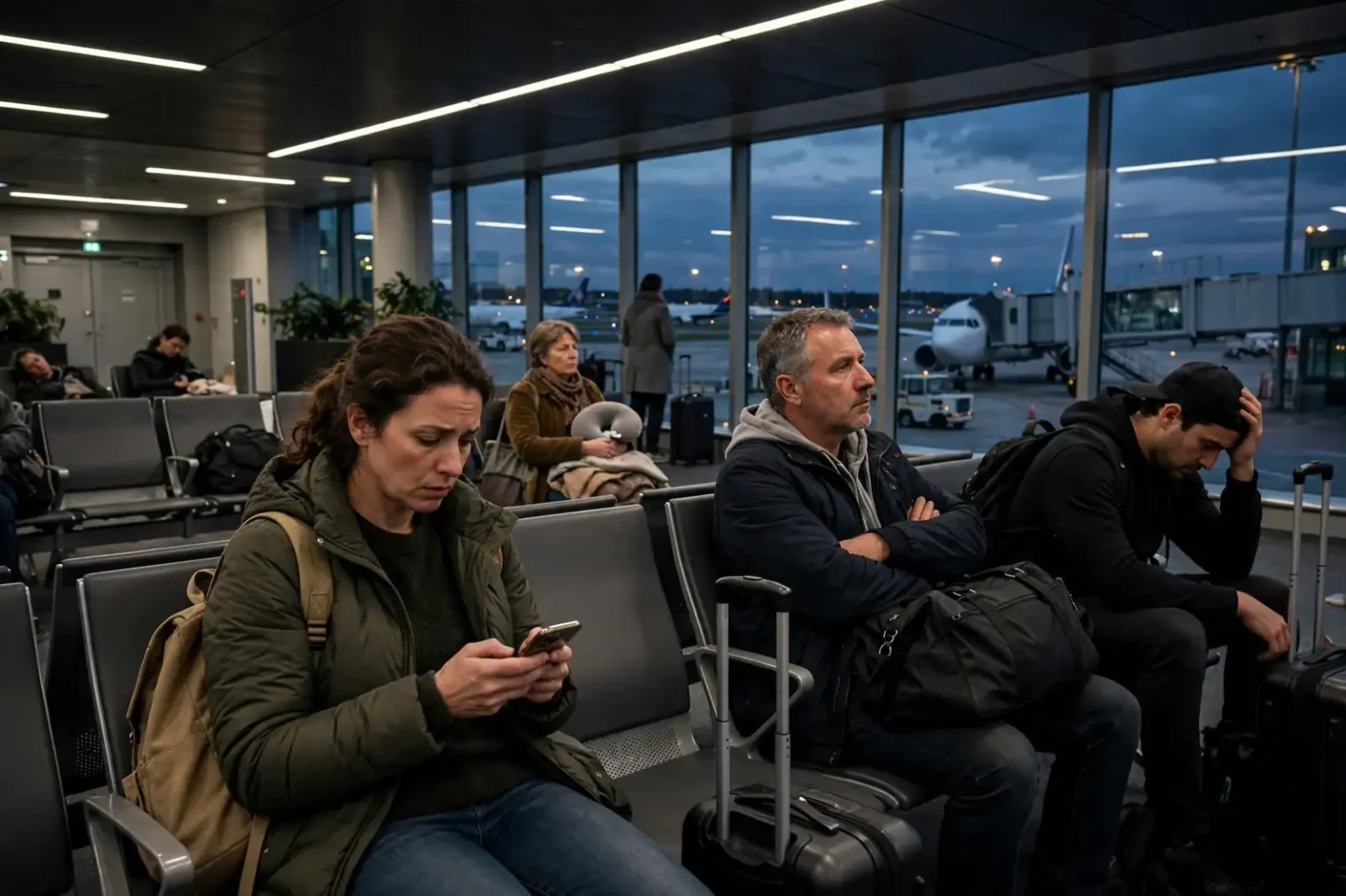
MOBILE, Ala. — Departure boards at Mobile Regional Airport went from on time to delayed almost all at once Friday afternoon, Nov. 13, when the Federal Aviation Administration ordered every flight in the country to stay on the ground. By the time the order was lifted shortly after 7:30 p.m., travelers from Mobile to Birmingham, Gulf Shores and Pensacola had lost an afternoon, and in many cases an evening, to one of the broadest air travel disruptions the nation has seen.
Update, Nov. 14: Gulf Shores Back to Normal, Birmingham Delays Linger
A day after the nationwide ground stop, the recovery across Alabama was uneven.
- Gulf Shores International Airport: Operations were back to normal Saturday. Of the three Allegiant flights on Friday’s schedule, only one was affected by the FAA order, a departure to Belleville, Ill., which was canceled. Several general aviation aircraft were also delayed, but the airport reported no other major problems. Airport leaders said they stayed in close contact with air traffic control, the airline and general aviation users throughout the stoppage, and they still urged passengers to confirm their flight status with the airline before leaving home. An airport official described the nationwide halt as a very rare event.
- Birmingham-Shuttlesworth International Airport: Dozens of flights were delayed or canceled Friday, and airport officials were still tallying the total Saturday. Disruptions continued into Saturday as airlines and air traffic controllers worked through the backlog, and the airport warned that delays and some cancellations could persist for the next couple of days. Officials said the terminal remained calm and thanked travelers for their patience. Some flights began moving again Friday evening after the order was lifted, but many had already been canceled.
- Huntsville International Airport: No update was immediately available.
The FAA lifted the ground stop at about 7:30 p.m. Friday. Federal transportation officials later attributed the communications breakdown that triggered it to aging air traffic control systems.
The FAA attributed the halt to a communications outage linked to trouble at regional centers that handle air traffic control, and described the step as one taken under extraordinary circumstances and for safety. Departures resumed in the evening, but airport officials across Alabama warned that the backlog of canceled and delayed flights would take time to clear.
At a glance
- What happened: The FAA issued a nationwide ground stop Friday afternoon, halting departures at U.S. airports.
- Why: Federal officials pointed to communication problems affecting air traffic control.
- When it ended: The FAA lifted the order shortly after 7:30 p.m. Central time.
- Who was affected locally: Mobile Regional Airport, Gulf Shores International Airport, Pensacola International Airport, plus Birmingham, Huntsville and Montgomery.
- What travelers should do: Check flight status directly with the airline, and expect lingering delays as carriers rebuild their schedules.
Mobile: departures frozen, arrivals allowed in
The Mobile Airport Authority said it was following the FAA order, which meant no aircraft could leave Mobile Regional Airport while the stop was in place. Planes that were airborne when the order came down, whether bound for Mobile or departing from it, were allowed to complete their trips and land. Flights operated by American, United and Delta were all held at the gate.
Airport officials stressed that the order was a national directive and had nothing to do with conditions at Mobile itself. The authority’s acting executive director acknowledged that the stoppage was frustrating for passengers, particularly those trying to make connections or reach time-sensitive commitments, and said the safety of travelers, flight crews and airport employees remained the priority. The authority said it was staying in contact with its airline partners while waiting on direction from the FAA, and that it would post more information as it became available.
Once the order was lifted, the airport said flight operations were starting back up, but cautioned that some delays could linger while the system returned to normal.
Frustration in the terminal
Inside the terminal, several passengers said the hardest part was not knowing how long the wait would last. Travelers described hearing repeated delay announcements without any estimate of when flights might leave or any explanation of what was going on.
One traveler who was scheduled to leave around 4:26 p.m. said she watched her flight get pushed back again and again and, expecting it to be canceled, chose to rebook for Saturday. Another passenger, who had purchased his ticket through a third-party travel booking site, said he was told to seek a refund from that company, but could not reach either the booking site or the airline. A third traveler questioned why airlines had not invested more in the technology that keeps planes moving.
Gulf Shores and Pensacola feel it too
The stop reached even the smaller commercial airports along the coast. At Gulf Shores International Airport, the director said communication and technical issues were affecting the entire National Airspace System and every airport in it. An Allegiant flight arriving from Des Moines was able to land, but the return departure to Belleville was held on the ground until the order lifted. General aviation traffic at the airport was grounded as well. The director described the event as highly unusual and said the airport was keeping travelers informed in coordination with the airline.
Across the state line, Pensacola International Airport kept watch on developments and stayed in touch with its carriers and with federal aviation officials. Airport staff said they expected the FAA’s next update at 10 p.m. Central time. Pensacola, like Mobile, urged travelers to get the latest delay and cancellation information straight from their airlines.
Across Alabama: cancellations pile up
The effects were heaviest at the state’s larger airports, where evening schedules were largely wiped out.
- Birmingham-Shuttlesworth International Airport: Early in the afternoon, the airport said little was known about the cause and warned that travel disruptions could stretch into the weekend. After the stop was lifted, the airport said a handful of flights would arrive and depart Friday night, but most of the evening’s flights had already been canceled. Travelers booked over the next day or two were told to monitor their flights with their airlines and to expect more delays while carriers and the FAA worked to restore normal operations.
- Huntsville International Airport: Airport officials explained that no aircraft could depart while the order was in effect. Once it was canceled, the airport said flights were expected to resume and advised travelers to check with their airlines.
- Montgomery Regional Airport: Most of the airport’s scheduled incoming flights were canceled during the stop. The airport said it remained ready to support its airlines into the evening and encouraged passengers to check flight status directly with their carriers.
In Birmingham, one Southwest Airlines passenger traveling to Maryland for military duty said his plane was already taxiing for takeoff when it suddenly stopped and the pilot announced that the FAA had grounded all aircraft. The jet waited on the runway roughly an hour before returning to the gate so passengers could get off. He said the airline handed out snacks, the mood at the gate stayed calm, and a crowd of roughly 100 people thinned to about 10 as travelers left or went to find food. He said he planned to wait it out because he needed to make it to his duty assignment.
Guidance also went out from the University of Alabama to employees whose travel was affected. The university said its contracted business travel agency was tracking every flight booked through the school’s Concur travel system and would work directly with affected travelers to rebook as seats opened up.
What federal officials said
The U.S. secretary of transportation described the cause as a communication issue and, at an evening news conference after the stop was lifted, pointed to outdated air traffic control technology as the source of the problems.
The U.S. homeland security secretary cautioned during the afternoon that recovery would take some time and said officials could not rule anything out while the cause was being investigated. He also stressed that the event should be understood as an outage, and said it should not be compared to the Sept. 11 attacks.
What a ground stop is
A ground stop is one of the tools the FAA uses to manage air traffic when the system cannot safely handle the normal flow of flights. Under a ground stop, aircraft that have not yet taken off are held at their departure airports, while flights already airborne typically keep flying to where they were headed. That is why travelers in Mobile saw arriving planes land even as every outbound flight sat at the gate.
Most ground stops are limited to a single airport or region and are triggered by thunderstorms, low visibility, equipment problems or runway issues. A stop covering every airport in the country is far rarer. In January 2023, a failure of the FAA’s Notice to Air Missions system, which distributes safety information to pilots, led the agency to halt domestic departures nationwide for the first time since the Sept. 11, 2001, attacks. Friday’s order shows how dependent the system is on reliable communication between pilots, controllers and the facilities that manage the nation’s airspace.
Why the backlog lingers after flights resume
Even a few hours on the ground can throw airline schedules off for a day or more. Aircraft and crews end up in the wrong cities, flight crews can run up against federal limits on how long they may work, and canceled passengers compete for a limited number of open seats on later flights. Airports in Birmingham and Mobile both warned that residual delays were likely as carriers worked to reposition planes and people.
Tips for affected travelers
Airport officials in Mobile, Pensacola, Birmingham, Huntsville and Montgomery all gave the same core advice: the airline, not the airport, has the latest information on any individual flight. Other steps that can help:
- Turn on alerts. The Mobile Airport Authority recommends signing up for airline text and email notifications and checking flight status through the airline’s website or mobile app.
- Act quickly on rebooking. Airline apps often let travelers change to a new flight without waiting in line at the counter or on the phone.
- Know your refund rights. Under U.S. Department of Transportation rules, passengers are generally entitled to a refund when an airline cancels or significantly changes a flight and the traveler chooses not to accept the alternative offered.
- Booked through a third party? Tickets purchased through an online travel agency may need to be changed or refunded through that agency, so keep its confirmation number handy.
- Keep records. Save receipts and notices from the airline in case you need to request a refund or reimbursement later.
What comes next
The FAA had not released a detailed explanation of what caused the communication failure as of Friday night. Airports across the region said they would keep coordinating with airlines and federal aviation officials, and travelers with trips planned over the weekend were advised to confirm their flights before heading to the airport.