Fairhope Passes Revised Noise Ordinance in Contentious 4-1 Vote
Fairhope City Council approved a new noise ordinance in a 4-1 vote, setting decibel limits amid disputes between residents and venues.
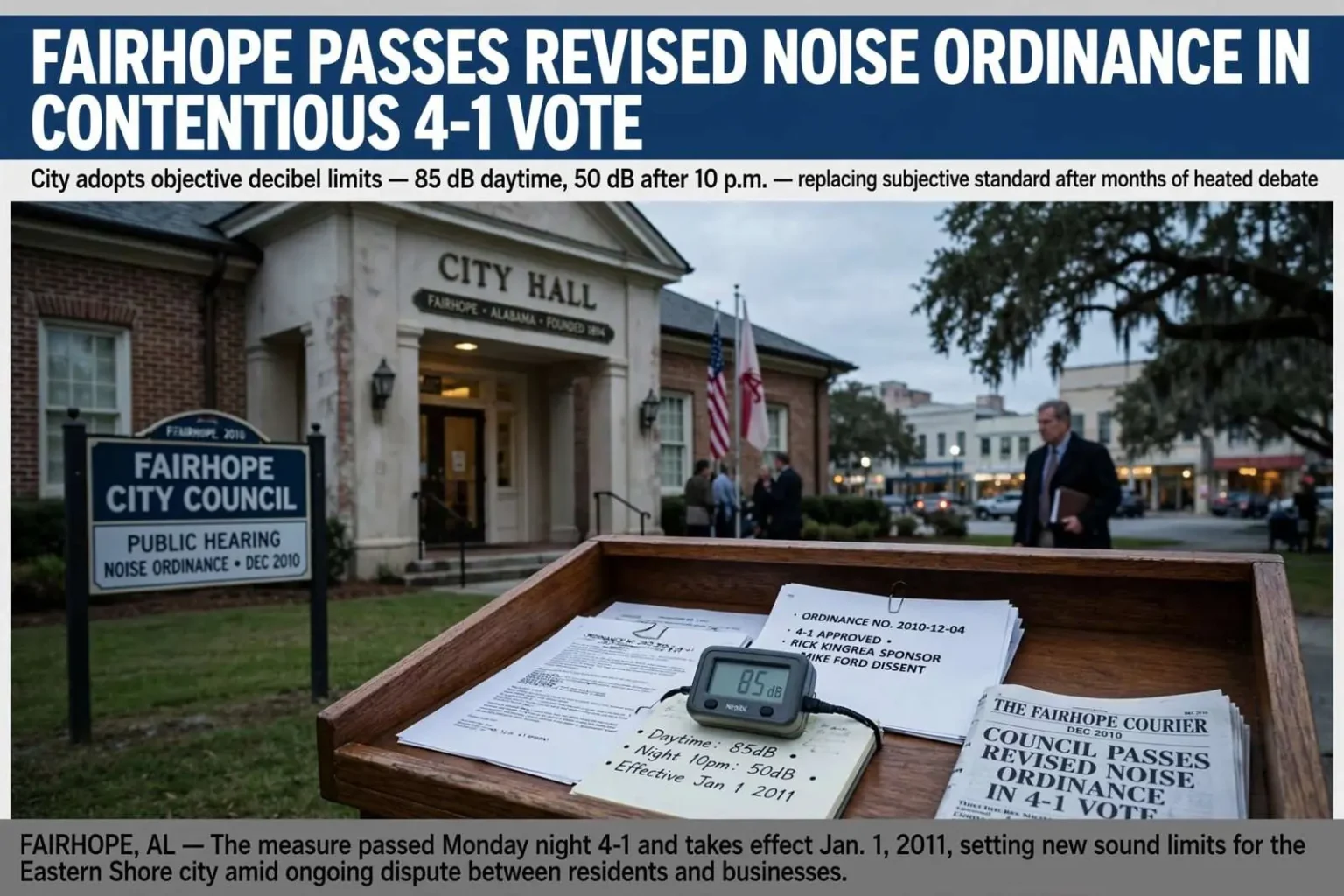
The Fairhope City Council approved a new noise ordinance on Monday in a 4-1 vote, capping months of heated debate between residents and local business owners over acceptable sound levels in the Eastern Shore community. Councilman Mike Ford cast the lone dissenting vote against the measure, which takes effect January 1, 2011, giving both sides of the dispute a new set of rules to live with heading into the new year.
The ordinance introduces objective decibel-based standards to replace a previous system that relied on police officers making subjective noise determinations from a complainant’s property. Under the old framework, enforcement turned on an officer’s judgment about whether a sound was “unreasonably loud,” a standard that varied from call to call and exposed the city to challenges that its rules were too vague to enforce fairly.
New Decibel Limits Set at 85 and 50
Under the revised law, maximum noise levels are capped at 85 decibels during daytime hours and 50 decibels after 10 p.m. The daytime figure accommodates the ordinary hum of a busy commercial district, while the late-night limit is designed to protect residential streets from amplified music and outdoor patron noise spilling out of restaurants and bars.
Council President Lonnie Mixon said the most significant change is the shift to decibel meter measurements, bringing a more objective standard to enforcement. Officers will be able to document readings at the property line rather than arguing impressions, and business owners will know in advance what their sound systems must stay under, replacing guesswork with a number both sides can measure.
Councilman Rick Kingrea, who sponsored the ordinance, acknowledged the deep divisions surrounding the issue. “Fifty percent think this ordinance goes too far and another 50 percent think it doesn’t go far enough,” Kingrea said. “The one mutual agreement that they have is that 100 percent believe that if we don’t do what they want us to do it’s going to be the ruination of Fairhope. I have to tell you I don’t think that’s true.”
Kingrea noted the new ordinance was modeled after Mobile’s noise regulations, chosen because that city’s law has successfully withstood legal challenges. Borrowing tested language from Alabama’s largest city gave Fairhope’s legal staff a measure of confidence that the new standards would survive the court scrutiny opponents had promised if the council went too far in either direction. The sponsor also argued that fixed numbers would protect compliant businesses from complaints that had no factual basis, since a meter reading either meets the cap or it does not.
Residents Push for Stricter Limits
Three residents spoke against the proposed limits during the meeting, arguing for a lower daytime cap of 65 decibels. They pointed to noise ordinances in Destin and Orange Beach, where tighter restrictions have been implemented without harming local businesses, and argued that Fairhope — a community that prides itself on its quiet, residential character — had little to lose by matching or beating its neighbors’ standards.
Patricia Havard, who lives near Fly Creek Cafe — a waterfront restaurant that has been at the center of Fairhope’s noise disputes — expressed disappointment with the outcome. “The noise coming from the business is extremely disruptive,” Havard said after the vote, giving voice to the neighborhood concerns that drove the council to take up the ordinance in the first place.
The residents who favored a stricter daytime limit lost that argument Monday, but their advocacy shaped the debate throughout the process. The 85-decibel daytime standard that passed sits well above what they asked for, leaving some neighbors skeptical that the new law will change conditions on the streets closest to the cafes and music venues at the heart of the dispute. Their comparison to Destin and Orange Beach carried weight in the hearings, though, and several council members cited those cities while explaining why they settled on measurable limits rather than the vaguer standard the old ordinance contained.
Attorney Blocked From Speaking at Meeting
Local attorney Sam Crosby, who represents Fly Creek Cafe, was not permitted to address the council Monday after failing to sign up by the noon deadline required under council procedures. Mixon said the council had already heard from Crosby at prior hearings and needed to follow its established rules, a decision that frustrated the cafe’s side on the final night of the debate.
At an earlier hearing, Crosby and two other attorneys along with a noise expert had spoken on behalf of Fly Creek Cafe, building a record of legal and technical argument that stretched across multiple sessions. That earlier testimony covered the constitutional questions the ordinance raised, the accuracy of decibel measurement in outdoor settings, and the potential effect of strict limits on the city’s restaurant business, and it gave the council a detailed technical record to draw on as it redrafted the measure through the fall.
In the days leading up to Monday’s vote, Crosby had endorsed some provisions of the amended ordinance, calling its objective standards “clearer and fairer to Fairhope businesses and citizens” and noting the new language resolved potential constitutional issues present in the prior law. That assessment mattered, because a noise ordinance built on vague standards invites lawsuits that evenhanded, measurable rules tend to avoid.
The cafe’s acceptance of the objective framework did not extend to every detail of the final version, and business owners in Fairhope’s entertainment district will be watching how enforcement unfolds once the ordinance takes effect in January. The decibel meters that officers use, where readings are taken, and how citations are written will all determine whether the new law works as advertised for both sides.
A Long-Running Dispute
The noise ordinance debate had simmered throughout 2010, fueled by friction between residents living near venues that feature live amplified music, outdoor patios, and late-night hours. Fairhope’s downtown and waterfront dining scene had grown steadily in the years before the vote, and with the growth came sound systems, patio crowds, and bands playing past the hour when nearby streets once went quiet.
The controversy highlighted the growing tension between Fairhope’s expanding dining and entertainment scene and the quiet residential character many longtime residents want to preserve along the Eastern Shore. The city sits on a bluff over Mobile Bay, and its walkable downtown — lined with shops, cafes, and galleries — has long been one of its defining attractions, drawing visitors from across the region on weekends.
That same appeal has driven the residential growth that surrounds the commercial core, and the two constituencies now share streets where a restaurant patio and a bedroom window can sit within a few dozen yards of each other. The ordinance that emerged from Monday’s vote is the council’s attempt to draw a workable line between them, and both sides have said the final judgment on that line will come from how it is enforced rather than how it was written.
Fairhope’s experience mirrors disputes playing out in waterfront towns across the Gulf Coast. Places that spent decades cultivating a walkable downtown built on restaurants and live music inevitably attract residents who want to live within walking distance of it, and the resulting complaints land on city councils that must choose between the tax revenue and jobs the venues generate and the peace the neighbors moved there expecting. Objective decibel standards have become the most common answer because they move the argument from opinion to measurement, even when neither side is fully satisfied with the numbers chosen.
Councilman Ford’s dissent reflected the view, held by some residents, that the compromise still leans too far toward the business community. He did not carry a second vote, but his opposition ensured the record shows the council was not unanimous on a measure that has already produced more public comment and more hearings than almost any other local issue of the year.
Between now and the January 1 effective date, city staff have a preparation window: officers who will take the decibel readings can be trained on the equipment, business owners can test their sound levels against the new caps, and residents can learn how complaints will be handled under the measurable standard. That run-up period is when the ordinance’s practical questions — meter placement, repeated violations, and the hours that define “daytime” — get worked out before the first citation is written.
What happens after January will determine whether the debate truly ends. If the 85-and-50 framework quiets the neighborhoods without hollowing out the patios and music stages that have made Fairhope a dining destination, the ordinance will have done its job; if either side keeps score the way it has all year, the issue is likely to return to the council chamber that has heard so much of it already.