Man Found Dead in Mobile Bay Near Fairhope Pier as Police Investigate Possible Drowning
Fairhope police are investigating a possible drowning after a man was found dead in Mobile Bay near a private pier on Sea Cliff Drive early Wednesday. No foul play is suspected so far.
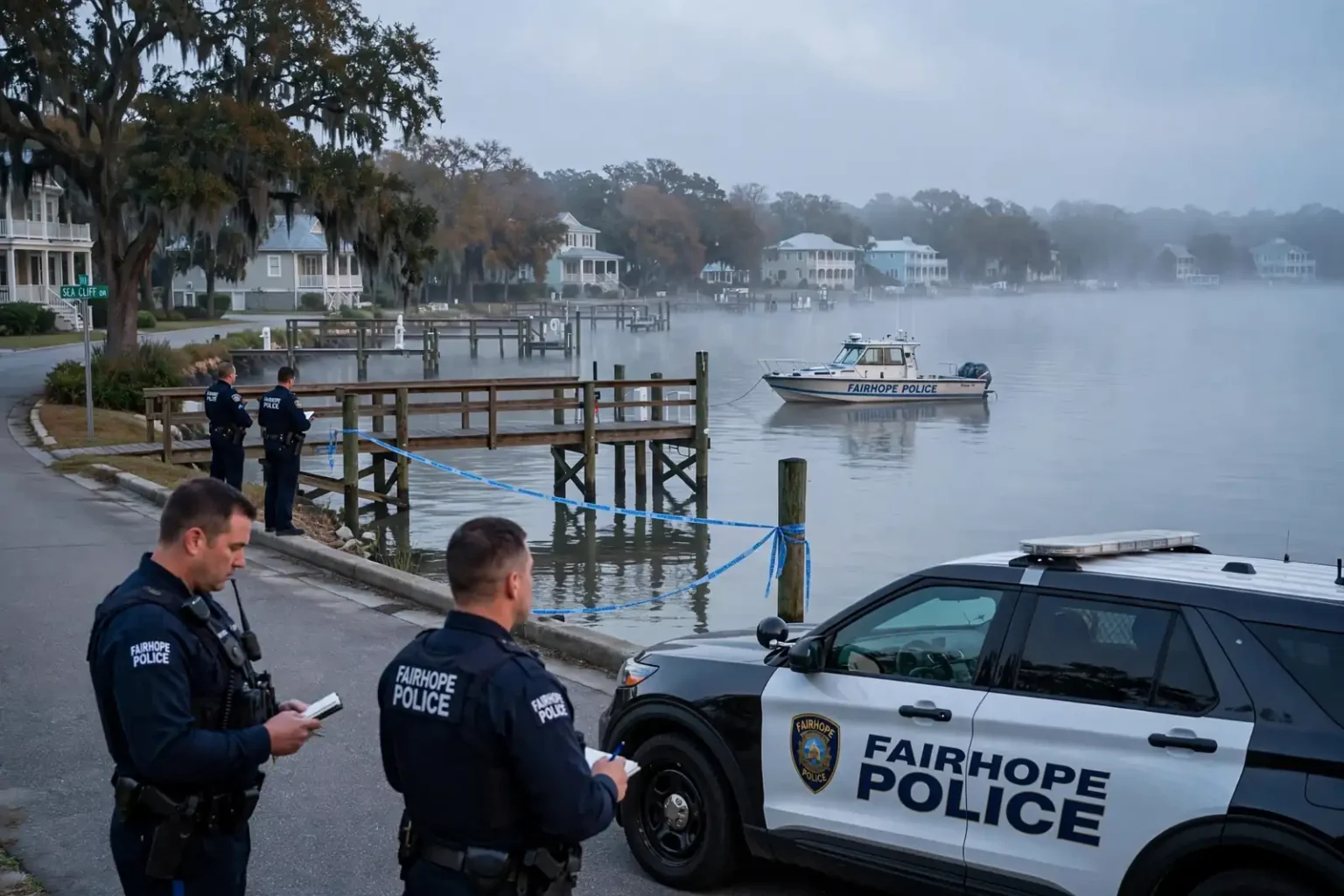
FAIRHOPE, Ala. — A man was discovered dead in the waters of Mobile Bay off Fairhope early Wednesday, and police are treating the case as a possible drowning. Investigators said they have found nothing so far to suggest foul play.
The discovery came on the morning of Nov. 11, Veterans Day, along a stretch of the city’s residential bayfront where private piers reach out from backyards into the water. Authorities have not released the man’s name.
Key Details at a Glance
- When: About 7:45 a.m. Wednesday, Nov. 11, 2026
- Where: Off Sea Cliff Drive in Fairhope, close to a privately owned pier
- Who found him: A member of the public, who spotted the man near a private pier
- Who responded: Officers with the Fairhope Police Department, along with the Fairhope Fire Department and EMS crews
- What police found: A man in the water who was confirmed dead when officers arrived
- Status: Under investigation as a possible drowning; police do not suspect foul play and do not believe a crime occurred
- Next step: An autopsy will be performed to determine the cause of death
- Identity: Not yet released while relatives are notified
What Police Have Said So Far
Fairhope officers were sent to Sea Cliff Drive shortly before 8 a.m. after a member of the public found a man in the water close to a privately owned pier and called for help. Firefighters from the Fairhope Fire Department and EMS personnel also responded. Once on scene, officers determined that the man had died.
Police said the death is being looked at as a possible drowning. They also said there is currently no indication that anyone else was involved, and they do not believe the death was the result of a criminal act. The department has not said how long the man may have been in the water, whether he lived in the neighborhood, or how he came to be in the bay.
The man’s identity is being held back until his next of kin have been told. Police have not released his age.
The Setting: Fairhope’s Bayfront Neighborhoods
Fairhope sits on the eastern shore of Mobile Bay in Baldwin County, and much of its identity is tied to the water. Homes along the bluffs and lowlands of the shoreline often have long wooden piers that stretch over shallow water, giving residents a place to fish, launch small boats, watch the sunset or simply enjoy the breeze. The city’s public municipal pier downtown is one of its best-known landmarks, but many more private piers line the shore in the residential neighborhoods beyond it.
Mobile Bay itself is a broad, relatively shallow estuary where rivers from the Mobile-Tensaw Delta meet the saltier waters of the Gulf of Mexico. Its average depth is only around 10 feet, and near the eastern shore the bottom often slopes gently away from land. Even so, shallow water can be dangerous. Soft or uneven bottoms, sudden drop-offs, currents, wind-driven waves and cool temperatures can all make it hard for a person who falls in to get back out, particularly in darkness or if the person is injured or alone.
How Death Investigations Typically Unfold
When someone is found dead outside of a hospital or a medical setting, a standard set of steps usually follows, regardless of whether a crime is suspected. Investigators document the scene, gather information from the person who called for help and from anyone nearby, and work to establish a timeline of the hours before the death.
In Alabama, deaths that are sudden, unexpected or unexplained fall under the review of the county coroner. Coroners can order an autopsy, and many of those examinations are performed by forensic pathologists at the Alabama Department of Forensic Sciences. Toxicology testing, which can take weeks, is often part of that process. Police have said an autopsy will be performed in this case to determine the cause of death.
Why Possible Drowning Is the Working Term
Police often describe a water death as a possible drowning in the early stages because the final cause of death is a medical determination rather than a police one. A person found in the water may have drowned, but other events, such as a heart attack, a fall that caused a head injury, or a medical emergency that happened before the person entered the water, can also explain such cases. A formal ruling on the cause and manner of death generally comes only after a medical examination and a review of the circumstances.
The absence of any sign of foul play at this point means investigators have not found evidence that another person caused the death. That assessment can be revisited if new information emerges, which is a normal part of any open investigation.
Why the Name Has Not Been Released
Withholding a name until relatives are informed is a long-standing practice among law enforcement agencies. The goal is to make sure family members learn of a loss privately and directly from officials, rather than through social media or word of mouth. When relatives live out of town or are difficult to reach, the notification process can take longer. Agencies typically release a name only after that step is complete, and sometimes only after the family has had time to grieve privately.
Water Safety on Piers and Docks
While the cause of this death has not been determined, the case is a reminder of the risks that come with life on the water, even in familiar places like a backyard pier. Safety experts and public health agencies offer guidance that applies to anyone who spends time near the bay:
- Avoid going out alone, especially at night or early in the morning when few people are around to notice trouble.
- Keep piers well lit and in good repair, with sturdy railings and boards free of rot, loose nails and slippery algae.
- Wear a life jacket when fishing from the end of a pier, wading or boarding a small boat, particularly for those who are not strong swimmers.
- Skip alcohol around the water. Federal health officials have reported that alcohol is involved in a large share of adult deaths tied to water recreation.
- Let someone know your plans and when you expect to return if you head out to fish or check a boat.
- Keep a phone within reach in a waterproof case or bag.
Cooler Water Brings Added Risk
As fall settles over the Gulf Coast, water temperatures in Mobile Bay drop from their summer highs. Cool water can sap body heat far faster than air at the same temperature, and a sudden plunge can trigger gasping, rapid breathing and a spike in heart rate. Those reactions make it harder to swim or to call for help. People who fall in should try to stay calm, keep their head above water and float or hold onto something until they can climb out or be rescued.
What to Do If You See Someone in the Water
Bystanders who spot a person in distress should call 911 right away and give as precise a location as possible, including the street address of the nearest home or pier. Safety instructors commonly teach a simple sequence for would-be rescuers: reach, throw, but do not go. That means extending a pole, a paddle or a branch, or throwing something that floats, such as a cooler, a cushion or a life ring, while staying safely on the pier or shore. Entering the water to attempt a rescue without training can put a second life at risk.
If a person has been pulled from the water and is not breathing, emergency dispatchers can walk callers through CPR until first responders arrive.
A Broader Look at Drowning
Drowning remains one of the leading causes of unintentional injury death in the United States. Federal health officials estimate that more than 4,000 people die from drowning in the country each year. Most attention goes to summer swimming, but drownings occur in every season and in every type of water, from pools and lakes to bays and open ocean. Coastal communities like those along Mobile Bay see year-round activity on the water, from fishing and crabbing to boating and paddling.
Respecting the Family and Avoiding Speculation
In the hours after an incident like this, rumors can spread quickly through neighborhood groups and social media. Residents are encouraged to let investigators do their work and to avoid sharing unconfirmed details, guesses about the man’s identity or photos of the scene. Families sometimes learn of a death from an online post before officials can reach them, which is exactly what the notification process is meant to prevent. Waiting for official information is one of the simplest ways neighbors can show respect for a grieving family.
Those who were close to the scene, including anyone who made the discovery, may find the experience upsetting in the days that follow. It is normal to feel shaken, and talking with friends, family, a faith leader or a counselor can help.
What Comes Next
The investigation remains open with the Fairhope Police Department. Further details, including the man’s name and any findings on the cause of death, are expected to come from authorities once the family has been notified and the examination process moves forward. Anyone who believes they may have information that could help investigators understand what happened can contact the Fairhope Police Department.
For neighbors along the bayfront, the morning’s events were a sobering start to a holiday dedicated to honoring others. As the community waits for answers, officials have offered no indication that the public faces any ongoing danger.