

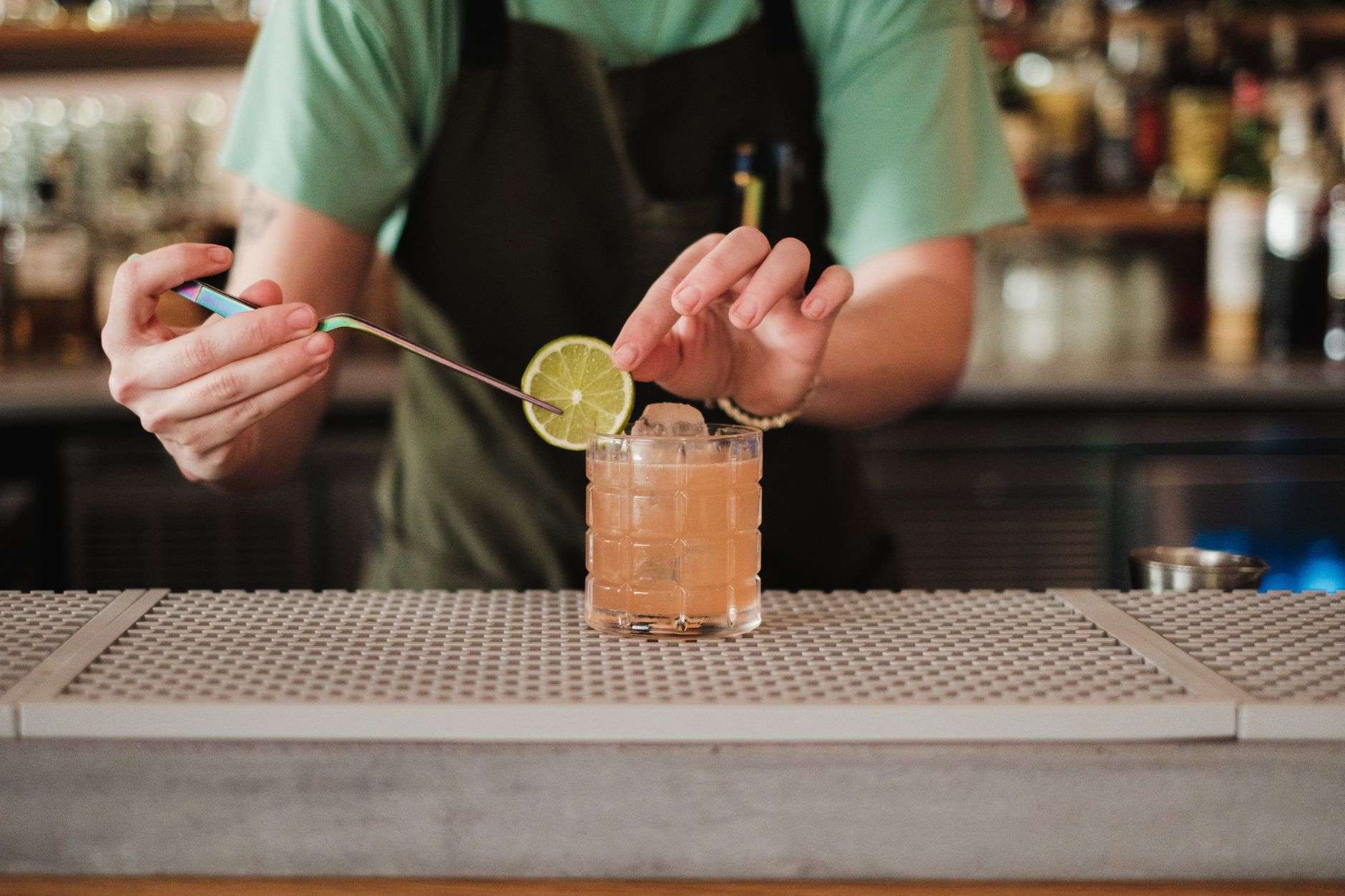
Bartender Baylyn Ball of Fairhope Social Club swept the inaugural Eastern Shore Bartender’s Championship, taking both the People’s Choice award and first place from the judges’ panel after a tie-breaker at The Hope Farm in Fairhope on Thursday, Sept. 10.
The competition, which South Alabama News previewed on Aug. 21, brought together bartenders from six Eastern Shore establishments for a two-part contest: a batch round, in which each competitor supplied a large-format version of an original drink for attendees to taste and vote on, and a judged round, in which each bartender built a cocktail to be scored by a panel of three judges.
Ball won on both fronts. Her Baylyn’s Pink Lotus — a rum-based daiquiri built with apricot liqueur, honey, honeysuckle and a bit of lime juice blended together — carried the People’s Choice vote, and she finished first overall after the tie-breaker. La Martina was named runner-up.
“I was really excited for the batch competition because I got a lot of time to prepare, but the judge competition was very nerve-racking, but still fun at the same time,” Ball said.
How The Night Was Structured
The two-round format is a familiar one in bartending competitions, and the two halves test genuinely different skills.
The batch round rewards planning. A bartender working ahead of time can dial in proportions, let flavors marry, filter and clarify, and taste the finished product repeatedly before service — the same discipline that goes into a bar’s bottled or pre-batched cocktail program. It also tests whether a recipe holds up at volume, because a drink that is delightful in a single coupe can turn cloying or flat when scaled to serve a room.
The judged round strips all of that away. The bartender builds one drink, once, in front of people whose job is to find its flaws. Technique becomes visible: how the ice is handled, how the shake or stir is executed, whether the glass is chilled, whether the garnish is functional or decorative, whether the pour is clean. Ball’s description of the judged round as “nerve-racking” compared with the batch round is a fair account of the difference.
Putting both rounds in one night also produces a more complete picture of a bar program than either would alone, which is part of why the format is common at events meant to showcase a regional scene rather than crown a single technical specialist.
The Winning Drink
Ball’s Baylyn’s Pink Lotus starts from one of the most scrutinized templates in the craft cocktail canon. A daiquiri in its classical form is rum, lime juice and sugar, and it is often used as a diagnostic drink precisely because there is nowhere to hide: with three ingredients and no modifiers, balance is the entire exercise.
The Pink Lotus keeps that spine and layers sweetening and aromatic elements onto it. Apricot liqueur contributes stone-fruit depth and a measure of sweetness, honey adds body and a rounder texture than refined sugar would, honeysuckle supplies a floral top note, and lime juice supplies the acid that keeps the whole thing from collapsing into dessert. The result is a drink that reads as approachable while asking a fair amount of the person making it, since each of those sweet and floral components competes for the same space on the palate.
Who Competed
Six Eastern Shore venues fielded competitors:
- The Hope Farm, the host, a farm-to-table restaurant at 915 Nichols Ave. in Fairhope that also operates The Barn and The Cellar, a wine bar built around natural, sustainable, organic and biodynamic bottles. The restaurant was named a James Beard Award semifinalist in 2024.
- Little Bird, the group’s downtown Fairhope restaurant and cocktail bar. Both Little Bird and The Hope Farm are owned by Deep Roots Restaurant Group, which is based in Fairhope.
- 87 West, a craft cocktail bar in downtown Fairhope.
- La Martina, a tapas lounge and cocktail bar at 319 Fairhope Ave., which finished as runner-up.
- 2 Shots In, a bar at 333 S. Greeno Road.
- Fairhope Social Club, at 14 N. Church St. downtown, represented by Ball.
That the host restaurant and its sister property both entered, and that neither took the top prize, is worth noting for a first-year event. Competitions hosted by a participating venue can invite questions about the playing field; a clean win by an outside bar is the simplest answer to them.
The James Beard designation attached to the host is worth a word of explanation, because the term is used loosely. The James Beard Foundation Awards run in stages: a long list of semifinalists is announced first, that field is narrowed to finalists, and winners are named later in the year. Reaching the semifinalist round, as The Hope Farm did in 2024, places a restaurant on the national list under consideration in its category — a meaningful marker for a restaurant in a town of roughly 22,000 people.
The venue also suited the format. The Hope Farm operates its own working farm, and a competition whose drinks leaned on honey, honeysuckle and fresh citrus sat comfortably in a setting organized around seasonal produce. Hosting in a barn and farm setting rather than a hotel ballroom gave the event the character of an industry gathering more than a trade show.
How Craft Cocktail Competitions Are Generally Judged
Organizers of the Eastern Shore Bartender’s Championship have not published a scoring rubric, and the categories used by the three-judge panel were not announced. But cocktail competitions across the industry tend to converge on a similar set of criteria, and understanding them makes the results easier to read.
Judges typically score on some combination of the following:
- Taste and balance. The single heaviest-weighted category at most competitions. Judges are looking for whether sweet, sour, bitter, strength and dilution are in proportion, and whether the base spirit is still recognizable rather than buried.
- Aroma. A large share of flavor perception is olfactory, so garnish placement, expressed citrus oils and aromatic modifiers are assessed on what they contribute at the nose, not just on the palate.
- Appearance and presentation. Glassware choice, clarity, color, ice quality and whether the garnish serves the drink or merely decorates it.
- Originality. Whether the recipe shows an idea of its own rather than a small variation on a well-known template — and, conversely, whether a riff on a classic earns its departures.
- Technique and consistency. Efficiency of movement, cleanliness of the station, accuracy of pours, and whether the bartender could plausibly repeat the drink identically on a busy Friday night.
People’s Choice voting operates on entirely different logic. A room of guests tasting many drinks in sequence tends to reward immediacy, aroma and drinkability — qualities that register in the first sip — over the structural subtleties a judge might weigh. Winning both categories, as Ball did, generally means a drink succeeded on two different axes at once.
Fairhope’s Bar And Restaurant Scene
The competition landed in a town whose dining scene has expanded substantially in recent years. Fairhope, population 22,477 at the 2020 census, sits on the eastern shore of Mobile Bay in Baldwin County, about six miles south of Daphne. Founded in 1894 as a single-tax colony by followers of the economist Henry George, it spent much of the 20th century as a haven for artists and writers, and its compact, walkable downtown has become a regional draw in its own right.
That walkability matters commercially. A downtown where several bars and restaurants sit within a few blocks of one another supports the kind of multi-stop evening that sustains a cocktail program, and it lets venues with different identities — a fine-dining room, a tapas lounge, a neighborhood bar with pool tables, a craft cocktail room — coexist without directly cannibalizing one another. All six competing venues carry Fairhope addresses.
Baldwin County’s tourism economy adds a second layer. Visitor traffic gives Eastern Shore restaurants a customer base willing to pay for a cocktail built with fresh-squeezed juice and house-made syrups, which in turn makes it viable for a bar to employ someone with the time and training to develop drinks like the Pink Lotus. The economics of a craft bar program depend on exactly that: enough demand to justify the labor.
Why A First-Year Event Matters
Inaugural competitions serve a purpose beyond the trophy. They establish a peer network among people who normally see each other only as competitors for the same Saturday-night customer, and they give bartenders a reason to develop original recipes on a deadline — work that tends to migrate onto menus afterward.
There is a practical benefit to the batch round in particular. Pre-batching — mixing the shelf-stable portions of a cocktail in advance so that only fresh juice, ice and dilution are added to order — is how most high-volume bars deliver a complicated drink in under a minute. A competition that forces bartenders to build a batch that tastes right hours after it was made is, in effect, a competition in the skill those bars need most.
They also function as recruitment and retention tools in an industry where turnover is high. A bar that sends someone to a regional championship is signaling that it treats bartending as a craft with a ladder to climb, not merely as service labor. For the Eastern Shore, where the hospitality sector competes for staff with Gulf Shores, Orange Beach and Mobile, that signal has practical value.
Organizers have not announced whether the Eastern Shore Bartender’s Championship will return in 2027 or what form a second edition might take. For now, the first title belongs to Fairhope Social Club, and to a rum daiquiri built with apricot, honey and honeysuckle.