
FBI Mobile Dedicates Conference Room to Agent Steve Vogle on 9/11’s 25th Anniversary
The FBI's Mobile Division marked 25 years since the September 11 attacks by dedicating the Stephen C. Vogle Conference Room, and by reflecting on how the attacks dismantled information silos across federal, state and local law enforcement.
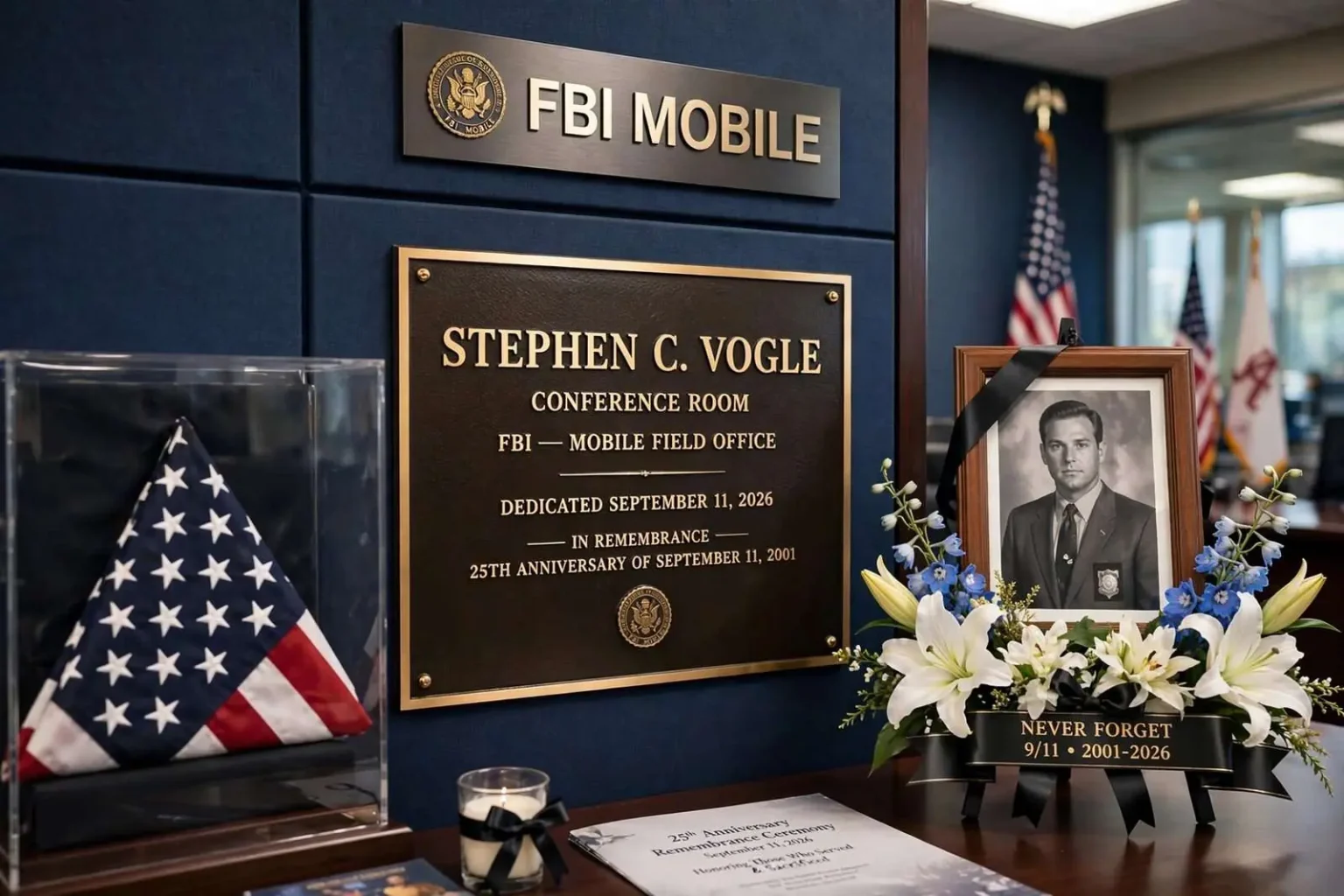
The FBI’s Mobile field office now has a Stephen C. Vogle Conference Room.
The dedication came during a ceremony marking the 25th anniversary of the September 11 attacks, one that brought together current and retired FBI employees, law enforcement partners and the families of former agents — including the family of Steve Vogle, a Mobile agent who responded to the attacks.
“These are our heroes. We’re amongst heroes,” his widow, Peggy Vogle, said, becoming emotional. “It’s just hard to put into words.”
The Ceremony
Christopher Flowers, special agent in charge of the FBI’s Mobile Division, said the gathering was meant to honor both the people lost and those who spent their careers serving afterward.
“Today being the 25th anniversary of 9/11, we hosted as an FBI division those who worked with the FBI prior to my arrival here — former employees, retired employees,” Flowers said. “But we also welcomed, of course, families, the Vogle family and the Myers family. To have them, as well as the event that we had today, just honoring the memory and the legacy of those who served before us, those who paid the ultimate sacrifice and all first responders, was an honor for the division to host.”
The Bryan A. Myers Conference Room, honoring another former employee, was dedicated several years ago.
What Changed Inside the Bureau
Flowers described the attacks as the dividing line in how American law enforcement handles information.
“I think what we saw before versus what we saw after was a lot of things were siloed in terms of information,” he said. “I think that a lot of agencies, whether they be federal, state or local, weren’t working to their fullest capabilities.”
The word “siloed” is doing specific work there. Before 2001, federal, state and local agencies operated largely separate intelligence and case systems, with limited mechanisms — and in some cases legal barriers — for sharing what they knew. Fragments of information sat in different files, in different agencies, with no one positioned to assemble them.
“We needed to work together, share information, share intelligence and partner together to disrupt any sort of potential acts for terrorism,” Flowers said.
He argued the resulting changes reach well beyond counterterrorism.
“The events of 9/11, as tragic as they were, what came out of that is a new birth, a new era for the FBI and how we crush violent crime as of today,” Flowers said.
That is a claim worth understanding plainly: the joint task force structures, shared databases and partnership habits built to prevent another attack are now the everyday machinery of ordinary criminal investigation.
Mobile Ran Leads, Too
Former FBI Mobile Special Agent in Charge Charles H. Middleton described how the investigation reached into every corner of the bureau.
Investigators did not initially know who was responsible. The New York and Washington field offices moved quickly to identify the hijackers — and as they did, leads spread outward.
“The response of New York and Washington Field were amazing in identifying these individuals,” Middleton said. “And even Mobile, we ended up running leads down here in Mobile of credit card use by the subjects. So every field division — there’s 57 — and the FBI had a role.”
Credit card transactions are among the most reliable ways to reconstruct a person’s movements, and in the days after the attacks agents in field offices across the country were chasing individual charges. A card used in south Alabama meant agents in Mobile knocking on doors.
Middleton drew a lasting lesson from it.
“A lot of times you get complacent and you think, ‘Yeah, everything’s going good in life,’ but there’s some serious evil out there,” he said. “That watchful eye is just imperative.”
‘Our Equivalent of Pearl Harbor’
Flowers returned repeatedly to a generational problem.
“This is a whole new generation of Americans, well over 100 million, who were not born or don’t remember what happened during 9/11,” he said. “I think it’s our equivalent of Pearl Harbor.”
The comparison is precise in a way that is easy to miss. Pearl Harbor is now something Americans know entirely through books, film and inherited stories. Flowers is saying 9/11 has crossed, or is crossing, that same threshold.
“That day will always be in our memories, and it’s important to future generations to understand what that means to us,” he said.
“Events like today and always remembering 9/11 is absolutely key to making sure that everyone who comes after us also knows that.”
Who Steve Vogle Was
For Peggy Vogle, the ceremony was not institutional. It was personal.
She said being surrounded by people who served, and seeing her husband remembered, was an honor and a privilege. Asked what he would have made of a conference room bearing his name, she laughed.
“He would love it,” she said. “He would be thrilled that a conference room was named after him. He would be able to command it. He would want to sit in the main seat. And he would humbly, but, you know, be a great leader. He always was.”
She described a man whose range was wider than his job title.
“He could command a room, but yet play with a grandchild, and he loved reading bedtime stories,” she said. “Yet he was not afraid of really anything. He was fearless and very loving, very kind.”
She called him a “gentle giant.”
Where the Service Came From
Peggy Vogle traced her husband’s commitment to public service back a generation. His father was the community postmaster. His mother was a career teacher.
“So they gave. They were in service to all of us,” she said. “And that’s what we need. Those are the best things in life. Those are the things money cannot buy, and we just need to always focus on that.”
A postmaster, a teacher, an FBI agent: three jobs whose common feature is that the work is done for people who mostly never learn the name of the person doing it.
A conference room in Mobile now carries one of them.