Federal Judge Dissolves Injunction, Clears Alabama’s Abortion Ban to Take Effect After Dobbs
Hours after the Dobbs ruling, a federal judge granted AG Steve Marshall's motion and cleared Alabama's 2019 near-total abortion ban to take effect.
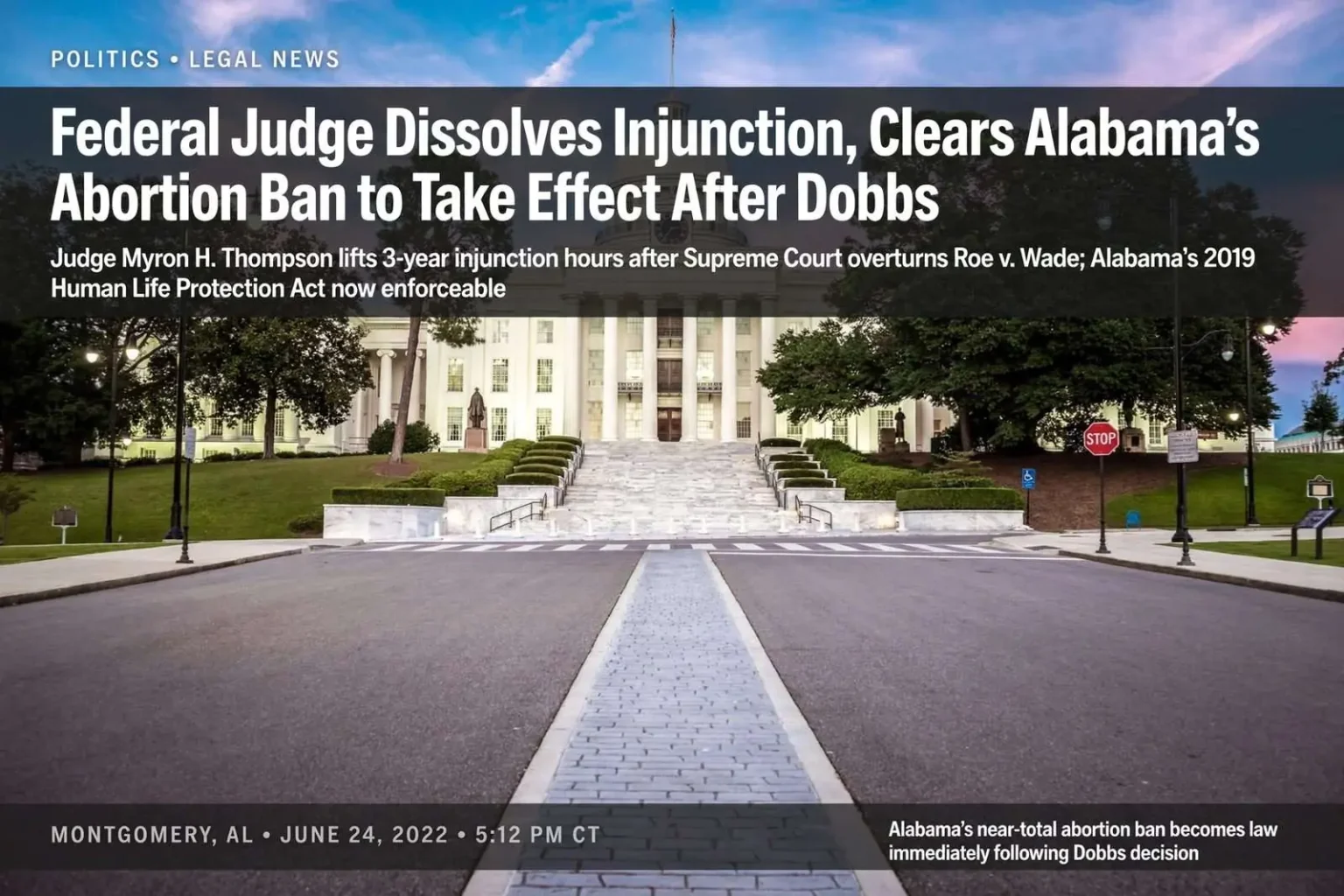
A federal judge has granted Attorney General Steve Marshall’s emergency motion to dissolve the injunction blocking Alabama’s near-total abortion ban, hours after the U.S. Supreme Court overturned Roe v. Wade. Judge Myron H. Thompson of the Middle District of Alabama dissolved the injunction during a conference call Friday afternoon, moving to reinstate the 2019 Human Life Protection Act almost immediately after the Supreme Court’s ruling. The sequence — a 6-3 opinion in Washington at midmorning, a phone hearing in Montgomery in the afternoon — converted three years of legal anticipation into enforceable state law before the day ended.
The Supreme Court’s Ruling
Friday morning, the high court decided Dobbs v. Jackson Women’s Health Organization, the case challenging a Mississippi law that bans most abortions after 15 weeks of pregnancy. In a 6-3 decision, the court overturned both Roe v. Wade, the 1973 ruling that established a nationwide right to abortion, and Planned Parenthood v. Casey, the 1992 decision that affirmed abortion rights while allowing some state restrictions. Writing for the majority, Justice Samuel Alito held that the Constitution does not bar states from regulating or prohibiting abortion, returning authority over the issue to the states and their elected representatives.
The Mississippi law at the center of the case had been enacted in 2018 and blocked by lower courts ever since, because 15 weeks fell well within the viability framework that Roe and Casey had established as the constitutional boundary. Mississippi had asked the court to use the case to reconsider that framework entirely — and in Dobbs, the court’s conservative majority did exactly what the state requested, erasing the federal floor that had governed abortion policy for nearly half a century.
Alito’s opinion framed the decision as returning the question to the democratic process rather than resolving it. The practical effect, though, was immediate and uneven: states whose pre-Roe restrictions or trigger laws remained on the books could enforce them, states protective of abortion access could remain so, and the legality of the procedure came to depend on state lines — with Alabama among the states moving to the strictest end of the map at once.
Alabama’s Ban Becomes Enforceable
The Alabama Legislature passed the Human Life Protection Act in 2019. The law makes performing an abortion at any stage of pregnancy a felony carrying a sentence of 10 to 99 years, or life in prison, for providers, with no exceptions for rape or incest. Its only exception is when the mother’s health faces serious risk. Then-Gov. Kay Ivey signed the measure, which had been written explicitly as a vehicle to force the courts to reconsider Roe — a strategy its legislative sponsors described openly at the time.
Providers including Planned Parenthood and women’s health centers across the state sued, arguing the ban violated patients’ privacy rights under the precedents the Supreme Court has now overturned. Thompson blocked the law while that challenge moved through the courts. That litigation — brought on behalf of Alabama providers and patients — had kept the statute unenforceable for three years, and the clinics that served the state had continued operating under the standard established in 1973 until Friday.
In a statement after Friday’s ruling, Marshall said there was no basis to keep the stay in place following the Dobbs decision, declaring the ban enforceable and warning that violations would be prosecuted, with penalties for providers ranging from 10 to 99 years in prison. The attorney general’s office had filed its emergency motion within hours of the Supreme Court’s decision, and Thompson’s conference-call order meant the state’s oldest and strictest anti-abortion law took effect the same Friday the constitutional landscape shifted.
What the Law Means in Practice
The Human Life Protection Act’s text bans abortion from the moment of fertilization, making it among the most restrictive statutes in the nation. Its criminal penalties attach to providers rather than to patients, an arrangement the Legislature built into the 2019 bill, and the absence of rape and incest exceptions set it apart from most comparable state laws. The single health exception is drawn narrowly — a serious risk to the mother’s health — leaving providers to make treatment decisions under threat of decades-long prison sentences.
The enforcement framework also includes reporting provisions, requiring that any abortions performed under the health exception be documented and, in effect, defended after the fact. Legal observers had noted from the law’s passage that its felony exposure would likely end the practice of abortion medicine in Alabama as soon as it took effect — and that is precisely what its enforcement on Friday set in motion, with clinics across the state moving to halt scheduled procedures.
For patients in Alabama, the law’s effect is reinforced by geography. The state had already operated a small number of clinics concentrated in its urban centers, and neighboring Mississippi had been governed by its own restrictive law and clinic litigation for years. With both states now moving to prohibitions, patients who previously obtained care within the region faced travel to states where abortion remains legal — distances that weigh most heavily on patients with limited means, no transportation or jobs that cannot spare days away.
The Road That Led Here
Friday’s sequence of events resolved a strategy three years in the making. When the Legislature passed the Human Life Protection Act in 2019, Roe was still the law of the land, and the bill’s defenders described it openly as a challenge case — legislation designed to fail in the lower courts, climb the appellate ladder and force the Supreme Court to revisit its precedents. Mississippi’s 15-week law ultimately became the vehicle the court chose to hear, but Alabama’s near-total ban stood ready as the harshest expression of the same position.
The litigation history shaped the day’s speed. Because Thompson’s injunction had been entered years earlier and the challenge had fully briefed the statute’s constitutionality under the old precedents, Friday’s motion did not require new fact-finding — only the application of Dobbs to an existing record. The conference call, brief and procedural, dissolved the stay without extended argument, reflecting how little remained undecided once the Supreme Court ruled.
Marshall’s statement cast the dissolution as the natural conclusion of the litigation, noting that the legal foundation for the injunction — the very precedents Dobbs overruled — no longer existed. Supporters of the law across the state’s political leadership echoed that framing within hours, while advocacy groups that had brought the original challenge signaled that litigation would continue on other grounds and that the fight over the statute’s application was entering a new phase.
What remains certain is the law’s immediate effect: as of Friday afternoon, performing an abortion in Alabama is a felony in almost every circumstance, and the state attorney general’s office has committed to prosecuting violations under the full weight of the 2019 statute. The Human Life Protection Act, passed as a message bill three years ago, has become the operative law of the state.
The Dobbs decision itself will be studied for its scope as much as its outcome. Beyond overturning Roe and Casey, the majority opinion rejected the method those rulings used — identifying a fundamental right in the Constitution’s liberty guarantees and testing state restrictions against it — and instead asked whether abortion is “deeply rooted” in the nation’s history and tradition, concluding it is not. The three dissenting justices warned in response that the ruling would leave fundamental rights dependent on geography and endanger the doctrinal reasoning behind other privacy-based decisions, concerns the majority disputed.
For the Middle District of Alabama, Friday’s conference call was an understated end to a role the federal courts in Montgomery had played for decades in abortion litigation. Thompson, a veteran judge appointed in 1980, had presided over the state’s major reproductive-rights cases through the entire arc from Roe’s supremacy to its reversal, and Friday’s order — entered by telephone, effective immediately — was the last act of that era.
Regional Effects Across the Gulf South
The ruling’s consequences radiate across the Southeast, where a band of states stretching from Texas through Louisiana, Mississippi and Alabama has enacted some of the nation’s most restrictive abortion laws. With Dobbs removing the federal floor, those statutes — some dormant for decades, some passed in anticipation of exactly this moment — began operating in tandem, creating a multi-state region where the procedure is largely or entirely prohibited and where enforcement regimes, criminal penalties and civil liabilities vary from line to line.
Health-care providers in the region have spent the years since 2019 preparing for the contingency now realized. Hospital systems, clinics and physicians’ groups across Alabama have had to review protocols for ectopic pregnancies, miscarriage management and other emergencies where the standard of care intersects with the law’s narrow health exception — decisions that clinicians note are made in minutes and reviewed afterward under criminal threat.
Local governments and community organizations, meanwhile, began adjusting to a new practical landscape for the women they serve. Alabama’s poverty rate, rural health-care shortages and existing maternity-care deserts — counties without obstetric services — formed the backdrop against which the ban now operates, and the state’s maternal health statistics had already drawn concern before the law’s enforcement.
Legal activity continues even as the law operates. The providers’ original challenge remains in the court system, and constitutional questions that Dobbs did not resolve — including claims under the Alabama Constitution and challenges to the statute’s application in medical emergencies — are expected to work through state and federal courts in the months ahead. Friday’s order ended the injunction; it did not end the litigation.
For now, though, the immediate facts are settled: the Supreme Court has returned the question to the states, Attorney General Marshall has declared Alabama’s ban in force, and the 2019 Human Life Protection Act — 10-to-99-year felony penalties, no rape or incest exceptions, one narrow health exception — is the law that governs the practice of abortion in Alabama.