

On a stretch of Dauphin Street between Joachim and Conception, there is a taco counter with a framed, signed photo of Guy Fieri hanging above the bar and a hot-sauce wall lined with locally bottled heat. Roosters — Frankie Little’s tacos-and-tequila spot in downtown Mobile — has been drawing crowds since 2017, and since Food Network’s “Diners, Drive-Ins and Dives” rolled its red Corvette up to the curb, it has carried the flag for Mobile’s food scene on national television.
The restaurant’s story begins nowhere near a flashy kitchen. Frankie Little grew up on a farm in Foley, next door to his grandparents, in the Baldwin County of fishing ponds, blackberry patches, and gardens — a childhood where farm-to-table was not a movement, just dinner. His grandmother spent part of her youth in Colombia, Costa Rica, and Panama, and the Latin American flavors she brought home settled into the family palate and, eventually, into the menu that made Roosters famous.
Tacos with a Baldwin County supply chain
What sets Roosters apart in a crowded taco market is the sourcing, which reads like a map of the Gulf Coast food economy. The corn tortillas come from E&H Tortilleria in Baldwin County, made with heirloom corn grown at Bayou Cora Farms in Bon Secour — a seed line that dates to the 1880s, preserved by generations of Alabamians. Gulf seafood shows up across the menu. This is a restaurant that treats “local” as a supply chain, not a slogan, and the difference is on every plate.
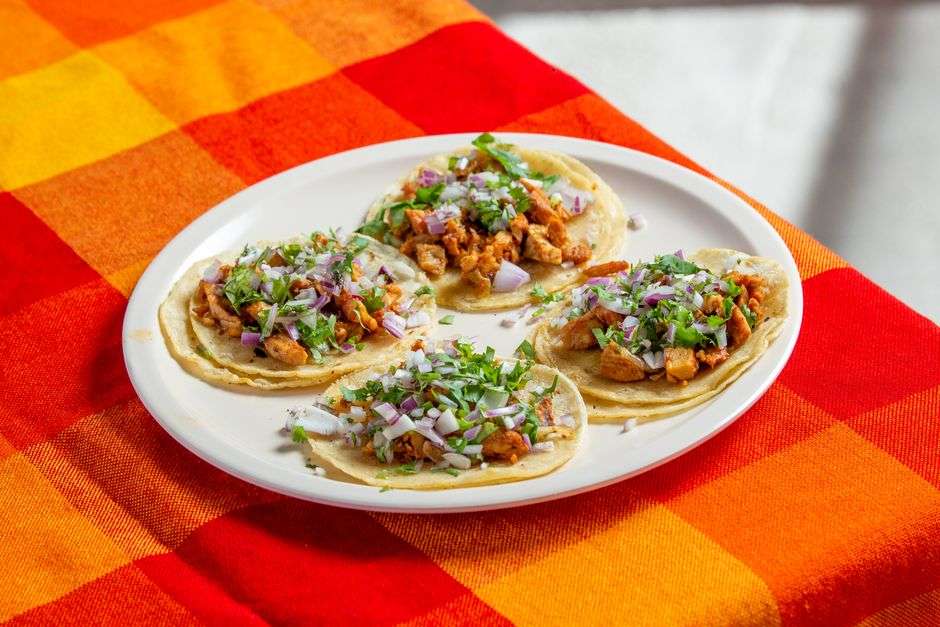
The tacos themselves cover the range from classic to Gulf Coast invention: the jerk chicken taco layered with grilled pineapple and mango habanero sauce; the chorizo taco topped with sweet plantains and cotija cheese; the carnitas pork taco with pickled red onion, cilantro, habanero sauce, and queso fresco. The kitchen’s cooking is built on real ingredients and real heat — the kind of food that has made the counter a lunch fixture for downtown office workers and a late-night stop for the college crowd alike.
The Flavortown moment
When “Diners, Drive-Ins and Dives” chose Roosters for its Gulf Coast feature, the episode put two dishes on national display: the Surf & Turf Burrito — grilled Gulf shrimp and barbacoa brisket tucked into a flour tortilla with Spanish rice, guacamole, pico de gallo, chipotle cream, and a pour of queso blanco and chorizo — and the Torta de Carnitas, the crispy braised pork sandwich layered with pickled onions, black bean purée, cilantro, and queso fresco. Fieri’s crew rolled in, the red Corvette parked out front, and the city’s food scene got the kind of validation that cannot be bought.
The moment lives on inside the restaurant: the signed Fieri photo over the bar, the hot-sauce wall — dozens of bottles of locally made sauce — and the steady stream of visitors who found Roosters through the show and kept coming back. For Little, the feature was bigger than a bumper sticker for the restaurant; it was recognition for the local-sourcing movement he had been championing since opening day.
A gathering place, not just a counter
Spend a lunch hour at Roosters and the room tells the story: regulars shoulder to shoulder with first-timers, families lingering over plates, students stacking orders between classes. Little talks about the restaurant as being “in the human experience business” as much as the food business, and the staff — many of them years into their tenure — reflect the same culture of longevity he asks of his farmers.
The community commitment runs in both directions. Roosters builds its menu around nearby farms and producers, gives them a platform in the heart of downtown, and keeps the music, the staff, and the menu tuned to the city rather than a franchise playbook. It is a downtown Mobile room in the fullest sense.
What’s next for the rooster
Little is exploring ways to grow the Roosters brand beyond Dauphin Street, and the expansion question is the one every beloved single-location restaurant eventually faces. His stated condition, though, is firm: whatever new markets get, the local sourcing and community spirit that started it all stay at the core. The tortillas will still come from Baldwin County corn; the shrimp will still come from the Gulf; the hot sauce will still be local.
For food lovers plotting a Mobile visit, Roosters belongs near the top of the list alongside the city’s older institutions. It captures what the Gulf Coast does best — the mix of cultures, the pride in local ingredients, the hospitality that treats strangers like regulars — with national recognition and a Baldwin County farm at its roots. Order the Surf & Turf Burrito if the episode convinced you; order the carnitas taco if you trust the regulars. Either way, you will understand why a red Corvette once parked exactly where you wish you could.
Roosters is on Dauphin Street in downtown Mobile. Go hungry, bring a tolerance for heat, and say hello to the photo on your way out.