

A new interactive aerospace education center opens to the public Tuesday at Brookley Aeroplex, giving Mobile-area families, students and aviation enthusiasts a hands-on look at how commercial jets are designed, built and flown. Flight Works Alabama, a 15,000-square-foot facility built with backing from Airbus, features roughly 40 interactive exhibits aimed primarily at middle and high school students, though organizers say visitors of any age will find something to explore.
Airbus officials are quick to note that the center is not meant to be a traditional museum, but rather a working, touchable introduction to the aerospace industry that surrounds Mobile’s Brookley campus. The distinction matters: where a museum displays artifacts behind glass, Flight Works is designed around the idea that visitors learn by doing — pulling levers, flying simulators, printing parts and piloting drones rather than reading placards.
Simulators, cockpits and virtual space
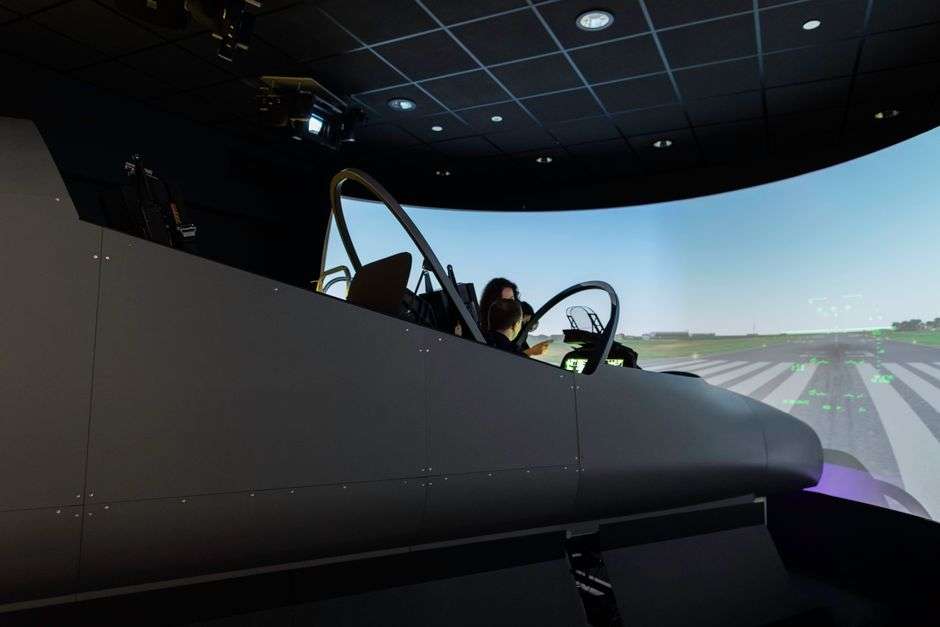
Centerpiece attractions include a full flight simulator that lets visitors take off and land a virtual A320 aircraft, with an upgraded option that turns the simulator into a fighter jet experience. A large-scale virtual reality setup will transport visitors to the International Space Station or send them on a simulated tour of the solar system, illustrating the broader reach of aerospace technology beyond commercial air travel. A replica cockpit modeled on the A320 — one of two aircraft families assembled at Airbus’s Mobile manufacturing campus — rounds out the facility’s signature exhibits, all of which were designed by an Orlando-based exhibit design firm.
The exhibit choices track the real work happening across the fence line at Brookley. Airbus’s final assembly plant in Mobile, the company’s first in the United States, turned out its first Alabama-built A320 family jet in 2015, and the addition of a second aircraft family at the Mobile campus broadened the range of work performed there. For students walking into Flight Works, the simulators and cockpit replica are not abstractions; they are models of the same aircraft being assembled a short walk away, staffed and shaped by the same industry that employs thousands of area workers.
Classrooms, labs and a drone aviary
Beyond the exhibit floor, Flight Works Alabama includes multiple classrooms, a fabrication lab equipped with five 3-D printers, and a shop space intended for hands-on learning. Organizers say the space is designed to serve a wide range of visitors, from high school students taking their first look at engineering careers to working aerospace professionals pursuing additional certifications to advance in the field.
That dual mission — tourism-style attraction and workforce training venue — mirrors the strategy aerospace employers across the Gulf Coast have embraced as they compete for skilled labor. Fabrication labs and additive manufacturing equipment introduce students to techniques used on real production lines, while certification courses give incumbent workers a path to promotion without leaving the region. For Mobile, which has spent years building the training infrastructure to support its growing aerospace sector, a permanent public-facing facility inside the Aeroplex extends that effort to an audience of students who may not yet know the industry exists in their backyard.
The exhibits are also calibrated to school science standards, another reason educators are expected to fold the center into field trip calendars. Middle and high school units on physics, aerodynamics and engineering design map naturally onto a simulator that demonstrates lift and control surfaces, a VR station that walks visitors through orbital mechanics, and a fabrication lab where a design goes from sketch to printed part in a single class period. Facilities that make those connections explicit tend to draw repeat school visits, which in turn smooths attendance across the calendar rather than concentrating it in summer months.
An outdoor drone “aviary” behind the building will let visitors bring their own drones and fly a specially designed course, adding an outdoor, active-learning component to the facility’s indoor exhibits. Drone flying has become one of the fastest-growing entry points into aviation for young people, and a supervised course gives hobbyists a place to fly legally and safely — no small consideration as federal rules around unmanned aircraft have tightened.
Opening in a pandemic year
Flight Works Alabama is classified as a tourist attraction, and pre-pandemic projections had estimated the center could draw as many as 50,000 visitors annually. With the COVID-19 pandemic still an active concern, the facility plans to limit capacity when it opens, a step organizers acknowledge will likely reduce visitor totals compared to those earlier projections, at least in the near term.
Opening a visitor attraction amid public health restrictions presents challenges no one planned for when the center was designed. Capacity limits affect everything from simulator queue times to summer camp enrollment, and touchable exhibits — the whole premise of the facility — require more attention to cleaning and spacing than a conventional gallery. Organizers are betting that demand will be waiting when restrictions ease, and that families who discover the center at reduced capacity will return with friends once normal operations resume.
The center opens to the public on Tuesday, Aug. 4. General admission is $13.50 for visitors 10 and older and $9 for children ages 4 to 9; children under 4 are admitted free. Tickets can be purchased online in advance through the facility’s website, an arrangement that helps staff manage capacity and gives families a way to plan visits around the busiest periods of the week.
Summer camps to fill out the first month
Flight Works Alabama also announced a lineup of summer camps for rising seventh graders through high school seniors, running throughout the month of August. A 3-D printing camp will meet Aug. 10-14, Aug. 17-21 and Aug. 24-28 from 9 a.m. to noon, priced at $130 per student. A sublimation camp will run on the same weeks from 12:30 to 3:30 p.m. for $140 per student. Families interested in registering can sign up through Flight Works staff or online, and organizers encourage early registration since sessions are capped.
The camp lineup leans into the same skills the facility’s fabrication lab showcases during regular hours. 3-D printing has moved from novelty to standard tool in aerospace manufacturing and prototyping, and students who learn it in middle and high school arrive at technical programs and apprenticeships with a head start. Sublimation printing — the process of transferring dye onto materials with heat — rounds out the offerings with a more design-oriented skill set, giving campers a second option in the afternoon hours.
Scheduling camps in weekly sessions across August also lets the facility test its classroom operations before the school year brings field trips and structured student groups. Educators across Mobile County have been looking for destinations that connect classroom math and science to visible local careers, and an aerospace center on the Brookley campus offers exactly that link.
Another layer at Brookley
The opening adds a new educational and tourism draw to the Brookley Aeroplex area, which has grown into a hub for aerospace manufacturing and workforce training in Mobile in recent years. The Aeroplex itself carries a long aviation history: the site served as a major Air Force base through World War II and the Cold War, and its closure decades ago could have left Mobile with a dormant airfield. Instead, the complex was converted to civilian industrial use and gradually filled with aviation tenants, culminating in Airbus’s decision to build its first U.S. assembly line there.
Each layer of that build-out — the assembly plant, the supplier facilities that followed, the training centers that feed workers into the industry — has added to the argument that aerospace is one of the region’s economic pillars. Flight Works extends the story to the public, letting families see the industry up close in a way that factory tours of a working assembly line cannot easily accommodate.
For tourists, the center gives Mobile an attraction that pairs naturally with the city’s existing draws, from the USS Alabama Battleship Memorial Park across the bay to the museums of downtown. Aviation-themed tourism has a reliable audience, and a facility backed by one of the world’s largest aircraft makers gives the area a credential few mid-sized cities can claim.
For students, the hope is simpler and longer-term: that a seventh grader who lands a virtual A320 on a Tuesday afternoon will remember the experience a decade later, when aircraft manufacturing, maintenance and engineering jobs in Mobile are looking for applicants. That pipeline — from exhibit floor to classroom to career — is the outcome every organizer of a facility like this one measures success by, even if it takes years to show up in the numbers.
Flight Works Alabama opens Tuesday, Aug. 4, at Brookley Aeroplex, with reduced capacity, online ticketing and a full slate of August camps waiting for the first wave of visitors.