FOLEY, Ala. — Drive past the Foley Activity Center on East Jessamine Avenue or stop for dinner at Local and Company Food+Drink on North McKenzie Street, and you are visiting two buildings that once housed Foley’s citizen-soldiers. Together, the city’s Foley National Guard armories trace a military tradition in the south Baldwin County community that now stretches back a full century.
The East Jessamine Avenue building served as a National Guard armory for more than five decades before it became the activity center. A few blocks away, the North McKenzie Street building that now holds a restaurant was the city’s first armory. And since 2023, a modern facility has carried that legacy forward.
Organizing a Guard unit in the 1920s
Foley residents began working to organize a local National Guard unit during the 1920s. Those efforts paid off in 1926, when the 106th Motorcycle Company of the 31st Division was formed in Foley. The company was formally mustered in at the Foley Motor Company.
Motorcycle companies of that era were organized largely to carry messages and dispatches, a vital job in the years before radio communication was widespread on the battlefield.
At first, the new unit had no armory of its own — no dedicated place to drill, store equipment or carry out other military duties. Early on it used the Masonic building on North Alston Street, which today houses the South Baldwin Chamber of Commerce. In February 1930, the company relocated to temporary quarters in the South Baldwin Wholesale Company warehouse on North McKenzie Street.
Building the first armory
Local leaders and residents soon set their sights on a permanent home for the company. The town bought property on North McKenzie Street, and plans were drawn up for a building measuring 50 feet by 150 feet with a two-story front.
The Great Depression slowed the project as money for construction proved hard to come by. But the community kept pushing, and on June 27, 1935, more than 1,500 people turned out for the opening ceremony of Foley’s new National Guard armory.
The armory quickly took on a role beyond military training. It became a community hub that hosted dances, formal balls, Red Cross blood drives and a variety of other events, a pattern common to many small-town armories of the era.
Called up before Pearl Harbor
In November 1940, more than 50 members of Foley’s National Guard unit were ordered to active duty — over a year before the Japanese attack on Pearl Harbor brought the United States into World War II.
Among them was Foley Mayor Frank V. Barchard Jr., who also served as publisher and editor of the town’s newspaper.
As the war went on, the Army concluded that motorcycle units were no longer as essential for carrying messages and dispatches. Members of the Foley company were reassigned to other units.
With the National Guard soldiers away on federal service, the Foley armory did not sit idle. It became home to the 55th Company, 7th District Southern Area of the Alabama State Guard. The State Guard was created to take on National Guard responsibilities at home while Guard units were activated for the war.
Barin Field and a World War II Heritage City
Foley’s wartime role went well beyond its Guard members. The community was also home to Barin Field, a major Navy aviation training center where pilots trained during the war.
In recognition of those contributions, the National Park Service later designated Foley as an American World War II Heritage City, a program that honors communities for their efforts on the home front and in support of the war.
Korean War and the sacrifice of William L. Smith
After World War II, the Alabama National Guard organized Company G, 200th Regiment of the 31st Infantry Division, with its headquarters at the Foley armory.
On Jan. 16, 1951, Company G was called to active duty along with the rest of the 31st Infantry Division during the Korean War. Its members were assigned to a range of duties.
One of them, Sgt. 1st Class William L. Smith of Foley, was sent to Korea. On Nov. 4, 1951, Smith was killed in action while leading a charge near Kumhwa, Korea. He was nine days short of his 20th birthday. He was posthumously awarded the Distinguished Service Cross, the Army’s second-highest award for valor in combat, behind only the Medal of Honor.
Smith had joined the National Guard at 16. He graduated from Foley High School in 1948, where he played halfback for the Foley Lions and earned three varsity letters.
Company G was reorganized in 1953 and returned to the Foley armory. The local unit was later redesignated as Company A of the 711th Signal Battalion. Its duties included radio relay, telephone repeater and wire operations, as well as message center functions — in a sense, an echo of the communications mission of the motorcycle couriers who founded the Foley unit decades earlier.
Fort William L. Smith on East Jessamine Avenue
By the 1960s, the 1935 armory could no longer meet the Guard’s needs, and planning began for a new facility on East Jessamine Avenue.
In August 1969, Company A and the headquarters detachment of Company B of the 711th Signal Battalion moved into the new building. When it was formally dedicated in January 1970, it was named Fort William L. Smith in honor of the young Foley soldier killed in Korea.
From 1969 until a new facility opened in 2023, the armory was home base for local Guard members. Soldiers trained there, responded to hurricanes and prepared for deployments overseas. In 2004, the Foley unit stationed at the armory was called to active duty and deployed to the Middle East.
The original armory finds a new purpose
The 1935 armory on North McKenzie Street remains in use today. After its military years, the building served as an antiques mall before becoming home to Local and Company Food+Drink, giving diners a chance to eat inside one of Foley’s most historic structures.
A modern armory for a new century
As the Alabama National Guard’s needs grew, a larger, more modern Foley armory became a priority in 2009. That facility, which has more than 30,000 square feet of space, was dedicated in 2023.
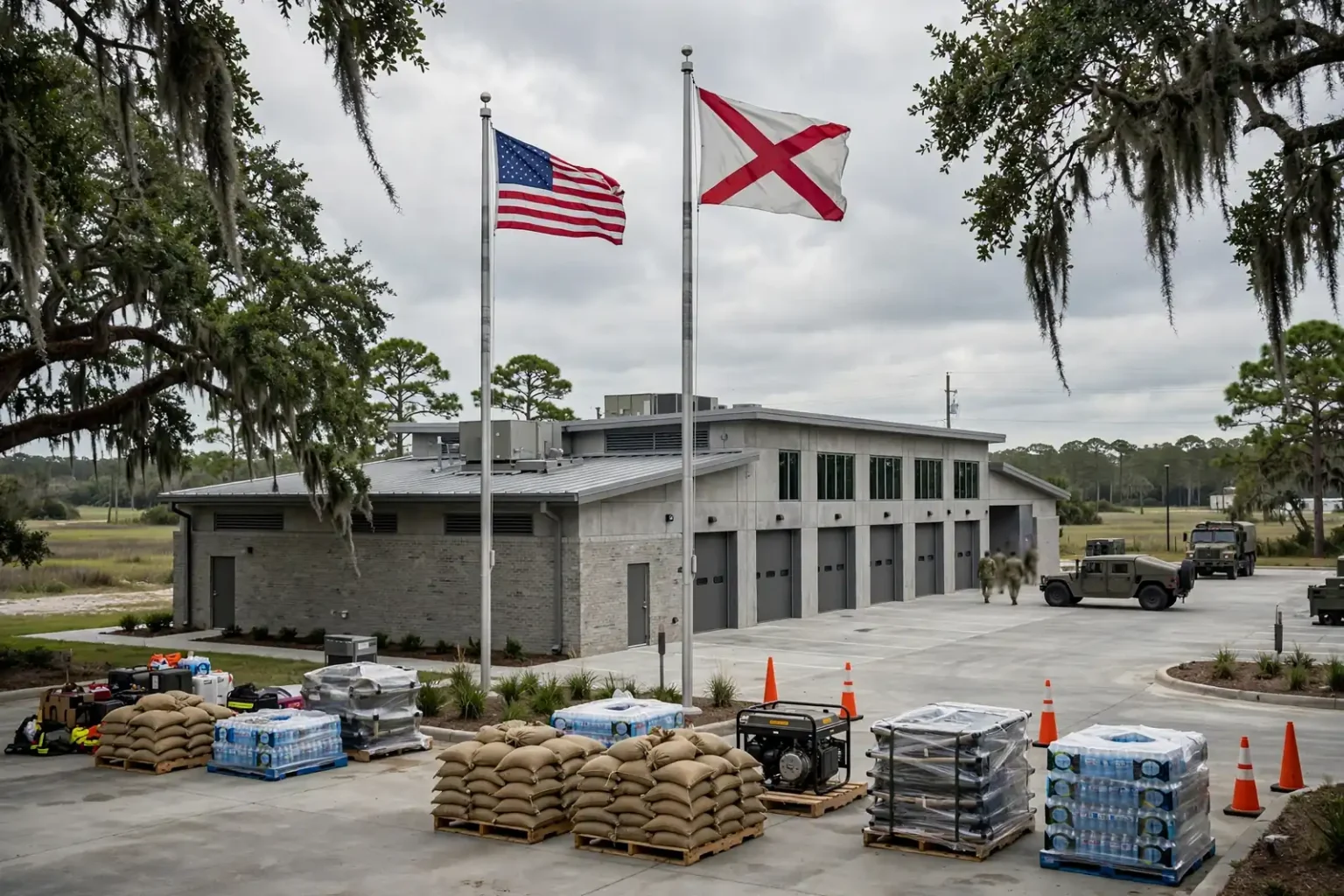
Beyond supporting day-to-day Guard operations, the new armory is designed to serve as a staging area for emergency response and recovery, including operations after hurricanes — a significant role in a coastal county where Guard members are often called on after major storms.
The City of Foley provided the land for the new armory. In exchange, the city received the former Guard facility on East Jessamine Avenue, which sits behind City Hall. The city has since renovated that building into the Foley Activity Center, which offers recreation space and houses offices for city departments.
A century of service
From the 1926 founding of the 106th Motorcycle Company to the 2023 dedication of a modern facility, Foley’s armories tell the story of a small town that repeatedly sent its residents into service — before Pearl Harbor, in Korea, in the Middle East and in response to storms at home.
Each of the three buildings remains in active use today: one as a restaurant, one as a city activity center and one as the current home of the local Guard. Taken together, they reflect a hundred years of military service, community involvement and continued public use in Foley.