Former Bayou La Batre Housing Officials Seek Trial Venue Change Over Media Coverage
Attorneys for two former Bayou La Batre Housing Authority officials are asking a judge to move their civil trial out of Mobile County, arguing pretrial media coverage of the $4.18 million retirement dispute has tainted the jury pool.
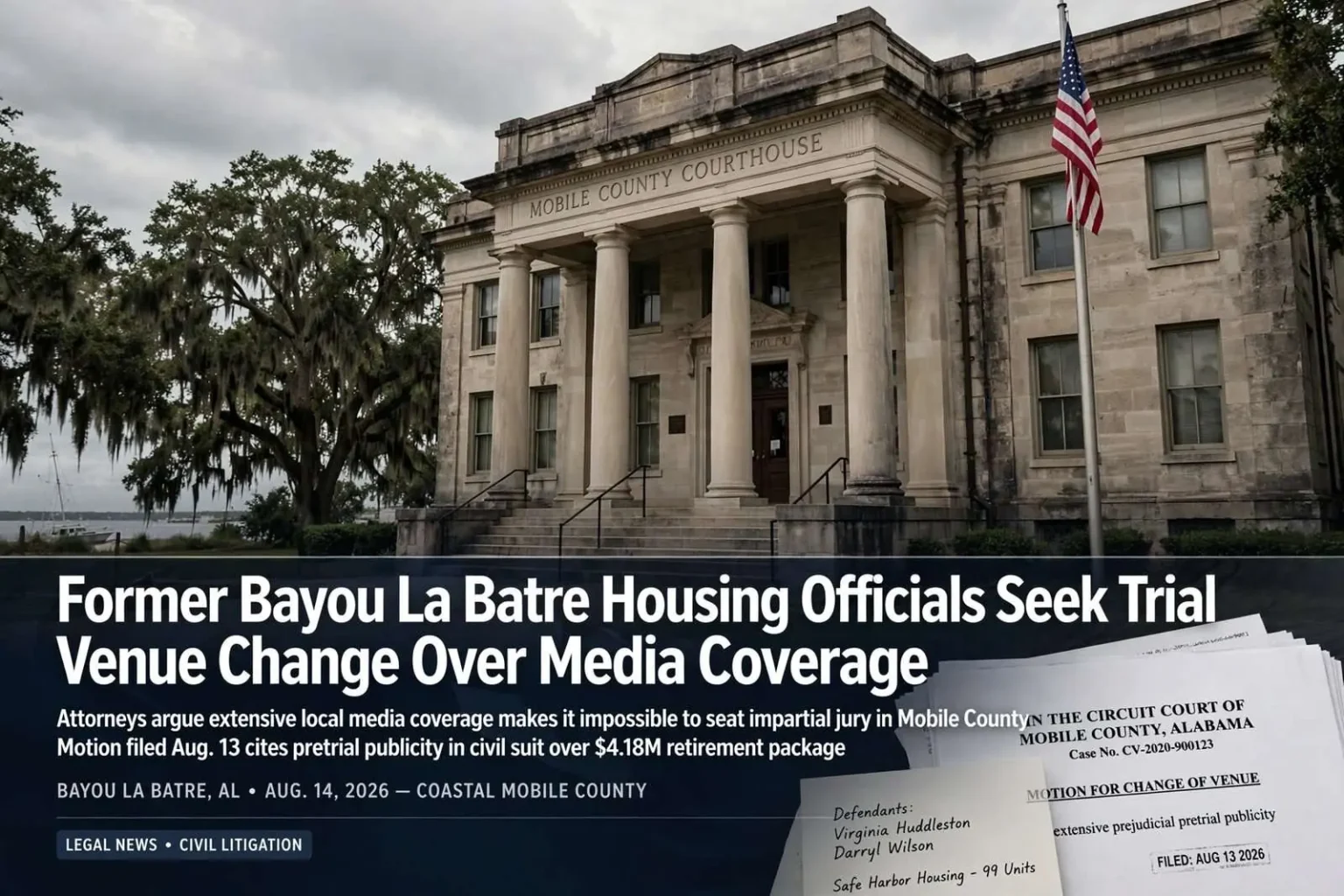
Attorneys for two former Bayou La Batre Housing Authority officials facing a civil lawsuit over a multimillion-dollar retirement package are asking a judge to move their trial out of Mobile County, arguing that extensive local media coverage has made it impossible to seat an impartial jury.
The motion is the latest turn in a case that has drawn sustained attention across coastal Mobile County since it was filed more than five years ago. Bayou La Batre — a small waterfront community of roughly two thousand residents best known for its seafood fleet and its appearances in film — is the kind of place where a dispute of this size at a public agency does not go unnoticed, and the defense says that attention has now contaminated the pool from which any Mobile County jury would be drawn.
In an Aug. 13 motion filed with Mobile County Circuit Judge Wesley Pipes on behalf of former executive director Virginia Huddleston and former facilities manager Darryl Wilson, attorney John G. Scherf argued that “extensive prejudicial pretrial publicity has created a substantial risk that Defendants cannot receive a fair and impartial trial before a Mobile County jury.”
As an alternative to a transfer, the motion asks the court to allow expanded questioning of prospective jurors about what they have read. The coverage at issue followed Pipes’ own July 7 order, which voided the pair’s retirement agreements and described the payments as an “attempted fleecing of public money.”
The filing points to coverage from several local and statewide news outlets and claims those outlets were tipped off by a current Housing Authority board member. According to the motion, Johnny Hatcher, the board’s chairman, “distributed a copy of the July 7, 2026, Order to local media and news agencies throughout Mobile County, Alabama” the day after it was issued.
The motion also accuses Hatcher of making “prejudicial” public comments about the case.
That allegation matters procedurally as well as rhetorically. Change-of-venue motions ask a court to weigh not just the volume of publicity but its sources; coverage actively promoted by a party to the litigation cuts differently than reporting a news organization pursued on its own. If the defense can show that the plaintiff’s own board amplified the coverage, it strengthens the argument that the publicity was orchestrated rather than organic — a distinction courts weigh when deciding whether prejudice in the jury pool can be cured by questioning prospective jurors individually.
Defense Cites Inflammatory Language
The motion highlights specific phrases used in media reports describing the defendants’ alleged conduct, including “attempted fleecing of public money,” “extravagantly excessive,” “unconscionable and illegal” and “windfall of epic proportions.” The defense argues such language goes beyond neutral reporting.
“These reports have repeated allegations of wrongdoing in language reasonably understood by the general public as expressing conclusions concerning Defendants’ conduct,” the motion states.
That distinction — between reporting allegations and declaring conclusions — is the heart of most venue motions built on pretrial publicity. News coverage that attributes accusations to the lawsuit itself, and includes the defendants’ responses, is generally considered routine. Coverage that uses words like “fleecing” and “illegal” as descriptions rather than quoted accusations, the defense argues, reads to an ordinary reader as a verdict rendered before trial. In a civil case where the defendants have not been found liable of anything, that framing is precisely what makes seating twelve impartial jurors difficult.
The filing also argues that the volume of coverage, combined with its timing so close to trial, has tainted the jury pool.
“The sheer volume and nature of the adverse publicity far exceeds routine news coverage,” the motion states, citing newspaper articles, television broadcasts, internet publications, social media posts and public statements from Housing Authority officials as contributing factors.
The breadth of the media list is significant for the motion’s chances. Publicity confined to one newspaper or one broadcast can sometimes be addressed by asking prospective jurors what they have read and excusing those who remember too much. Coverage that spans print, television, websites, social media and official statements reaches potential jurors through so many channels that the standard voir dire filtering becomes far harder, particularly in a county the size of Mobile, whose population still lives close enough to Bayou La Batre that the story registers locally.
“Given the nature, timing of the dissemination before trial, and cumulative effect of this publicity, together with the localized public interest surrounding the Bayou La Batre Housing Authority suit, Defendants respectfully submit that the interest of justice requires transfer to another Alabama county where an impartial jury may be selected,” the motion states.
The “interest of justice” standard is the one Alabama courts apply to civil venue transfers of this kind. A judge weighing such a motion looks at the intensity of the publicity, its tone, the timing relative to trial, and whether the events at the center of the case drew attention in the proposed new venue as well. A transfer, if granted, moves the trial — and the cost and inconvenience of attending it — to a county where the parties have fewer local ties.
Origins of the Dispute
The underlying lawsuit traces back to a series of contracts approved during the two defendants’ tenure at the helm of the Bayou La Batre Housing Authority, which oversees the 99-unit Safe Harbor housing development.
The authority itself grew out of Hurricane Katrina. The City of Bayou La Batre used federal grant money to buy property and develop affordable housing for residents displaced by the storm, and in 2008 the city council authorized incorporating the Housing Authority as a public nonprofit corporation to oversee the development — Safe Harbor, built with a $15.7 million federal grant.
Huddleston was hired as executive director in 2013, the same year Wilson resigned from the Housing Authority’s board to take the staff position. Court records show that over the following seven years, the pair’s pay and benefits were increased repeatedly through contract amendments.
Between 2016 and 2020, Huddleston’s annual salary rose from $69,000 to $120,000 and Wilson’s from $31,200 to $80,000, according to court records. The contracts also gave each of them 89 paid days off per year while requiring just 27 hours of work per week.
Those amendments culminated in 2020 in a combined $4.18 million lump-sum retirement package that the Housing Authority contends would have forced the sale of Safe Harbor, the agency’s only asset.
That total broke down to about $2.52 million for Huddleston and $1.66 million for Wilson, payable after roughly seven years of employment. The lawsuit alleges the board had already voted in 2019 toward selling Safe Harbor, and court records show the properties were listed with an auction company in 2020 before the arrangement unraveled. A new leadership team led by Hatcher reviewed the contracts and took the matter to court.
That figure is what transformed a local governance dispute into a years-long court fight. Safe Harbor’s 99 units of federally subsidized housing are the housing authority’s entire portfolio, and an obligation of $4.18 million against a small agency with a single asset raised the prospect, in the plaintiff’s telling, of dismantling the housing supply the authority exists to provide. The sequence of amendments — small changes layered over seven years, each approved by a board on which the future facilities manager had served until taking the staff job — forms the factual spine of the lawsuit.
The Housing Authority’s civil suit, filed in December 2020, accuses the two former officials and several former board members of breaching their fiduciary duties, conspiracy, conversion, negligence, wantonness, waste of corporate assets, misappropriation of corporate assets and unjust enrichment.
The claims span the standard catalogue of corporate-fiduciary theories applied to public agencies: breach of fiduciary duty for board members who approved benefits to their own colleagues, conspiracy and conversion for the alleged pooling of that authority, and unjust enrichment as the catch-all claim seeking return of the money itself. Wantonness, under Alabama law, carries the potential for punitive damages, which is one reason the stakes of the case extend well beyond the $4.18 million package at its center.
Huddleston also faced a separate third-degree theft charge, filed in 2022 and connected to flooring material purchased by the Housing Authority. That criminal case was dismissed in September 2024 after the Housing Authority’s board opted not to proceed, choosing instead to pursue the civil litigation.
The dismissal removed the criminal exposure from the dispute but not the civil one, and it consolidated the fight entirely in the courtroom the defense is now trying to move. A prosecutor’s or complainant’s decision not to proceed criminally has no binding effect on a civil case, where the burden of proof is lower and the plaintiff is the agency itself rather than the state.
The dispute has produced collateral fights as well. A 2020 search of the defendants’ home and the authority’s records became its own controversy when damaged computer equipment, missing documents and Hatcher’s presence during the search surfaced in court. A different judge who reviewed the matter in 2025 concluded he could not determine whether missing documents had been given to Hatcher during the search.
The July Order
On July 7, Pipes granted the Housing Authority summary judgment on the pair’s claim to $4,182,771 in promised retirement payments, ruling the agreements illegal, unconscionable and unenforceable. He found the contracts violated Alabama laws on conflicts of interest and reasonable compensation at public and nonprofit entities, and that the former board violated the Alabama Open Meetings Act by discussing compensation in executive session before approving it publicly.
“It is incredible that the board of directors of a non-profit housing authority would enter into a contract with two seven-year employees to effectively hand them virtually all of the assets of the authority in the form of retirement,” Pipes wrote, calling the proposed payments a “windfall of epic proportions.” Huddleston had defended the pay in a deposition. Asked how it compared with other housing authorities, she testified: “I don’t have a clue and I don’t care. I know my worth and I’ve earned every penny of it.”
The ruling rejected the pair’s claim to the money, but the Housing Authority’s broader claims of wrongdoing remain pending before the same judge.
What Happens Next
Pipes — the same judge whose order the defense says drove the coverage — will now have to weigh the defense’s request to move the trial against the Housing Authority’s interest in keeping the case in the county where the alleged misconduct occurred.
Pipes has set the civil jury trial for Oct. 19. If he denies both the transfer and the request for expanded juror questioning, the case will go to a Mobile County jury on that date.
Change-of-venue motions in Alabama civil cases require a showing that pretrial publicity has made it genuinely difficult to seat an impartial jury, a threshold courts apply carefully given the public’s right to open judicial proceedings. Judges are reluctant to reward publicity with a transfer when individual questioning of jurors — voir dire — can still identify twelve fair ones, but they grant transfers when the record shows saturation too deep to screen out.
Either ruling will shape the case’s next phase. If the motion is denied, the trial proceeds in Mobile County, where prospective jurors will face detailed questioning about what they have read and said about the case. If it is granted, the parties, the witnesses and the small-town dispute at the center of it all move to another Alabama county — one chosen for its distance from the coverage, not its connection to the community where the housing authority serves residents to this day.
The Bayou La Batre Housing Authority, a public agency, is responsible for administering federally subsidized housing in the coastal Mobile County community, including the Safe Harbor development at the center of the dispute. Whatever the venue outcome, the agency’s operations — and the residents of Safe Harbor’s 99 units — continue while the litigation over its past leadership works its way toward trial.