Army Opens Fort Rucker Land to Data Center and Power Plant Bids
The Army is inviting proposals to lease land at Fort Rucker and eight other installations for commercial power plants and data centers that must also provide the post with backup electricity.
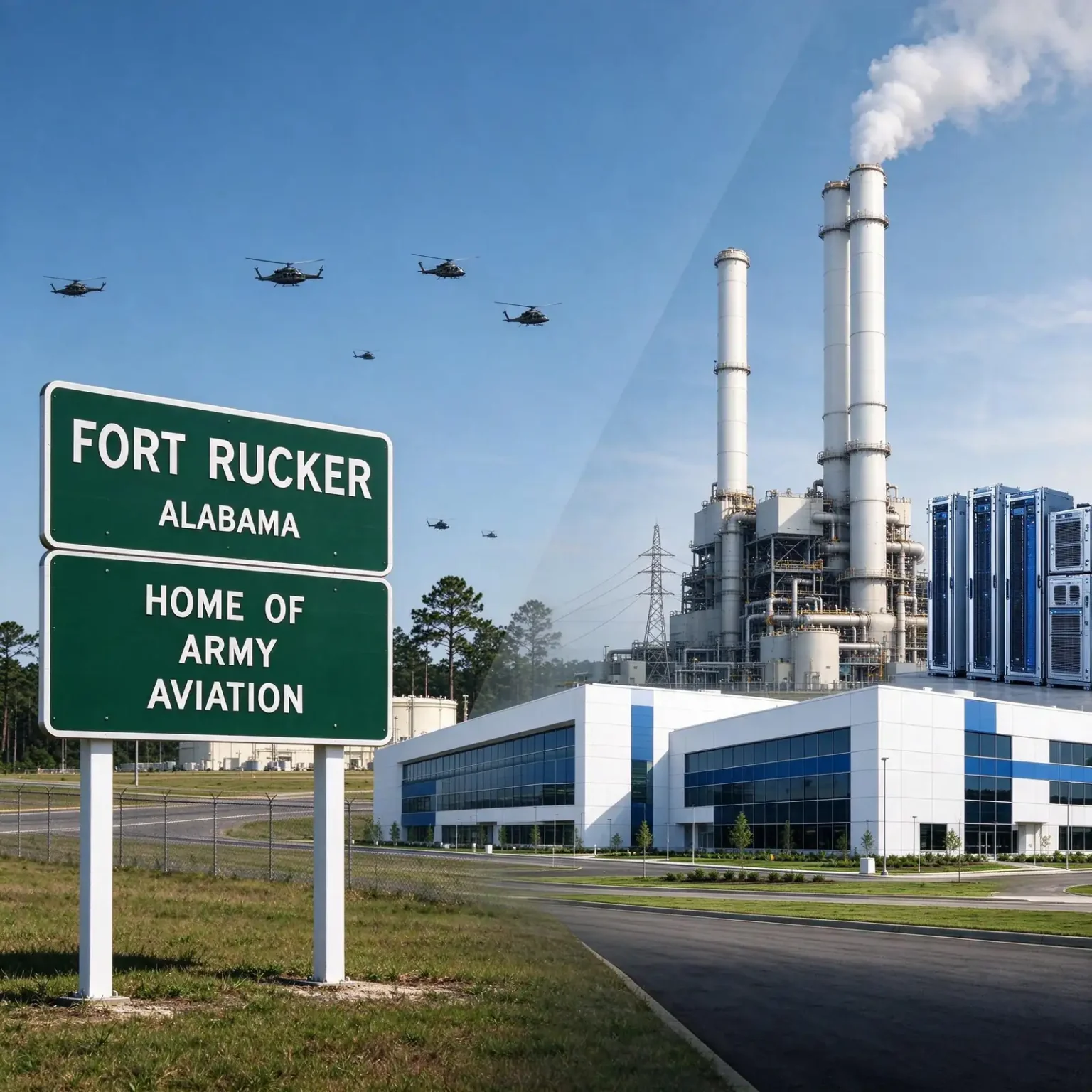
FORT RUCKER, Ala. — Private companies, public agencies and nonprofit groups now have a chance to pitch the U.S. Army on building a Fort Rucker data center and an accompanying power plant on land inside the Wiregrass installation, under a solicitation the Department of the Army issued Friday, Nov. 20, 2026.
Fort Rucker is one of nine Army properties named in the request for proposals, which seeks partners willing to lease Army land for decades, pay to build and run commercial energy generation and computing facilities, and in return guarantee the post a dependable source of backup electricity. Written proposals are due Jan. 18, 2027.
The opportunity could eventually bring a major private construction project to the home of Army aviation training, though the Army has not said how many leases it intends to award, which locations will be chosen or how large any facility would be. Below is a look at what the Army is asking for, what developers would have to deliver, and what the process means for the communities that surround the post.
What the Army Is Offering
The solicitation is built around a tool known as an Enhanced Use Lease, or EUL. Under federal law, military departments may lease land and facilities that are not considered excess to their needs, meaning the property stays in government ownership while a private or public partner uses it. In exchange, the tenant provides consideration to the military, which can take the form of cash or in-kind services and improvements.
In this case, the Army is offering what it describes as non-excess land at each of the nine sites. A winning bidder, which the Army calls an offeror, would take on essentially the entire life cycle of the project. According to the Army, that would include design, financing, permitting, development, construction, installation, ownership, maintenance, operation, security and, at the end of the lease, decommissioning.
The Army has stated a preference for projects that combine a commercial power generation facility with a commercial data center on the same campus. Bidders are not required to include a data center, however. The solicitation allows an applicant to propose an energy generation project by itself. The Army also reserves the option to sign one lease or several as a result of the solicitation.
The Nine Installations
Fort Rucker is the only Alabama location on the list. The other eight sites are spread across the country:
- Blue Grass Army Depot in Kentucky
- Pine Bluff Arsenal in Arkansas
- Tooele Army Depot in Utah
- Sierra Army Depot in California
- Fort McCoy in Wisconsin
- Fort Bragg in North Carolina
- Fort Hood in Texas
- Joint Base Lewis-McChord in Washington state
The mix includes large troop installations, training posts and industrial depots, which suggests the Army is casting a wide net to see where the private market sees the strongest potential.
Backup Power Is the Price of Admission
For the Army, the most important piece of the arrangement is energy resilience. Any project proposed under the solicitation must supply the installation with resilient power, and that commitment counts as part of what the tenant owes the Army in return for the lease.
The requirements are specific. A developer must be able to deliver resilient electricity to the installation within one hour of a grid outage, and keep it flowing for at least 14 continuous days. The Army defines an outage broadly, covering any interruption of electricity from the utility grid that serves the installation.
The tenant would also be responsible for any upgrades to the Army’s own utility infrastructure needed so the post can actually receive that power. The Army said it will give preference to proposals that promise contingency power for longer than the 14-day minimum.
Military planners have spent years focused on the risk that a long power outage could interrupt operations at domestic bases, many of which depend on the same commercial grids that serve nearby homes and businesses. A large power plant located on the installation itself, with a contractual duty to keep the post running during an outage, is one way to reduce that dependence.
Two Kinds of Data Centers
The Army is not limiting proposals to any particular size or capacity. It has, however, laid out two preferred models for the data center portion of a project.
Profile 1: Secure, Isolated Campuses
The first model is a hardened campus that is physically separated from other activity and constructed to ICD 705 standards, intended for Top Secret and IL6 workloads. ICD 705 refers to an Intelligence Community Directive that sets construction and security standards for Sensitive Compartmented Information Facilities, the specially built rooms and buildings where classified intelligence is handled. IL6 is an impact level used in the Defense Department’s cloud computing security framework for classified data.
In practical terms, a facility under this profile would be designed to handle sensitive government computing work, with physical protections well beyond those of a typical commercial server farm.
Profile 2: Hyperscale and AI Facilities
The second model covers large hyperscale facilities and centers built for artificial intelligence and high-performance computing, often abbreviated AI/HPC. The Army is asking that these facilities target a power usage effectiveness, or PUE, of 1.15 or lower.
PUE is a common efficiency measure in the data center industry. It compares the total energy a facility uses to the energy consumed by its computing equipment alone. A score of 1.0 would mean every unit of electricity goes directly to the servers, with nothing spent on cooling, lighting or other overhead. A target of 1.15 or below means the Army wants very little energy lost to those supporting systems.
Bidders who want to pair a commercial data center with power generation may plan both within a single campus master plan, according to the Army.
Strict Rules on Water
Data centers can consume large volumes of water for cooling, and the Army’s solicitation sets firm limits on how a project could obtain it.
Projects must avoid drawing on water aquifers. Instead, developers are directed to prioritize industrial greywater, treated wastewater from municipal systems, or closed-loop cooling towers that recirculate the same water. The Army is requiring that water use be net-neutral or better.
The selected developer would also have to pay, on its own, to obtain all industrial process water from non-drinking-water sources. The Army listed brackish groundwater, reclaimed municipal wastewater and treated runoff from industrial or agricultural operations as possible options, all subject to Army approval and to applicable regulations.
For the Wiregrass, where many communities and farms rely on groundwater, the water provisions are likely to be a point of local interest as the process unfolds.
Who Would Buy the Power and Computing Capacity
The arrangement is designed as a commercial venture rather than a government purchase. The Army said it expects all of the electricity generated, along with any data center capacity, to be sold to third-party buyers, known in the energy industry as off-takers.
Finding those customers would be the developer’s job. Lining up and locking in off-takers would fall to the winning bidder, which means the financial viability of any project would depend on private demand for power and computing services in the region.
Local Leaders Want Careful Review
The solicitation has begun drawing reaction from Alabama’s elected officials in Washington. In a statement issued Tuesday, Nov. 24, one member of the state’s congressional delegation said the top priority is making sure Fort Rucker stays in a strong position to carry out its national defense mission.
The statement expressed interest in learning more about the possible benefits and effects for both the post and the nearby communities as the Army works through the process. It also called for any development proposed for the installation to be reviewed thoroughly, to make certain it serves the interests of the military and of Alabama residents.
Why Fort Rucker Matters to the Region
Fort Rucker is home to the U.S. Army Aviation Center of Excellence and serves as the primary flight training installation for Army helicopter pilots. The post sits in the Wiregrass region of southeast Alabama, mostly in Dale County with a portion in Coffee County, and is surrounded by cities including Enterprise, Ozark and Daleville.
The installation carried the name Fort Novosel for a short time after a 2023 renaming, before the Fort Rucker name was restored in 2025.
Because the post is one of the largest employers in the Wiregrass, decisions about how its land is used tend to draw close attention from nearby cities and counties. A large energy and computing campus could bring construction activity and long-term jobs, but it could also raise questions about traffic, utilities, land use and water that local governments typically weigh in on during development.
Data Centers and Military Land
The Army’s move comes amid rapidly rising demand nationwide for data center space, driven in large part by artificial intelligence and cloud computing. Developers across the country have been searching for sites with ample land, access to large amounts of electricity and room to build their own generation.
Military installations offer large tracts of controlled, secured land. By leasing that land instead of selling it, the Army keeps ownership while gaining a private partner that funds construction and provides a backup power source. The Enhanced Use Lease model has been used by the military services for a range of projects over the years, including energy installations on bases.
What Happens Next
Interested organizations have until Jan. 18, 2027, to submit proposals. After that deadline, the Army will evaluate submissions and decide whether to award one or more leases at any of the nine installations.
Several important details remain unknown at this stage, including:
- Which of the nine sites, if any, will draw serious proposals
- How large a facility might be built at Fort Rucker, since the Army set no size requirements
- Whether a Fort Rucker proposal would include a data center or focus only on power generation
- What timeline any selected project would follow for permitting and construction
Any project chosen would still have to clear permitting and regulatory reviews before construction could begin, and water sourcing would require Army approval.
Residents of Enterprise, Ozark, Daleville and other communities near the post who want to follow the process can watch for updates from the Army and from their local and congressional representatives as the January deadline approaches and the evaluation period begins.