Florida Panhandle Okaloosa County
Fort Walton Beach woman critically hurt after car turns into her path in crosswalk
A woman was seriously injured in a Fort Walton Beach crosswalk when a turning car struck her at Racetrack and Mooney roads. The driver was cited.
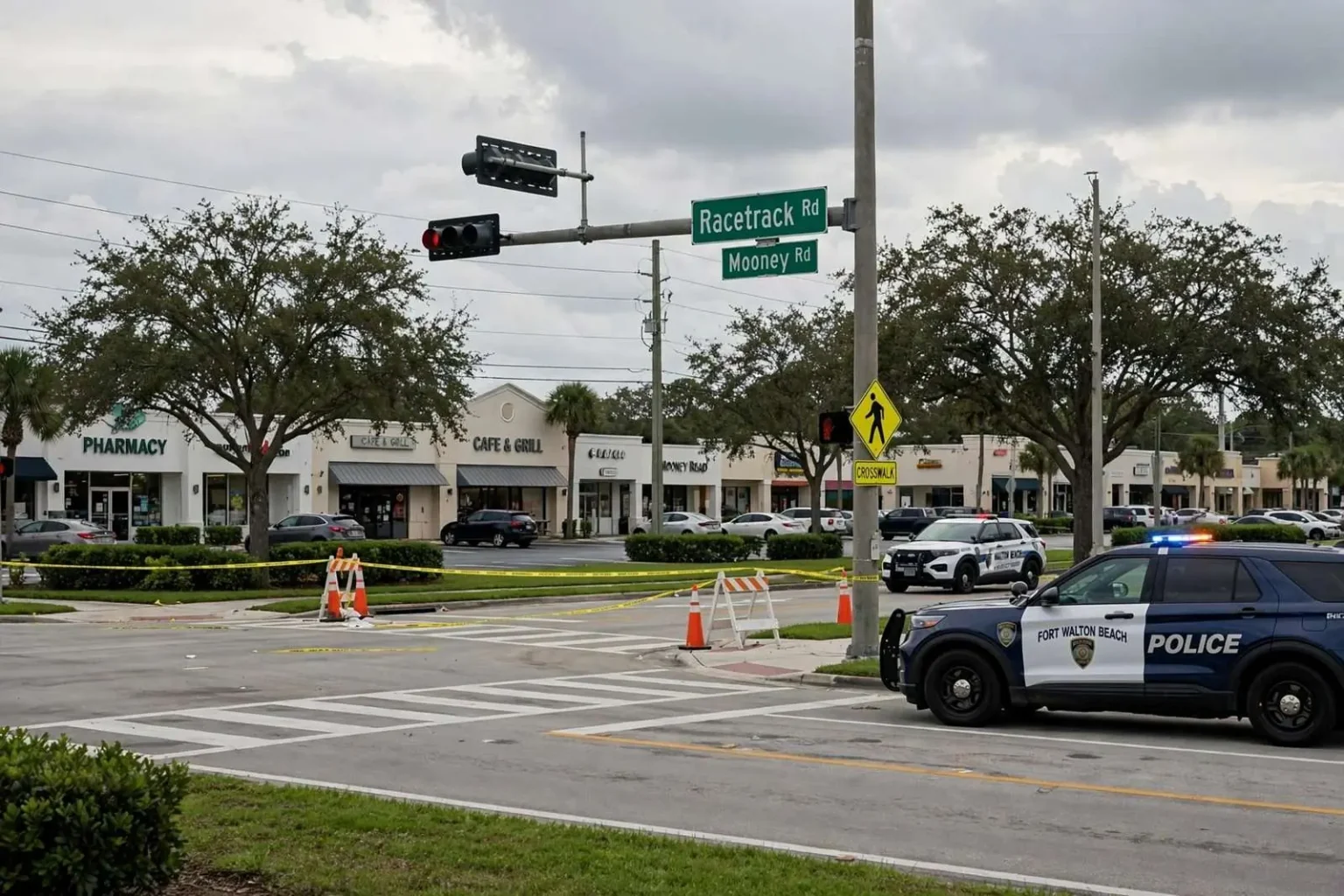
A 55-year-old woman suffered serious injuries in Fort Walton Beach after she was struck by a turning car while walking inside a marked crosswalk, according to investigators. The crash occurred at the intersection of Racetrack Road and Mooney Road, a junction that handles a steady flow of commuter and commercial traffic on the growing north side of the city.
Authorities identified the injured pedestrian as Diana Rosario. She was crossing Racetrack Road on foot when a 2016 Acura RLX made a turn and hit her, investigators said. The intersection is signalized, with marked crossings on multiple legs, and it sits along a stretch of roadway lined with shopping centers, restaurants and residential side streets that feed into the arterial throughout the day.
Rosario was transported to Fort Walton Beach Medical Center for treatment of what officials described as serious injuries. The hospital, located just a short drive from the crash scene, serves as one of the primary trauma receiving facilities for residents of Okaloosa County and the surrounding Emerald Coast communities. No updated condition was released at the time of the report.
Driver Cited in the Crash
The driver of the Acura, an 86-year-old Fort Walton Beach woman identified by investigators as Hazel Lareese Heifner, was charged with violating a pedestrian’s right of way, according to authorities. The citation reflects the determination that Rosario was lawfully within the crosswalk when the vehicle turned into her path. No further charges were announced at the time of the report, and authorities did not indicate whether additional factors such as speed or visibility played a role in the crash.
Under Florida law, drivers making a turn are required to yield to pedestrians who are lawfully within a crosswalk. The statute places the burden on the motorist to wait until the crossing is clear, and a citation for violating a pedestrian’s right of way is the most common enforcement outcome when a turn leads to a collision with someone on foot. In serious-injury cases, investigators typically reconstruct the sequence of signals, vehicle movements and sightlines before finalizing their findings, and additional citations remain possible if that review supports them.
For the pedestrian, the consequences of a driver’s failure to yield can be severe regardless of who holds the legal right of way. A person on foot has no protection against a moving vehicle, and even low-speed turns can produce fractures, head injuries and extended hospitalizations. Traffic-safety officials across the Florida Panhandle have repeatedly urged both motorists and walkers to treat crosswalks as shared space that still requires eye contact and caution.
A Busy Corridor for Drivers and Walkers
Racetrack Road is one of the busier east-west corridors on the Fort Walton Beach side of Okaloosa County, carrying steady commuter and commercial traffic through a stretch lined with shopping centers and residential side streets. The roadway connects neighborhoods on the city’s northern side with the U.S. Highway 98 corridor and the commercial districts around Santa Rosa Mall and Mary Esther, and its daily traffic includes commuters, families running errands and visitors moving between lodging and the beaches.
Mooney Road, which meets Racetrack Road at the crash intersection, serves as a major north-south connector linking the Niceville and Valparaiso side of the county with the Fort Walton Beach area. The junction of the two roads sits near schools, churches and retail plazas, which puts a steady stream of pedestrians at the crossing at nearly every hour of the day. Sidewalks along portions of both roads funnel foot traffic toward the signalized crossings, including the one where Rosario was struck.
Turning movements at signalized and unsignalized intersections along that kind of arterial are a recurring hazard for people on foot. A driver’s attention is often focused on finding a gap in oncoming traffic rather than on the crossing beside them, and a pedestrian who has stepped into the crosswalk on a walk signal can be invisible to a motorist scanning the far lanes. The problem intensifies at wide intersections where the crossing distance is long and drivers making turns face competing demands for their attention.
What Florida Law Requires at Crosswalks
Florida’s traffic statutes are explicit about the obligations on both sides of a crosswalk. When traffic signals are present, pedestrians are required to cross on the walk signal and to remain within the marked lines, while drivers facing a green light must yield to anyone legally in the crosswalk before completing a turn. At unsignalized marked crossings, drivers must yield when a pedestrian is in the half of the roadway nearest their vehicle or approaching closely enough to be in danger.
The law also assigns duties to pedestrians, who are prohibited from suddenly leaving a curb and walking into the path of a vehicle that is so close it cannot reasonably yield. Safety educators stress that following those rules does not guarantee protection, however. Enforcement and signals matter far less than the split-second decisions made by a driver scanning traffic and a walker stepping off the curb, which is why officials consistently pair the legal guidance with a plea for mutual vigilance.
Traffic-safety officials across the Florida Panhandle have repeatedly urged both motorists and walkers to treat crosswalks as shared space that still requires eye contact and caution, noting that a pedestrian legally in the right of way has no protection from a vehicle that never sees them. Public-awareness campaigns in Escambia, Santa Rosa, Okaloosa and Walton counties have emphasized the same message in different forms: drivers should look for people on foot before every turn, and pedestrians should confirm that approaching vehicles are actually stopping before stepping into the roadway.
Pedestrian Risk Along the Gulf Coast
Pedestrian crashes remain a persistent concern along the Gulf Coast, where wide arterial roads, year-round tourism traffic and long stretches between signalized crossings combine to put walkers in close proximity to fast-moving vehicles. Communities from Pensacola to Panama City have recorded serious and fatal pedestrian crashes on multi-lane arterials similar to Racetrack Road, and state safety plans have repeatedly identified corridors in Northwest Florida among those needing improved crossings, lighting and signal timing.
The region’s layout contributes to the problem. Much of the coastal urban area developed around high-capacity roads built to move beach traffic quickly, with commercial destinations strung along the frontage and neighborhoods behind it. Residents who live on one side of those roads and shop, work or attend school on the other often have no practical alternative to walking across them, sometimes at intersections where signals cycle quickly and turning volumes are heavy.
Tourism adds another layer of risk during the peak seasons. Visitors unfamiliar with local road geometry, distracted by navigation and concentrated in the same corridors as residents, produce turning volumes that outstrip what the road network sees in the off-season. Combined with year-round warm weather that keeps people walking outdoors in every month, the conditions make Northwest Florida’s pedestrian crash counts a standing concern for county and city planners.
Injury outcomes in these crashes depend heavily on speed. A person struck by a vehicle turning through a crosswalk at neighborhood speeds is far more likely to survive than one hit at arterial speeds mid-block, which is why safety engineers focus on keeping turning speeds low at signalized junctions and on giving pedestrians a head start with leading walk intervals. Investigators have not said how fast the Acura was moving when it struck Rosario, and the citation issued at the scene does not resolve that question.
What Happens After a Serious Pedestrian Crash
When a pedestrian crash produces life-threatening injuries, the response typically involves more than the initial citation. Investigators document the scene, photograph vehicle damage and rest positions, and interview witnesses before any final accounting of fault is issued. In cases like the one on Racetrack Road, the at-scene charge for failing to yield can stand on its own, or it can be supplemented if the investigation reveals violations such as careless driving. Prosecutors become involved only when the evidence supports criminal charges, which is not automatic in a crash that began as an ordinary turning movement.
For the injured pedestrian, the road forward usually runs through a lengthy medical and financial recovery. Hospitalization, rehabilitation and time away from work create costs that can extend well beyond what an initial treatment stay suggests, and claims arising from a crash where the driver was cited generally rest on the finding that the pedestrian was lawfully in the crosswalk. Insurance processes in Florida move independently of any criminal or traffic case, and families often wait months for a full picture of both.
The citation Heifner received is a non-criminal traffic offense under Florida law, punishable by fine and points rather than jail time, unless the investigation elevates it. Authorities said no further charges had been announced as of the time of the report, leaving the resolution of the case dependent on the completion of the crash reconstruction and the pedestrian’s medical outcome.
Older Drivers and Turning Crashes
The driver’s age, 86, has drawn attention to the broader question of how aging affects driving ability, particularly at intersections. Research on older motorists has consistently found that per-mile crash rates rise among the oldest drivers, with intersection turning movements among the most common crash types for that group, reflecting changes in vision, judgment of gaps in traffic and the speed of scanning multiple directions. Florida’s licensing system requires renewal every eight years, with vision testing at renewals, but it does not impose across-the-board restrictions based on age alone.
Advocates for older drivers note that most remain safe behind the wheel for decades past the age at which some begin to struggle, and that blanket age-based rules unfairly penalize capable drivers in a state where remaining mobile is often essential to independence. The preferred approach among safety specialists is functional assessment: family members, physicians and law enforcement officers can refer drivers for re-examination when observable problems arise, and restrictions such as daylight-only or no-highway driving can be tailored to what an individual can still do safely.
None of that changes the immediate facts in the Fort Walton Beach case, where investigators concluded the pedestrian held the right of way. But the crash illustrates the scenario intersection-safety advocates describe most often: a capable driver completing a routine turn who simply fails to register a person on foot until it is too late. The remedy, they argue, lies in engineering that makes pedestrians more conspicuous, signals that separate turning vehicles from crossing walkers, and habits on both sides that assume nothing about the other’s intentions.
A Standing Reminder for Emerald Coast Drivers
For residents of Fort Walton Beach and neighboring communities, the crash at Racetrack and Mooney is a reminder that marked crosswalks and signals define legal rights, not physical safety. Officials continue to encourage drivers to make a deliberate scan for pedestrians before every turn, especially at intersections bordered by retail parking where walkers appear from between vehicles, and to remember that yielding to a person already in the crossing is not a courtesy but a legal obligation.
Pedestrians, for their part, are urged to use signalized crossings where they exist, to make eye contact with turning drivers before stepping out, and to stay alert to vehicles that may be focused on oncoming traffic rather than the crosswalk. Neither behavior prevents every crash, but together they address the failures that investigators most often find in collisions of this kind: a driver looking for a gap in traffic, and a walker trusting that being in the right means being seen.
Authorities said the investigation into the Racetrack Road crash remained active at the time of the report, and anyone with additional information was encouraged to contact the Fort Walton Beach Police Department. Updates on Rosario’s condition had not been released.