Fountain Correctional Facility Officer Faces Felony Cell Phone Charge After Package Meant for Inmate Is Seized
A 29-year-old officer at Fountain Correctional Facility near Atmore is jailed on a prohibited activities charge after investigators seized four new phones, chargers and earbuds they say were bound for an inmate.
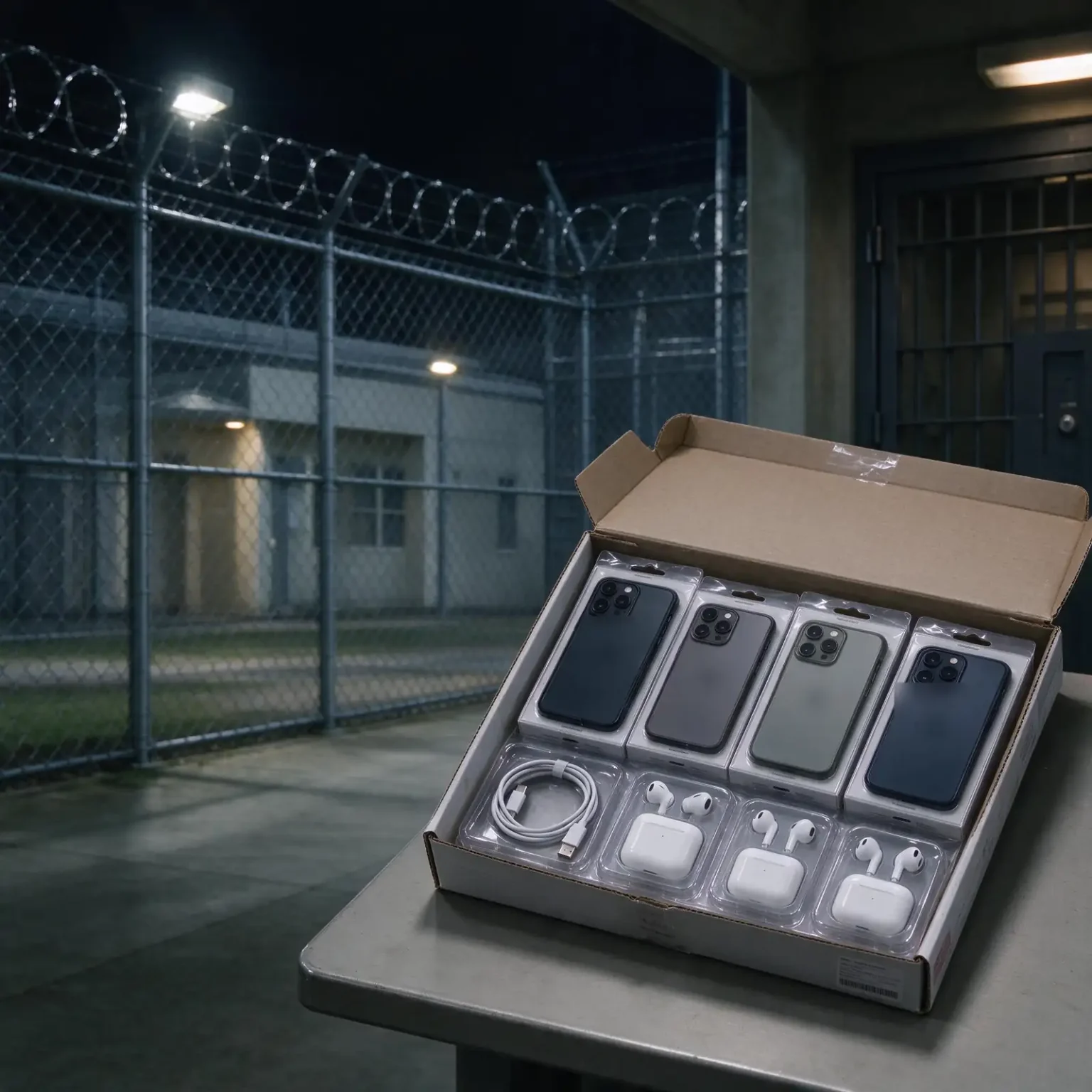
ATMORE, Ala. — A Fountain Correctional Facility officer is facing a felony charge under Alabama’s prison cell phone law after state corrections investigators intercepted a package of phones and accessories that they say was headed for an inmate. Kerry Watson, 29, a correctional officer at the Escambia County prison, was arrested on Friday, Nov. 20, and booked into the county jail in Brewton.
The Alabama Department of Corrections said Watson is charged with prohibited activities, the offense the state uses when inmates or prison employees possess or deliver unauthorized phones and similar devices. No bond was listed for her after booking. Like anyone accused of a crime, she is presumed innocent unless and until proven guilty in court.
At a glance
- Who: Kerry Watson, 29, a correctional officer assigned to Fountain Correctional Facility in Escambia County.
- When: Friday, Nov. 20, 2026.
- What was found: A package holding four new cell phones, four charging cables and three pairs of wireless earbuds.
- Alleged purpose: Investigators concluded the items were going to be carried into the prison and handed to an inmate.
- Charge: Prohibited activities, a Class C felony under Alabama law.
- Investigating agency: The ADOC Law Enforcement Services Division.
- Custody: Escambia County Detention Center in Brewton, with no bond listed.
The law behind the charge
Alabama’s prohibited activities statute targets the flow of unauthorized communication devices into state prisons. It makes it a crime for an inmate, or for an employee of the Department of Corrections, to possess or deliver an unauthorized cell phone or other wireless communication device, or a computer capable of moving programs to or from inmates. A violation is classified as a Class C felony.
Under Alabama’s general sentencing ranges, a Class C felony carries a possible prison term of one year and one day up to 10 years, along with a fine of up to $15,000. Where a sentence actually lands depends on many factors, including a defendant’s prior record and any plea agreement, so the statutory range describes the outer limits rather than a likely result.
The law treats staff and inmates alike on this point, which reflects how prison phones typically move. Devices rarely appear inside a secure facility on their own; they generally come in through visitors, deliveries, items thrown over fences, or people who work inside the walls. Alabama also has separate promoting prison contraband offenses, graded in degrees, that can apply to other banned items such as drugs or weapons. In this case, ADOC has announced only the prohibited activities charge.
What the package held
According to the department, the package in Watson’s possession contained four cell phones that were still new, four charging cables to power them and three sets of wireless earbuds. The combination amounts to a ready-to-use kit: phones to make calls and send messages, the cords needed to keep them running, and small earpieces that let a user talk or listen quietly.
Investigators with the Law Enforcement Services Division determined that the items were meant to go into Fountain and end up with an inmate, ADOC said. The department has not said which inmate was the intended recipient, how the package came to be in the officer’s possession, or whether anyone else is under investigation.
Why phones are such a concern for prison officials
Corrections officials across the country regard contraband cell phones as one of the most serious security problems inside prisons, and the department laid out its reasons in announcing the arrest. An official said an illegal phone can put correctional staff, incarcerated people and the general public in danger. The department said such phones can be used to carry out crimes both inside a facility and beyond its fences, including organizing efforts to bring in more contraband.
Inmates in Alabama prisons may communicate with the outside world through approved, monitored channels. An unauthorized phone sidesteps that monitoring, which is why prison systems treat it differently from ordinary contraband. Phones smuggled into prisons nationwide have been linked to drug trafficking, fraud schemes, intimidation of witnesses and the planning of violence, both behind bars and in the community.
The department also emphasized that it intends to pursue anyone who tries to bring forbidden items into its prisons, and that its own employees are not exempt. An official added that contraband cases are worked together with local, state and federal law enforcement agencies when the circumstances call for it.
Who investigates cases like this
The Law Enforcement Services Division is the investigative arm of the Alabama Department of Corrections. Its agents look into criminal activity connected to the state prison system, including contraband, drug cases and allegations of wrongdoing by staff. The division’s work often involves searches, interviews and coordination with outside agencies, and cases it develops can be presented to local prosecutors for court action.
When a corrections employee is accused of a crime tied to the job, the case typically has two tracks. One is the criminal case in the courts. The other is the employment side, which is handled internally by the department. ADOC has not said what employment action, if any, has been taken regarding Watson.
A prison with recent contraband cases
Watson’s arrest is the latest in a series of contraband investigations tied to Fountain Correctional Facility this year. Earlier this month, the department announced that two contract workers at Fountain were arrested on prison contraband charges in a case involving narcotics and other banned items. That case involved different people and different charges from the one announced this week, and ADOC has not linked the two.
In August, the department also reported seizing marijuana and cash at a Montgomery home during an investigation into contraband believed to be bound for the same prison. Again, there is no indication from ADOC that that case is connected to Watson’s arrest.
About Fountain Correctional Facility
Fountain Correctional Facility is a state prison for men located near Atmore in Escambia County, in the far southwestern corner of Alabama close to the Florida line. The Atmore area has long been home to several state corrections operations. Holman Correctional Facility, which houses Alabama’s execution chamber, sits nearby.
Escambia County is also at the center of the state’s prison construction plans. Alabama has been building a new, large men’s prison in Elmore County and has pursued a second large facility in Escambia County, a project that has drawn attention from lawmakers over its cost and oversight.
Alabama’s prison system has faced years of scrutiny over staffing shortages, violence and contraband, including a federal lawsuit brought by the U.S. Department of Justice over conditions in men’s prisons. Short staffing can make screening of people and packages entering a prison more difficult, and corrections officials have repeatedly pointed to contraband as a driver of violence and drug overdoses inside facilities.
How prisons try to stop contraband
Prison systems rely on several layers of defense to keep phones and other banned items out. Common measures include:
- Searches of people, bags and vehicles at entry points, including staff.
- Body scanners and metal detectors at facility entrances.
- Drug-detecting and phone-detecting K-9 teams.
- Inspection of incoming mail and packages.
- Perimeter patrols to catch items thrown over fences or dropped near the grounds.
- Shakedowns of housing units to find items that have already slipped through.
- Investigations of employees, contractors and visitors suspected of helping inmates obtain contraband.
Because employees pass through security every day and know how a facility operates, a staff member accused of bringing in contraband is treated as an especially serious matter by corrections agencies. Investigations of that kind often aim not only at the person caught with the items but also at anyone on the outside or inside who may have arranged or paid for the delivery.
What comes next in the case
After a felony arrest in Alabama, a defendant generally makes an initial appearance before a judge or magistrate, where conditions of release and bond are addressed. Felony cases usually begin in district court, where a preliminary hearing may be held to decide whether there is probable cause to send the case to a grand jury.
If a grand jury in Escambia County returns an indictment, the case would move to circuit court for arraignment, at which point the defendant enters a plea. From there, the case could be resolved through a plea agreement, dismissed, or taken to trial before a jury. Any conviction would require proof beyond a reasonable doubt.
The Department of Corrections has not released further details about the investigation, including whether additional arrests are expected. Anyone with information about contraband or criminal activity in Alabama prisons can contact the Alabama Department of Corrections.