

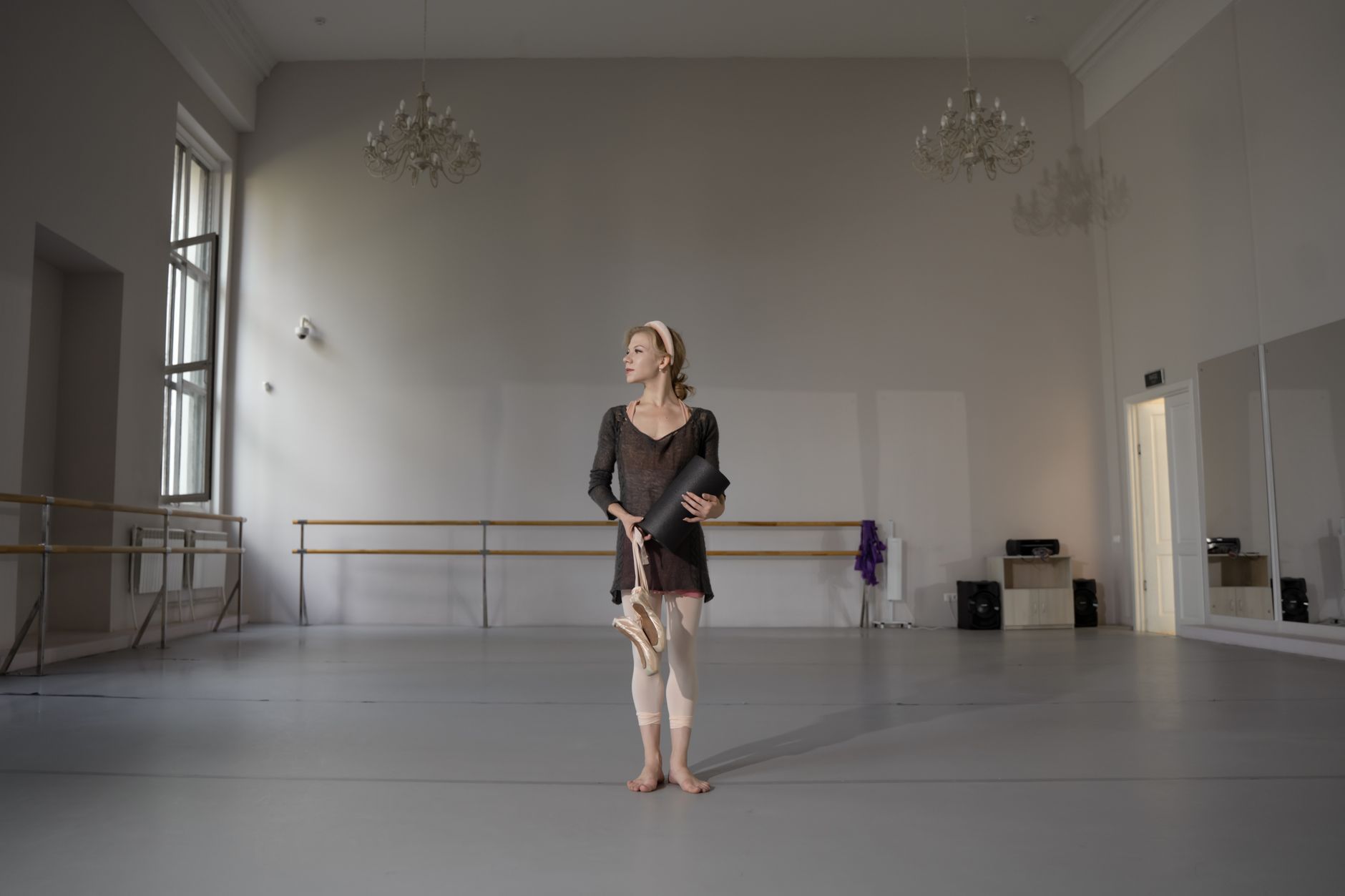
Few people in Baldwin County can say they have danced in The Nutcracker at a national theater, toured with a Broadway-style company in Europe and written down choreography in a specialized notation system used by the world’s great ballet companies. Point Clear ballerina Barbara Haines can say all of that, and her story continues to unfold from a quiet home studio on Mobile Bay.
A former professional dancer from Budapest, Haines has built a second life on the Eastern Shore as a teacher, movement therapist, researcher and artist. Her path from the ballet stages of Hungary to Point Clear, recounted in a 2025 conversation with a former colleague from a Fairhope dance studio, is a reminder of how much international talent has quietly settled along the shores of Mobile Bay.
A Childhood Dream Born in Budapest
Like many little girls, Haines dreamed of being a ballerina. At age 6, after watching a ballet performance on television at home in Budapest, she asked her mother for lessons. Adél Orosz, the ballet master at the Kálmán Nádasdy Conservatory, gave her a one-month trial. Haines showed a natural gift, and she excelled.
She was born on the Buda side of the city. Budapest was historically formed from separate towns on either bank of the Danube River: hilly, green Buda on the west and flatter, busier Pest on the east. Haines describes Buda as scenic and natural and Pest as more urban and industrial, and she notes the two halves are connected by seven bridges. Her conservatory sat on the Buda side.
At 14, she was accepted into the Art Conservatory of Pécs, in southern Hungary, where she completed her advanced studies. In 1993, at 18, she earned her performing certificate as a professional ballerina.
From the National Theatre to a Modernist Company
While waiting for a diploma program to open at the Hungarian Dance University, Haines received a contract with the National Theatre of Hungary, where she danced from 1993 to 1996 in well-loved classical productions including The Nutcracker and Coppélia.
When she entered university, she was hired by Iván Markó, one of Hungary’s most renowned choreographers, to help rebuild his company around a daring, modernist vision. Markó had danced with Maurice Béjart’s company, and when he created his own version of Béjart’s most famous work, Bolero, set to Maurice Ravel’s hypnotic score, it awakened Haines’ interest in the movement of the body. It also drew her toward one of dance history’s great mysteries: Vaslav Nijinsky’s choreography for The Rite of Spring.
Nijinsky’s ballet, set to Igor Stravinsky’s score, caused an uproar at its 1913 Paris premiere with the Ballets Russes and was performed only a handful of times before the original choreography was largely lost. Scholars and companies have spent decades trying to reconstruct it. That fascination with preserving and recovering dance would shape the rest of Haines’ career.
Touring Europe and Earning a Teaching Diploma
Haines put her pedagogy studies on hold to seize an opportunity with a touring company based in Basel, Switzerland, that staged Broadway musicals in the vein of The Phantom of the Opera. She later returned to Hungary, where she taught the Olympic rhythmic gymnastics team.
In 2004, she earned her bachelor’s degree in Classical Ballet Pedagogy, following the Vaganova method, along with Cultural Studies. The Vaganova method, developed by the Russian dancer and teacher Agrippina Vaganova, is one of the world’s most influential systems of classical ballet training, known for its emphasis on strength, flexibility and expressive use of the whole body. Her résumé, by her former colleague’s count, runs ten pages.
A Blind Date, a Golf Course and a Move to Point Clear
How does a Hungarian ballerina end up in Point Clear, Alabama? Friends set her up on a blind date.
“My friends sent me on a blind date with a guy named Kenneth Eugene from Mobile, who was in Yugoslavia working as an architect/engineer with the company, KBR, Kellogg Brown & Root,” Haines said. “He was a golfer, and our second date was on a golf course. I knew nothing about it, so I quickly got a lesson.”
The couple married and moved to Point Clear in 2004 to help care for Kenneth’s ill mother. They planned to return to Europe but decided to stay and raise their two daughters bilingually.
Point Clear, stretching along Scenic Highway 98 south of Fairhope, has long drawn visitors and newcomers with its live oaks, bayfront homes and its famous resort, the Grand Hotel, whose history on the site dates to the 1800s. It is not the first place one might expect to find a Vaganova-trained ballet master, but Haines quickly found a place in the Eastern Shore’s arts community.
In 2007, she walked into Creative Outlet Dance Center in Fairhope, and the studio asked her to teach almost immediately. Years later, a chance meeting over the tomato table at McKenzie’s Farm Market reunited her with the studio’s owner and led to a long conversation over coffee.
Writing Dance Down: Benesh Movement Notation
A lifelong learner, Haines returned to school to study Benesh Movement Notation, earning a master’s degree, and in 2023 she became a registered and certified choreologist.
Benesh Movement Notation was devised in the mid-20th century by Rudolf and Joan Benesh in Britain and is widely used for recording and restaging dance works. Notators use a five-line staff, similar in appearance to a musical staff, to capture the position and movement of the body over time. The system is a tool for analyzing movement, rhythm and phrasing and for teaching the structure of dance. Most importantly, it allows choreography to be recorded accurately so that works by master choreographers such as George Balanchine or Nijinsky can be preserved as part of dance heritage.
Why write dance down in an age of video? A recording captures one performance by one set of dancers, complete with their individual quirks, camera angles that hide parts of the stage and moments where the choreographer’s intention is unclear. A notated score, by contrast, records the structure of the work itself: which foot, which count, which direction, which spatial pattern. Companies such as Britain’s Royal Ballet have long employed notators, and stagers use scores to mount ballets faithfully in theaters far from where they were created. For a dancer who became fascinated early on with a lost masterpiece like Nijinsky’s Rite of Spring, the appeal is obvious: notation is one of the few ways to make sure the next great work is not lost the same way.
Her doctoral research on the subject has been accepted at Transart Institute in partnership with Liverpool John Moores University in the United Kingdom. Its working title is “Voice & Vision: Mapping One Artist’s Vision Who Gave Voice to Modernism in Choreographic Art.”
Her travels have taken her around the world to study cultural dance, from Aboriginal communities in Australia and the Poarch Creek Indians in Atmore to nomadic communities in Kazakhstan. She has also taken part in artist residencies aimed at understanding dance as an art form in which context becomes a living experience.
“The core of my research is dance, where the lines of movement have expanded over the course of my career from stage works to drawn textures in felt,” she said. “My future aim is to form an ‘atemporal language,’ one that would motivate students beyond the quotidian.”
Her visual art grows from that same idea. Her artist statement describes how “the multidimensional vision brought the contextual layers of texture, color, material, light, movement, and sound to an aesthetic enclosure where Haines realized it’s impossible to separate all these instances.”
Ballet Master at the University of Mobile
Haines is also the ballet master for the University of Mobile’s musical theater program, where she teaches 16-week intensive courses for undergraduate, graduate and doctoral students. Her classes focus on the Vaganova method, Progressing Ballet Technique, dance history and classical variations, along with elementary reading skills in dance notation.
“My classes are not easy,” she said. Students are immersed in a blend of traditional dance training and AI-driven 3D technology. “AI is transforming the way we think about dance, and we are at the forefront of that change.”
The Fifth Line: Movement as Therapy
Drawing on her professional career, Haines established an alternative movement therapy practice at her home studio in Point Clear called The Fifth Line. There she designs custom sessions for individual needs through a conditioning and rehabilitation program that addresses:
- Dance injuries and conditioning
- Osteoporosis and scoliosis
- Hip- and knee-oriented work
- Shoulder and pelvic applications
- Pre- and postnatal conditions
As of 2025, one of Haines’ daughters was heading off to college, and the younger was a few years from graduating from Bayside Academy in Daphne. Once both are grown, Haines said, she and Kenneth will most likely return to Europe. Her work, after all, travels well.
“I can notate choreography from anywhere I live,” she said.
Until then, the Eastern Shore is fortunate to count among its residents an artist whose career spans the stages of Budapest, the touring circuit of Europe and the scholarly work of preserving dance for future generations.