

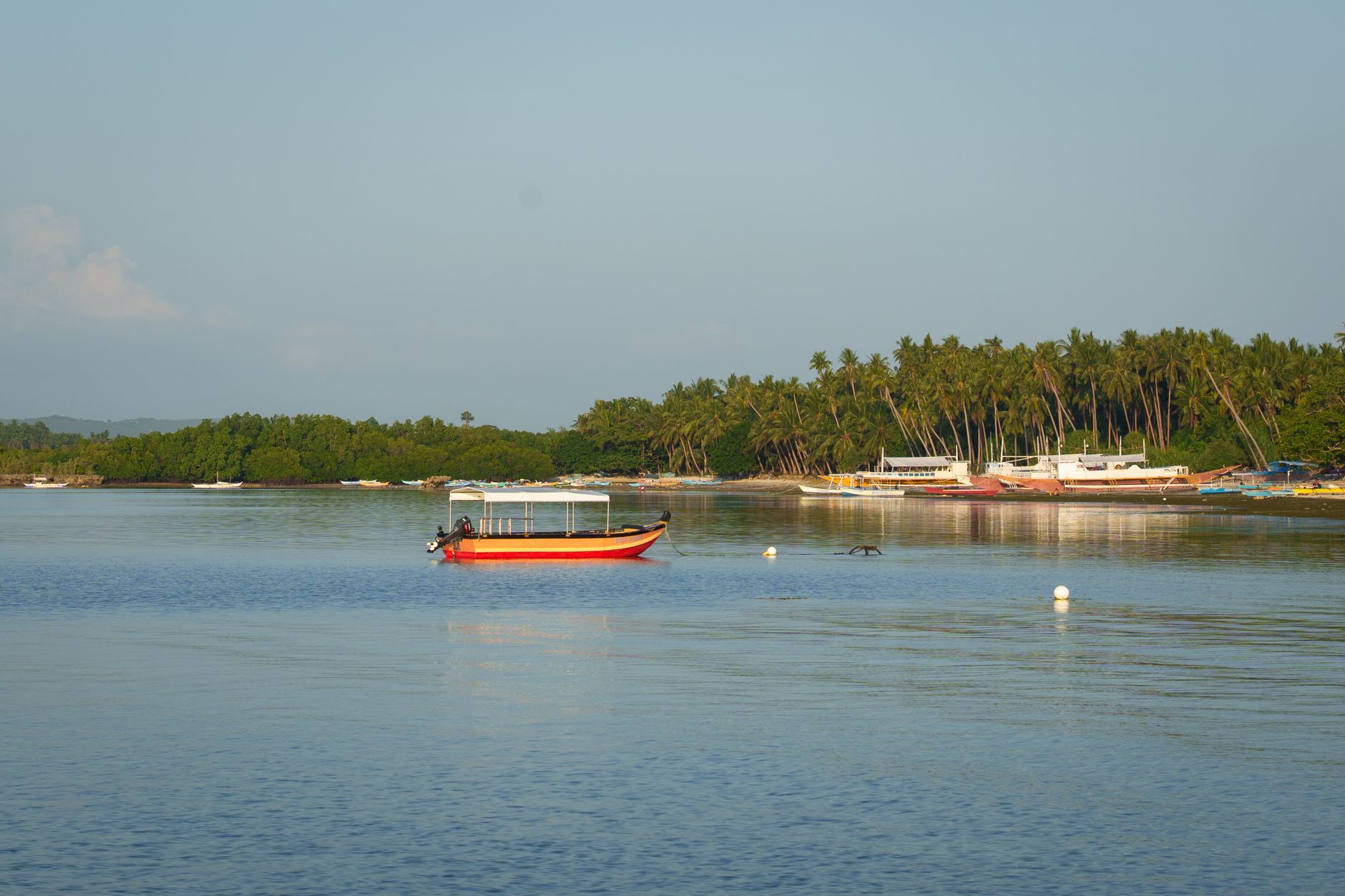
Jimbo Meador has a way of turning a cup of coffee into an afternoon of history. Sit down with him at an outdoor table, as one longtime acquaintance did in late 2023 at Refuge Coffee Shop next to Thomas Hospital in Fairhope, and the stories start almost immediately: shrimp nets and cast nets, schooners and stevedores, Jimmy Buffett and Winston Groom, and a warning about Mobile Bay that he delivers with the authority of someone who has spent eight decades on its water.
At 82, Meador is about as close to a true “Old Salt” as the Eastern Shore has. He grew up in Mobile, spent his summers in Point Clear, and has worked as an outdoor writer, fishing guide, boat designer, stevedore, Orvis dealer representative, shotgun representative, boat captain, eco-tourism expert, sailor, windsurfer and naturalist. The common thread is obvious. Nearly everything he has done has kept him on or near the water.
The Real-Life Inspiration Behind a Famous Book
Any conversation about Meador eventually arrives at Forrest Gump. The 1986 novel by the late Winston Groom, who grew up in Mobile and later lived in Point Clear, is dedicated to Meador and George Radcliff. Many people who know Meador have long believed that elements of the book’s title character were inspired by him, and it is a claim few around the Eastern Shore would argue with. The novel became the basis for the 1994 film starring Tom Hanks, which won six Academy Awards, including Best Picture.
Groom was one of several famous friends woven through Meador’s stories. His circle also included Jimmy Buffett, novelist and poet Jim Harrison, and legendary fly-fishing author and instructor Lefty Kreh, all of whom have since died, along with many others who are still living.
A Boyhood on the Bay
Meador’s father owned W.M. Meador and Company, a Mobile food brokerage that packaged Big Bill’s Rice and Beans. Jimbo attended University Military School in Mobile and spent much of his youth on the Eastern Shore and the Gulf Coast, fishing, pulling trawl nets for shrimp and crabs, and doing just about anything that put him on the water.
As a boy he lived in the country in Springhill, near what is now Municipal Park. “I fished the lake and set traps to catch raccoons to sell the pelts,” he says. “Davy Crockett was popular back then and every kid wanted a coonskin hat. There was nobody out there but me and the coons.”
At 14, he says, he was arrested by Mobile police for shooting ducks in the marsh where the lake is now. “It was within the city limits. They had extended the city limits westward, and I was unaware.”
Summers belonged to Battles Wharf. Meador slept on the family’s screen porch, and an older friend known as the Duke would wake him before daylight most mornings to fish, go floundering, pull a seine net, scoop shrimp from pilings for bait and check for jubilees, the rare natural event in which low oxygen drives flounder, crabs and shrimp into the shallows along the Eastern Shore.
“He made me my first cast net when I was five years old, and added to the length each year. He taught me how to throw it left-handed because he was left-handed,” Meador says. “We fished for speckled trout with Calcutta cane poles and a popping cork. We had a wooden skiff that we rowed to where we wanted to fish.” They sold their catch to Mr. Stern in Fairhope, he says, “and we never missed a jubilee.”
He remembers the old Tuveson’s Boat Works in Battles Wharf, the spot that is now PointClear Landing, where local families once bought boat gas. “Dad helped Mr. Tuveson buy that property,” Meador says, adding that his father also helped install the rail used to launch a big wooden catamaran there. “I played and fished in that creek growing up. After Tuveson took over, all the mullet fishermen kept their boats there. I kinda wished they had left it alone.”
A Knack for Speaking Up About Development
Meador has never been shy about pushing back when he thinks development threatens the places he loves. Years ago, when a sign went up on property near the Grand Hotel announcing the “Future Home of Bay View Condos,” Meador had his own sign made the next day and planted it on his family’s nearby land: “Future Home of Bay View Hog Farm, 300 Duroc, and Yorkshire Hogs.” The condo project was scrapped in favor of a development better suited to the area. His family later gave part of its property, once the site of a hotel, to the Presbyterian church where Bay Treat now stands.
His candor traveled with him. As Orvis’s regional representative for the entire Southern United States, he was invited to a development presentation in the 30-A area of Northwest Florida for the project that became WaterColor, where the developers hoped he would put a large Orvis store. Asked what he thought, he told them bluntly that they were “fixin’ to destroy the very reason people come here” by failing to protect the natural habitat and wildlife. After the meeting, he says, the developers hired a naturalist and redesigned the project to keep natural areas intact.
A Warning for Mobile Bay
Meador’s greatest passion today is the health of Mobile Bay and the Mobile-Tensaw River Delta, and he speaks about it with urgency. He blames rapid growth and the way stormwater is handled.
“We’ve paved, roofed, and asphalted most of Baldwin County. We’ve built concrete drains to carry the water as quickly as possible to tributaries that empty into the Bay,” he says. “There is no buffer for that water to filter through the ground naturally before it enters and contaminates the natural habitat.”
He explains that nitrogen, phosphorus and other pollutants over-fertilize algae and trigger large blooms. “Everything needs oxygen. These algae blooms reduce the oxygen levels in the water and also get on the gills of fish so they can’t breathe.”
He draws a sharp line between those die-offs and the jubilees he grew up with. “These are not jubilees we are having that are killing the fish,” he says, describing fish kills among top-water species like mullet caused by a lack of oxygen. “Jubilees involve bottom fish like flounder that don’t have a swim bladder. In jubilees, they recover when the conditions change. When the water gets to the point where nothing can survive, the Bay, as we know it, is history. We have to do better.”
For Meador, the key is grass. Submerged aquatic vegetation traps sediment, shelters juvenile shrimp, crabs and fish, and helps keep water clear, a role scientists and coastal managers have documented extensively. “Any place with grass beds will have clean water. The Delta is the last nursery ground,” he says. “It has a lot of invasive grasses, but it’s still grass. It’s the habitat for all our fisheries including shrimp, crabs, and fish.”
He compares the loss of the bay’s grass beds to throwing a tarp over a lawn. “It only takes a day or two for the grass to begin to die. It’s the same in the Bay. Grass has to have sunlight to have photosynthesis to live.” Then, true to form, he wraps it up: “That’s all I’ve got to say about that.”
To better understand what he was seeing in the Delta, Meador later earned certified master naturalist credentials through programs at the University of Southern Mississippi and the University of Florida. “If Alabama offered a Naturalist program, I would have gotten one there, too,” he says. He describes his style as plainspoken. “I’m not using any Latin. I just tell it like it is. I speak Jimbonics. What we need to do is protect the Bay.” He is a strong supporter of Mobile Baykeeper and has served on most of the region’s conservation boards at one time or another.
Tugboats, Stevedores and the Last Sailing Ship
In his early adult years, Meador worked as a tugboat captain pushing barges along the Intracoastal Waterway and the Mississippi River. “I have a 100-ton captain’s license, which afforded me lots of time off to hunt and fish. It suited my lifestyle,” he says.
He also went to work for Ryan Stevedoring in Mobile, hired by a man known as the “Rock of the Dock” after proving he could splice a rope. He was paired with Mr. Jansen, a Swede in his late 70s who had been bosun on the Chiquimula, a four-masted schooner Meador describes as the last sailing ship in Mobile. “A Bosun is the most important person besides the captain, on a ship,” Meador says. According to Meador, Jimmy Buffett’s grandfather had once captained the Chiquimula, which now lies underwater below a hill near Spanish Fort.
The two men made “save-alls,” nets hung outside a ship’s deck to catch cargo that fell overboard, working from the middle outward. Jansen always finished his side first, until the day Meador beat him. After that, they got along fine. Later, fishing in the Delta near the Chiquimula’s resting place, Meador had to bait Jansen’s hook because the old sailor’s hands were too big for the cricket can. “He was reflecting on his old sailing days, and I could see he was getting sad, so we moved to a new fishing spot.”
Ryan Stevedoring sent Meador to Wrightsville Beach, North Carolina, to supervise loading ammunition onto cargo ships bound for the Vietnam War. There he found himself living the pages of one of his favorite books, Robert Ruark’s The Old Man and the Boy. “The two years I was there, I lived everything in that book,” he says.
Promotions eventually landed him in a Mobile office in a coat and tie. One day he came home and told his wife, Lynn, “I think I’m going to go shrimp,” and he quit.
A Point Clear Love Story
Lynn, born Carolyn McPhillips, grew up in Point Clear near Zundel’s Wharf, where her father owned the grocery store that later became Boo Boo’s King Cole Club. She attended the old Point Clear School and went on to teach elementary school in Mobile, including at Mary B. Austin Elementary. For the past 15 years, Meador has been her caregiver as her health declined. “I’m paying her back for the free spirit lifestyle she allowed me to live,” he says.
It is a fitting line from a man whose life has been defined by the water, by friendship and by an unwillingness to stay quiet about what matters. Spend an hour with Jimbo Meador, and you come away with a notebook full of stories and a clearer sense of what the Eastern Shore stands to lose if Mobile Bay is not protected.