

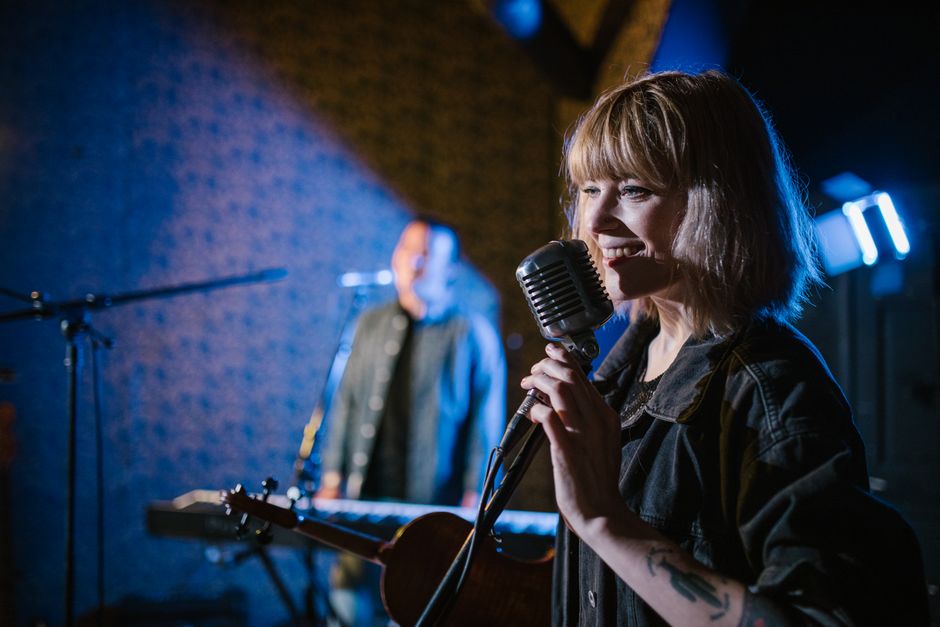
Some Gulf Coast musicians arrive by way of a plan; Rhonda Hart arrived by way of a friend’s phone call and a stage at the Flora-Bama. Two decades later, she is one of the most familiar faces on the coastal music scene — a songwriter with a platinum-selling past in Nashville who now plays five or more nights a week in bars, courtyards, and beach venues from Perdido Key to Pensacola Beach.
Hart’s story starts far from the Gulf. She grew up in a musical family, starting in Oregon before moving to Nashville in the 1980s and 1990s with her mother and stepfather, Tommy Collins — the honky-tonk songwriter and Grand Ole Opry favorite whose songs were cut by legends and who now rests in the Nashville Songwriters Hall of Fame. Collins’s influence shaped Hart’s writing the way growing up backstage shapes everything: quietly, permanently, and in song form.
The kitchen-table hit
It was in Nashville that Hart’s name entered the country-music record books. She and Deana Carter — roommates at the time, trading “girl talk” around a kitchen table — co-wrote “Did I Shave My Legs for This?”, the slyly funny song about romantic expectations colliding with a spouse glued to the game. The song became the title track of Carter’s debut album, released by Capitol Nashville on September 3, 1996 — an album that eventually earned 5× Platinum certification from the RIAA for U.S. sales exceeding five million copies, and whose lead single, “Strawberry Wine,” went to number one on the Billboard Hot Country chart.
The title track was released as the album’s final single in October 1997, but its afterlife has been remarkable. For the song’s 25th anniversary, the hit was reissued with guest appearances from a who’s-who of country women — Sara Evans, Lauren Alaina, Ashley McBryde, Terri Clark, and Martina McBride among them, with Vince Gill adding lead guitar — a measure of how deeply the kitchen-table anthem embedded itself in the genre.
For Hart, the credit sits comfortably alongside her other Nashville chapters: writing songs, playing in an all-girl band that included Carter, and absorbing the craft of a stepfather who turned honky-tonk storytelling into a Hall of Fame career.
From the road to the shore
By 2008, Hart was tired of the road. A friend’s invitation — “Come on down to the beach” — brought her to the Gulf Shores area, and a familiar institution kept her there: the Frank Brown International Songwriters’ Festival, the annual Flora-Bama gathering that draws writers from Nashville and beyond every November. She had known the festival as a songwriter; once she arrived, she credits the late Joe Gilchrist, the Flora-Bama co-owner and festival founder, with making her a permanent part of it. “The community spirit, the love of music, and how giving the people in the area are,” she says of what kept her. “Joe had that spirit, and it resonates.”
Gilchrist, who died in 2015, built the Flora-Bama into the Gulf Coast’s best-known musical crossroads, and the songwriters’ festival named for Frank Brown — the club’s legendary night watchman — remains one of the country’s great showcases for the people behind the songs. Hart has been involved ever since, playing the festival and the main room she has anchored every Wednesday night for more than a decade, from 6 to 10 p.m., a residency measured in years rather than months.
A working musician’s week
The week on the coast, for Hart, is a round of stages that most touring musicians would envy for its variety. Tuesdays find her at The Front Porch in Lillian with Elaine Petty. Wednesdays belong to the Flora-Bama’s main room. Thursdays run to Fresh Off the Boat or the SanBar Courtyard at SanRoc Cay Marina, where she plays with Smokin’ Elvis’ or the Smokey Otis Band. Other nights land her at the Purple Parrot, the Flora-Bama Yacht Club, or out with the Hartstrings, her three-piece band, at the Point Restaurant, Perdido Key spots, and venues along Pensacola Beach.
That schedule — five days a week, sometimes more — is a sentence no Nashville publisher would write into a plan, and exactly why it works. Coastal audiences reward presence: the same faces week after week, the requests remembered, the stories between songs told like family history. Hart’s voice does the heavy lifting, but it is the bright spirit and infectious personality regulars describe first when they recommend her to visitors.
Why the coast suits a songwriter
There is a case to be made that the Gulf Coast is quietly one of the best places in America to be a working musician. The venue density is remarkable — beach bars, marina courtyards, oyster rooms, and hotel stages within a short drive of each other — and the audiences mix tourists seeking a night out with locals who follow the players like season-ticket holders. The songwriters’ festival knits it together, giving the region a musical identity beyond the cover-band circuit.
Hart embodies that identity: a writer with a multi-platinum credit who treats a Wednesday residency with the seriousness of a Grand Ole Opry appearance, and a beach-town scene that repays her with two decades of steady work and a community that shows up.
For anyone building a week of live music on the coast, the recommendation writes itself: a Wednesday night at the Flora-Bama, a Thursday at SanRoc Cay, and an ear out for the Frank Brown festival each November. The voice you will hear — polished by Nashville, at home on the sand — belongs to Rhonda Hart, and it has been soundtracking the coast long enough to feel like part of the scenery. In the best possible way, it is.