

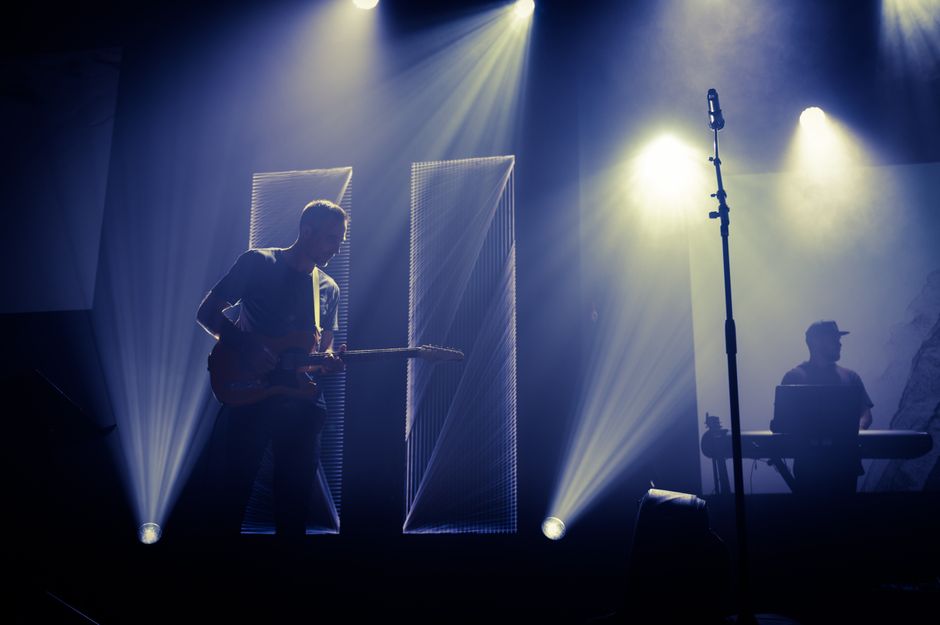
For more than half a century, Corky Hughes has been the guitarist other guitarists go hear. Ask around the Mobile music scene and the reviews are unanimous — but the man himself keeps his assessment of a lifetime in music to a single word: “Content.”
It fits. Hughes, a Mobile native whose low-key style is as well known locally as his playing, has spent five decades building a career one gig at a time — from a West Mobile roller rink to roadhouses across the South, from two grueling national tours with a Southern rock band to nearly 150 shows a year alongside singer-songwriter Grayson Capps. And his partnership with Capps, now in its 15th year, is about to yield its biggest project yet: “The Weight of the World,” Capps’ first album of original material in nine years, co-produced by Hughes and set for release in November.
Roller rinks and one-dollar bills
Hughes’ first stage was Skate Haven, the West Mobile skating rink where, in the mid-1970s, teenagers came as much for the live rock as for the skating. His first band, Home Brew, played Friday and Saturday nights there. He still remembers the set list, the exact guitar and amp he used, and how the owner settled up at the end of the night — carefully counting out $125 in one-dollar bills.
“A lot of bands played there, and it was usually either Friday or Saturday nights,” Hughes recalls. “It was very popular for teen-agers. It was a fun thing to do.”
He learned folk and country songs from his father, who played tenor banjo and guitar. But the adventurous rock of Led Zeppelin and the Allman Brothers Band pulled him in a harder direction, and a serious run at success followed with the Mobile-based band Excalibur.
The blues education
Before that, though, came an education no school could offer. In 1976, Hughes scored a union gig playing for patients and staff at Searcy Hospital — and it connected him with saxophonist and bandleader Theodore Arthur Jr., a Mobile legend known for his decades with the Excelsior Band but also an in-demand sideman who had played with B.B. King, Bobby “Blue” Bland and Ike & Tina Turner.
Touring the region as Theodore Arthur and Reality, the young guitarist played blues, R&B, funk and disco across the South — horn sections and background singers, packed roadhouses down dirt roads, a couple of hundred people ready to party in the middle of the woods. Arthur became a mentor, and the association led to a face-to-face meeting with B.B. King in New Orleans.
Famous guitarists kept crossing his path. He and his wife Nancy ran into Led Zeppelin’s Jimmy Page in a Crescent City shop. Jeff Beck once came out to hear the Tone Poems-era band Hughes played with in Atlanta. And in Florida, Allman Brothers great Dickey Betts joined Excalibur on stage to tear through “Stormy Monday” and “Southbound.”
Two tours with Jim Dandy
The most eye-opening chapter came in 1984, when a re-formed Excalibur opened for a version of Black Oak Arkansas — officially, for legal reasons, “Jim Dandy’s Black Oak Arkansas,” fronted by the famously boisterous Jim Mangrum. Hughes speaks highly of Mangrum to this day, 42 years after Mangrum invited him to join as a third guitarist for two tours that “seemed to last forever.”
The band had been wildly popular in the early 1970s; a decade later, Mangrum and founding member Rickie Lee Reynolds were chasing a comeback with a relentless schedule of clubs, festivals and theaters. Hughes saw every state but Alaska, Hawaii and Maine within months. Life on the road — bunks on the bus at first, then a downsized van packed with bandmates and their laundry — eventually wore him down.
“It just got to be too crazy, and I didn’t want to do it anymore,” he says. “If we had stayed on the bus, I probably would have stayed in the band a lot longer.”
Atlanta, then home
Black Oak’s loss became Mobile’s gain, eventually. Hughes and Nancy relocated first to Atlanta, where he played with the Tone Poets and Darryl Rhoades and the Mighty, Mighty, Mighty Men from Glad. They came home to Mobile in 1992, and Hughes promptly joined Kevin Danzig and the Heard on a Department of Defense Mediterranean tour — performing at military facilities in Egypt, Turkey, Greece and Italy, and at the 1992 World’s Fair in Seville, Spain.
Back home, his improvisational skills powered the jam band Kung Fu Mama for a decade. He has since played with a long list of Gulf Coast artists — Carlos Washington’s Giant People, Star Cullars, Molly Thomas, Jimmy Hall and Wet Willie, Bo Diddley — and can be heard on records by Beverly Jo Scott, Lisa Mills and violinist Tom Morley, along with the Americana collective Willie Sugarcapps.
The Grayson Capps partnership
Kung Fu Mama is also what connected him with Grayson Capps. In 2011, Capps — the Fairhope-based songwriter who emerged from the New Orleans scene — had hired Hughes’ former Kung Fu Mama bandmates, and when his guitarist stepped away, the call to Hughes was obvious.
Neither expected how natural it would feel. “He is all about the song and nothing else,” Capps says. “I’ve never played with anybody where it was so effortless.” The two musicians describe their interplay in visual terms: “We both frame each other,” Capps says. “When I’m singing he’s creating a frame for my vocals… and then when I’m not singing it’s natural for me to do the same for him, to give him a canvas to paint.”
The friendship matters as much as the fretwork. “It’s also whether you can get along in the van and enjoy spending day after day with each other,” Capps says. “And Corky’s just such a humble, nice dude and has become one of my best friends. He’s unassuming… and one of the best guitar players I’ve ever heard in my life.”
The two play at least 150 shows a year together, as a duo and with a full band, anchoring the Sunday sessions in season at the Frog Pond at Blue Moon Farm in Silverhill and touring repeatedly around the country and through Europe — Holland, Germany, Belgium, Italy and Norway. Capps estimates they have traveled close to a million miles together, to the moon and back twice.
Less is more
Now Hughes’ empathic guitar lines color “The Weight of the World,” the new Capps album recorded at Dauphin Street Sound in Mobile and co-produced by Hughes and Ryan Avinger. It is the latest entry in a catalogue of sideman work that has made Hughes one of the most respected players on the Gulf Coast — respected not just for speed or flash, but for taste.
“I try to not overplay,” he says. “It’s very important. I try to play something meaningful that’s not just a bunch of notes. Sometimes if a guitar solo goes too long, you might wind up just playing random, stock licks. I try to just fill that space that’s available and then move on.”
Like his one-word answer about contentment, it is pithy, precise and satisfying. He has already said what he wanted to say.