

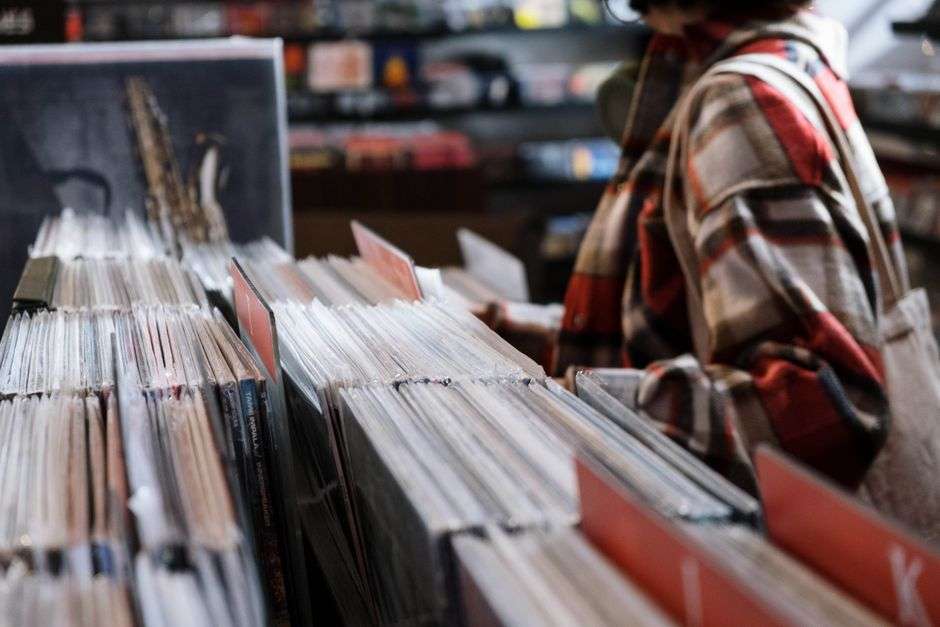
Browsers flipping through the vinyl at Mobile Records in Midtown may chat with the shopkeeper about a pressing or a label without realizing they’re talking to a man who has spent six decades inside the music business — as a guitarist, singer, songwriter, producer, label owner, TV host and, briefly, the star of one of the most notorious musicals ever staged.
From Melbourne Architecture School to the Lead in Hair
Keith Glass grew up in Melbourne, Australia, and was in a popular local rock band called Camp-Act in the late 1960s while studying architectural design at the Royal Melbourne Institute of Technology. In his fourth year, an open casting call for the stage production Hair changed everything. He turned up with an acoustic guitar, sang a song and read some dialogue, and the next day was offered the lead role.
He postponed his studies, planning to return in six months. He never did. The production drew attention in 1969 for its brief full-frontal nudity — a novelty at the time — and among the curious one night was a visitor in town filming a movie: Mick Jagger, in Australia shooting Ned Kelly. “Mick Jagger saw me naked,” Glass likes to tease, before conceding it depends on which way Jagger was looking at the moment. “He probably saw me because I was front and center.”
Records, Labels and a Life on Records
Theater gave way to the record business. Glass and a partner opened an influential Melbourne record store, which led to starting a label to record and distribute other artists. His production credits include early work by Nick Cave’s band The Birthday Party and a live album by Texas singer-songwriters Jimmie Dale Gilmore and Butch Hancock. He hosted a music TV show in Australia, released numerous albums under his own name and as a duo with lifelong friend Mick Hamilton, and wrote for Rhythms Magazine.
Coastal Alabama entered the picture in 2001, when Glass performed at the Frank Brown International Songwriters Festival, whose home base is the Flora-Bama Lounge. Enchanted by the area — and by the former Betty Breslin, who became his wife — he relocated to Mobile, spent his first decade here playing music and hunting record collections across the region, and watched the audience at record shows grow noticeably younger. That was his cue: he opened the shop near the intersection of Sage Avenue and Emogene Street in 2012, and it was an instant hit.
Nearly Half a Million Records
Ask how many records the store holds and Glass won’t venture a guess. His longtime partner, Nick Piechowski, will: roughly 300,000 albums on the showroom floor, another 100,000 in the back room and perhaps 60,000 45s — close to half a million records under one roof. Visitors from Europe, Glass says, have told him it is one of the best record shops, if not the best, in the world.
The shop’s success has never been about novelty. Glass inspects and knows his inventory the way he learned to as a collector — traveling the region sorting through countless collections, always on the lookout for treasures or at least something that could turn a modest profit. The selection spans genres and decades, which is precisely the point: a store built by a musician for people who care about music.
An Architect After All
After more than 20 years in Mobile, Glass is preparing to return to Australia for good. The pace — seven days a week in his late 70s — has become difficult to sustain, and family and the place he calls home are pulling him back. A new residence awaits in Bacchus Marsh, on the outskirts of Melbourne, and he designed it himself, picking up the architectural training he abandoned 55 years ago for a turn in the spotlight: a small, simple house in the style of Mies van der Rohe, with clean angles, no ornamentation and a view over parkland.
He plans to leave the shop in Nick Piechowski’s capable hands. The farewell comes with characteristic humor — work at his age “is not for the faint of heart,” he says, before admitting he stopped at an estate sale that very morning and bought a stack of records.
Whatever happens next, Mobile has been the beneficiary of an extraordinary detour: an Australian rocker who followed a festival gig to the Gulf Coast and stayed two decades, leaving behind one of the deepest record collections in the Southeast.