
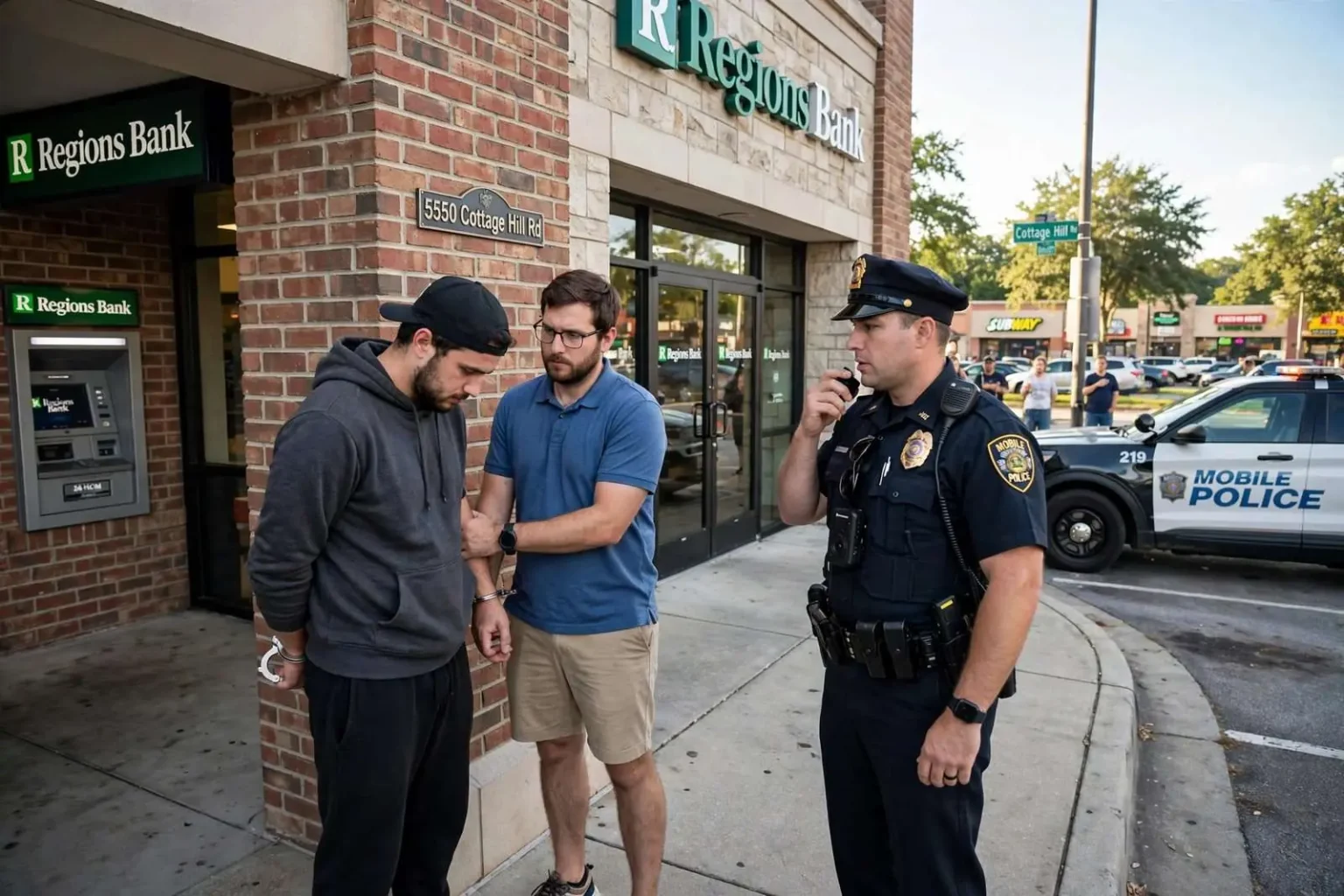
A would-be bank robber’s getaway lasted only a few steps on an August afternoon in 2021, after a bystander stepped in and held him for police, according to the Mobile Police Department. Officers were called to the Regions Bank branch on Cottage Hill Road at about 2:19 p.m. after a report of a robbery inside, and by the time patrol units arrived, the suspect was already back in the lobby — detained by a customer who refused to let him leave.
Police said a male suspect entered the branch and told a teller he had a knife before demanding cash. The teller complied and handed over money. No one inside the bank was reported injured during the encounter. As the suspect tried to flee on foot, police said a “Good Samaritan” stopped him, escorted him back into the bank, and kept him there until officers arrived and took him into custody. The money taken in the robbery was recovered in full, investigators said. Police did not immediately release the suspect’s name pending formal charges.
The sequence — a threat, a quick handover of cash and an arrest before the suspect reached the parking lot — is unusual in bank robberies, where suspects more often escape in vehicles and are identified later through surveillance footage and tips. In this case, the entire incident closed within minutes, in front of the witnesses who had just watched it happen.
The Scene on Cottage Hill Road
The Regions Bank branch sits along Cottage Hill Road, one of west Mobile’s busiest commercial arteries, a multi-lane corridor lined with shopping centers, restaurants, churches and residential neighborhoods branching off in both directions. Bank branches along corridors like this one see steady weekday traffic, and a mid-afternoon report of a robbery brings a heavy emergency response — multiple patrol units, supervisors and investigators — to a strip of road that is rarely quiet. At 2:19 p.m. on an August weekday, the branch would have been staffed for full operations, with tellers at their stations and customers in line for ordinary errands.
For the tellers involved, a robbery demand is the moment their training is designed for. Bank employees are instructed to comply with demands, hand over the cash and stay observant — noting descriptions, direction of flight and anything that helps investigators — rather than to resist or trigger confrontations. That the teller complied and no one was injured follows the standard script that banks drill precisely because cash is replaceable and people are not. The full recovery of the stolen money, confirmed by investigators afterward, meant the institution’s loss was zero, and the case against the suspect gained its strongest physical evidence: the cash itself, recovered from the man police say took it.
The bystander’s intervention is the part of the case that stands out. Police credited a “Good Samaritan” — a term departments use for civilians who step in — with stopping the fleeing suspect, walking him back into the bank and holding him there until officers arrived. Civilian detentions occupy tricky legal territory in Alabama, where citizens can lawfully detain someone they have witnessed committing a felony, but the line between a lawful detention and a dangerous confrontation is thin, especially when the suspect has claimed to be armed. In this instance the intervention ended without injury, and it gave police something they rarely get in robbery cases: a suspect in custody with the proceeds on him, identified by an eyewitness standing next to him.
What the Suspect Faces
Robbery in Alabama is a felony with severe consequences, and claiming to possess a weapon — even when no weapon is shown — elevates the crime. Under state law, a robbery committed while the defendant claims to be armed with a dangerous weapon can be charged as first-degree robbery, a class A felony punishable by decades in prison. The claim of a knife, made to force the teller’s compliance, is exactly the kind of statement prosecutors use to seek the higher charge, and the fact that no knife was ever displayed does not soften the offense in the eyes of the law; the threat itself is what makes the robbery.
Investigators also had the benefit of a complete evidentiary picture. Bank branch cameras capture the lobby and teller line from multiple angles, and the transaction records from the drawer document exactly how much cash left the bank. With the suspect detained at the scene, officers could photograph him, recover the money and take witness statements while memories were fresh. Cases built this way move quickly through the court system, and prosecutors typically present them to a grand jury within weeks. The decision not to release the suspect’s name immediately pending formal charges is standard procedure, allowing booking and charging paperwork to catch up before public identification.
For the Mobile Police Department, the afternoon demonstrated the value of fast dispatch and short travel times on the west side of the city. Cottage Hill Road branches are minutes from several patrol beats, and officers arriving to find a suspect already detained avoid the more dangerous alternative — a search for a fleeing robber through dense afternoon traffic. Departments across the Gulf Coast regularly emphasize the same point in public safety messaging: the fastest way to turn a robbery into an arrest is information, and the second fastest, when circumstances allow, is a witness who keeps the suspect where he stands.
Bank Robbery in the Local Context
Bank robberies in Mobile follow a pattern familiar to investigators nationwide: they are often impulsive, committed by individuals in financial distress, and solved quickly when cameras, witnesses and the banks’ own silent alarm systems work together. Branches are required to maintain security measures, from cameras and time-delay locks to dye packs and GPS trackers placed in with the cash, and the money a robber takes is frequently marked and traceable. The full recovery of funds in this case reflects those layers of protection doing their job.
The Good Samaritan’s role also highlights a reality of mid-afternoon commercial corridors: robbery scenes are full of witnesses. Customers in line, employees of neighboring businesses and drivers on Cottage Hill Road all become sources of information, and in this case one of them became the difference between an open case and a closed one. Police departments generally walk a careful line in talking about such interventions, praising the outcome while cautioning the public that confronting a fleeing suspect — particularly one who has claimed to be armed — carries real risk, and that calling 911 and providing a description and direction of travel is the safer path.
By the end of that August afternoon, the Regions Bank branch had reopened its normal rhythm: tellers back at their stations, the recovered cash logged into evidence, and a suspect in the Mobile County Metro Jail facing robbery charges that his own seven-minute crime spree had made easy to prove. The teller who complied with training, the customer who refused to look away and the officers who arrived within minutes each played a part in an outcome that ended with no injuries, no losses and no getaway.
After the Arrest
Once formal charges are filed, the case moves into the Mobile County court system, where the defendant faces an arraignment, the appointment of counsel or the retention of a private attorney, and a schedule of hearings leading toward trial or a plea. In robbery prosecutions where the suspect was captured at the scene with the stolen money, plea negotiations tend to resolve the case relatively quickly, because the evidence leaves little room for defense. Judges weigh the defendant’s record, the terror experienced by the employees involved and the claim of a weapon in setting any sentence, and victim-impact statements from the tellers who lived through the encounter become part of the record.
The broader lesson for area businesses is one that security consultants repeat after every incident like it: the layers that worked here — employee compliance training, functioning cameras, alert witnesses and rapid police response — are the same layers that failed bank robberies elsewhere in the region lacked. Corridors like Cottage Hill Road, with their steady flow of customers and heavy patrol presence, give robbers little time and less cover. A suspect who walks into a busy branch mid-afternoon is betting against all of those advantages at once, and on this August day in 2021, he lost the bet before he reached the door.
For Mobile residents, the story ends the way the best local crime stories do: nobody hurt, money returned, an arrest made, and a reminder that the person standing next to you in line at the bank may be the one who decides how the day ends. The Mobile Police Department’s account of the incident gave credit where it was due — to a teller who followed procedure, to a citizen who acted, and to a patrol response that arrived in time to accept the handoff.


