Goodwill Gulf Coast Receives $5 Million Gift, Largest Donation in Its History
Goodwill Gulf Coast has received an unexpected $5 million donation from philanthropist MacKenzie Scott, the largest single gift in the Mobile-based nonprofit's history.
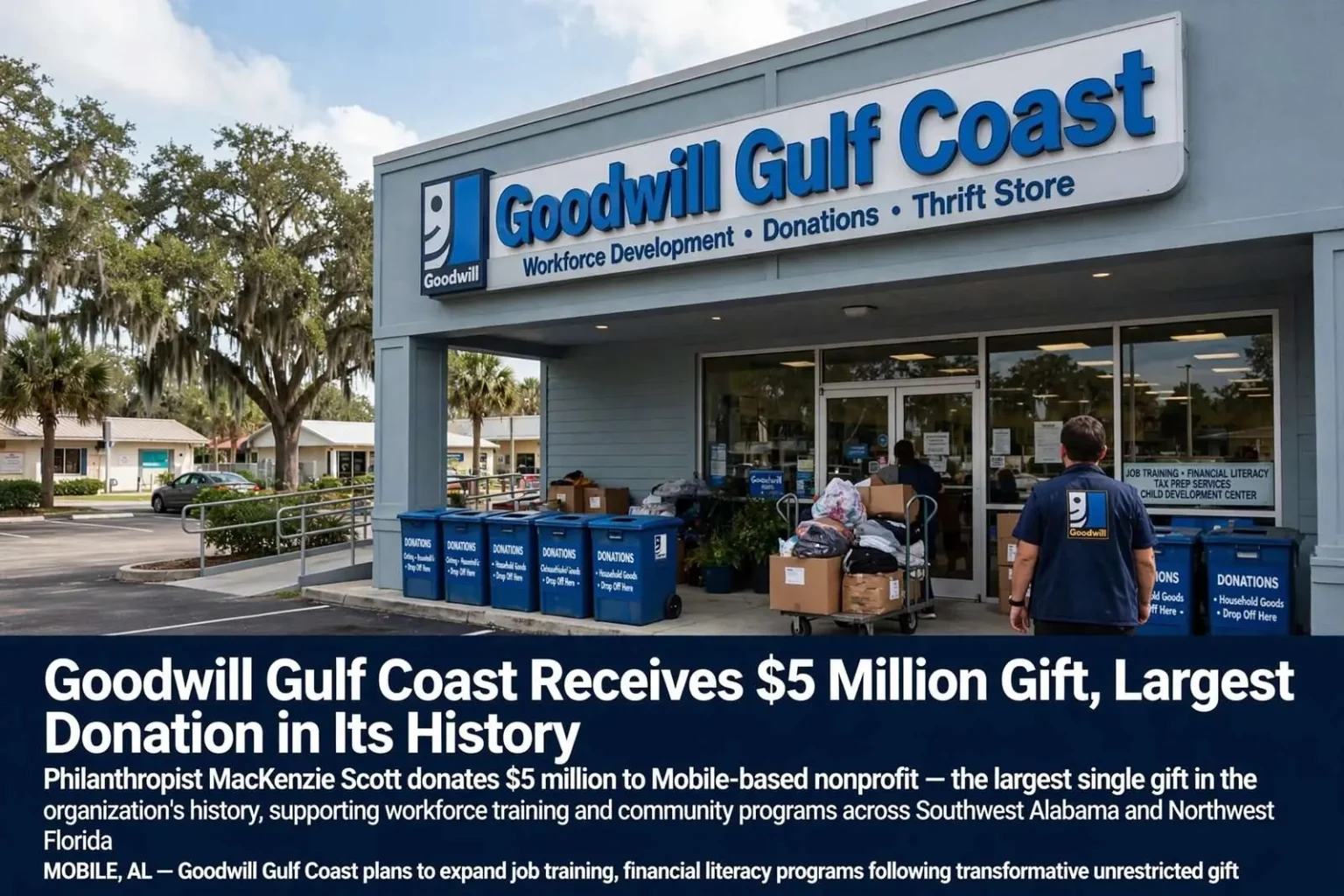
Goodwill Gulf Coast has received a $5 million donation from philanthropist MacKenzie Scott, the largest single gift the Mobile-based nonprofit has ever received. “It’s the largest in our history by a long shot,” said Frank Harkins, president and CEO of Goodwill Gulf Coast. “We’re very grateful.” The gift dwarfs anything the organization has raised in its decades of operation along the Gulf Coast, and it arrived with few strings and little warning.
Harkins said he is not aware of any prior connection between Scott and the region the organization serves across Southwest Alabama and Northwest Florida. He said Goodwill Gulf Coast first learned a gift was coming through a call from a third party, and the money followed shortly after. The indirect approach is characteristic of Scott, whose giving operation has become known for quiet research, sudden notifications and unrestricted gifts that leave recipient boards free to spend the money as they see fit.
Scott, an author and philanthropist who was previously married to Amazon founder Jeff Bezos, pledged in 2020 to give away the bulk of her fortune and has directed billions of dollars to hundreds of nonprofits, colleges and community organizations across the country. Goodwill Gulf Coast is among the local groups singled out for support, part of a giving strategy that has focused heavily on organizations serving low-income communities, workforce training and racial equity. Her team has emphasized speed over ceremony, often informing recipients only days before gifts are announced publicly.
Far more than a thrift store
Goodwill Gulf Coast serves roughly 11,000 people a year across seven counties in Alabama and three counties in Northwest Florida, offering far more than the retail stores most residents associate with the Goodwill name. “Most people think of us as a thrift store, but we’re much more than a thrift store,” Harkins said. “We do workforce development for the community, and pre-COVID we prepared 600 individuals with jobs. With COVID this year, we’ve reduced that number to about 425.”
The donated goods that fill the organization’s stores are, in effect, the fuel for its mission. Sales revenue funds job training, employment placement and support services for people facing barriers to work, whether those barriers are disabilities, lack of education, criminal records or long absences from the workforce. Every bag of clothing dropped at a Gulf Coast donation center translates directly into program funding.
Beyond job training and placement, the organization provides financial literacy classes and free income tax preparation help to the public. Its tax assistance work each spring helps working families claim credits they are often entitled to but frequently miss, putting real money back into household budgets across the region. Financial literacy courses cover budgeting, credit and saving, skills that program graduates carry into the jobs the organization helps them find.
It also operates a Child Development Center in Spring Hill that offers preschool education for local families, and has distributed medical equipment to roughly 3,000 individuals in need. The equipment program, which provides items such as wheelchairs and other durable medical goods to people who cannot afford them, fills a gap that neither insurance nor charity care always reaches.
The pandemic hit the organization’s operations and finances hard this year, Harkins said, forcing the closure of its facilities for about 40 days. “It was a huge blow financially to all of us,” he said. Store closures cut off the retail revenue that funds the mission almost overnight, while demand for employment services climbed as layoffs swept the region. The organization retained its core programs through the shutdown and worked to resume services as quickly as public health rules allowed.
Planning for an unexpected windfall
Harkins said Goodwill Gulf Coast’s volunteer board of directors is still developing a plan for how to put the unexpected gift to use, with an eye toward making the money stretch as far as possible to support the organization’s mission. “We were not expecting this,” Harkins said. “We’ll be coming up with a plan to maximize the use of the money. It’s a blessing, and we should treat it as such.”
Because the gift is unrestricted, the board can direct it wherever the need is greatest, whether that means rebuilding pandemic-depleted reserves, expanding job training capacity, upgrading facilities or seeding new programs. Nonprofit financial advisors generally recommend that boards receiving transformational gifts take deliberate time before committing them, and Harkins’ comments suggested the organization intends to do exactly that rather than spend in haste.
For the region, the timing is significant. The pandemic year has left unemployment elevated across Southwest Alabama and the Florida Panhandle, and workforce development organizations have been stretched thin trying to retrain workers whose industries contracted. A five-million-dollar infusion into the area’s largest workforce nonprofit arrives at precisely the moment its services are most in demand.
The gift also puts Goodwill Gulf Coast in the company of a distinctive cohort of recipients nationally. Scott’s philanthropy has famously favored organizations working on the ground in overlooked communities over large, well-endowed institutions, and her researchers have looked for evidence that a nonprofit delivers measurable benefit to people with low incomes. That a Mobile-based organization made the list speaks, Harkins suggested, to the reach and quality of the work being done along the Gulf Coast.
Scott’s giving has reshaped nonprofit fundraising conversations across the country since her 2020 pledge, prompting organizations of every size to consider how they would absorb and deploy a sudden nine-figure-scale national giving sweep that has now, in a small way, reached the Gulf Coast. For Goodwill Gulf Coast, the immediate work ahead is practical: finishing the board’s plan, communicating with staff and donors, and turning the largest gift in its history into jobs, classes and services for the roughly 11,000 people it serves each year.
The counties Goodwill Gulf Coast covers include the Mobile and Baldwin County markets on the Alabama side, stretching across Southwest Alabama and into the western reach of the Florida Panhandle. That service footprint spans dense urban neighborhoods, suburban growth corridors and rural communities where the nearest job training program may be an hour’s drive away. The organization’s retail stores double as donation points and as training grounds, giving program participants real workplace experience in retail operations, warehousing, donation processing and customer service before they move on to outside employment.
Workforce development experts note that Goodwill’s model is unusual among nonprofits because it largely funds itself. Rather than depending primarily on grants and donations, the organization converts community donations of clothing and household goods into revenue, which then pays for programs. That self-sustaining engine is also what made the pandemic so damaging: when stores closed, the mission funding closed with them, even as the need for job placement services spiked.
What the money could mean locally
The $5 million gift represents a scale of funding that could transform the organization’s annual program budget. Depending on how the board allocates it, the money could support hundreds of additional job placements over multiple years, expand the financial literacy and tax preparation programs that reach working families, or shore up the Child Development Center in Spring Hill, which provides preschool education that doubles as child care enabling parents to work or train.
The medical equipment distribution program, which has already served roughly 3,000 individuals, is another area where added funding could expand reach. Durable medical equipment such as wheelchairs, walkers and hospital beds is expensive new and often sits unused in storage once a patient no longer needs it, making donation-and-refurbishment programs a cost-effective way to serve people whose insurance will not cover the items they need.
Community leaders in Mobile said the gift is also a signal about the region itself. National philanthropies have historically concentrated their largest gifts in major metropolitan areas, and a five-million-dollar grant landing in Mobile suggests that Scott’s researchers looked carefully at what Goodwill Gulf Coast delivers for its service area. For local donors, the endorsement may carry weight: large national gifts often prompt matching interest from local foundations and individuals who want to be part of scaling proven organizations.
Scott’s approach to philanthropy has drawn attention precisely because it departs from convention. She has given without naming requirements, without requiring logos or ceremonies, and with public letters explaining her philosophy rather than press events. Recipients are frequently small to mid-sized organizations led by people from the communities they serve. Her team’s vetting process, conducted largely out of public view, has repeatedly identified organizations whose program results stand out within their fields, and Goodwill Gulf Coast’s workforce numbers placed it among them.
For now, the organization’s stores have reopened, its job training programs are rebuilding toward pre-pandemic levels, and its staff is adjusting to the reality that the largest gift in its history arrived in the middle of the hardest year it has faced. Harkins said the gratitude the organization feels is matched by a sense of responsibility to the donors and shoppers whose everyday contributions built the organization long before a billionaire’s check arrived, and to the 11,000 people a year who count on the mission continuing no matter what.