
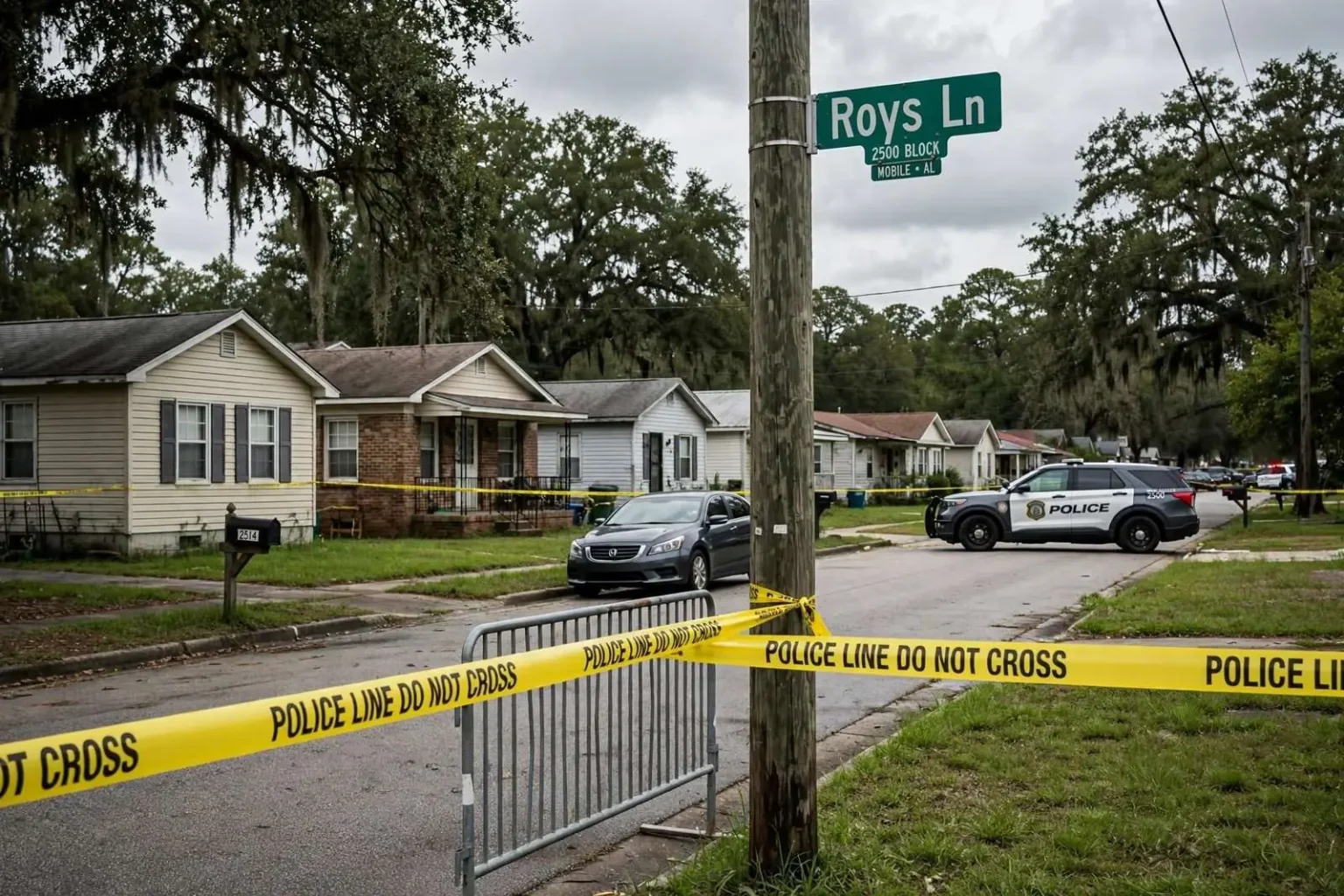
A Mobile judge has ruled that prosecutors presented enough evidence to move the case of a man accused in a fatal shooting on Roys Lane toward a grand jury, clearing the way for jurors to consider a murder indictment. The ruling came after a preliminary hearing for John Howell, the Mobile man accused in the April shooting that killed 51-year-old Jacob Griffith. With the finding of probable cause, the case now leaves the district court level and enters the next phase of Alabama’s criminal process.
The decision does not determine guilt or innocence. It is a procedural checkpoint, one of the first in any felony case, and it signals only that the judge who heard the evidence believed a crime occurred and that there is reason to believe the person charged committed it. From here, the question of a formal murder indictment rests with a Mobile County grand jury, an entirely separate body that will review the evidence independently.
For residents of the Roys Lane area, the hearing marked the first public step in a case that began with violence on a street many there describe as quiet and unremarkable. The proceedings also offered a window into how felony cases move through the local courts — a process that can stretch over months and involves multiple layers of review before any trial ever begins.
What Happened on Roys Lane
Roys Lane is a residential street just off Dauphin Island Parkway in Mobile, sitting in a part of the city where modest homes, small lots and neighborhood side streets branch off one of the city’s busiest southern corridors. Dauphin Island Parkway, often called D-I-P by locals, runs south from the city toward the communities along Mobile Bay, carrying commuter and commercial traffic past residential pockets like the one along Roys Lane.
According to prosecutors, the shooting that killed Jacob Griffith occurred in April. Griffith was 51 years old. Details about the circumstances of the shooting have been limited in public filings, which is common in the early stages of a murder case, when investigators protect the integrity of their work and prosecutors disclose evidence selectively.
Neighbors described Roys Lane as a typically quiet street, and said the shooting was out of character for the area. Residents of streets like Roys Lane often know one another by name, and violent crime on such blocks tends to ripple through the surrounding community long after police tape comes down. The April killing stood out precisely because the street sees so little of it.
The loss has been felt among those who live nearby, and the legal proceedings that follow — hearings, grand jury review, and potentially a trial — will keep the case in the public record for the foreseeable future. Each stage brings renewed attention to a neighborhood that, by the account of the people who live there, rarely makes headlines.
The Preliminary Hearing and What It Decided
A preliminary hearing is a short but important proceeding held in district court. At such a hearing, a judge examines whether there is probable cause to believe a crime occurred and that the person charged committed it. It is a lower bar than the proof required for a conviction, and it is not a finding of guilt. Defense attorneys frequently use the hearing to test the strength of the state’s evidence and to lock in testimony, while prosecutors need only present enough to satisfy the probable-cause standard.
In Alabama, felony cases generally begin in district court, where bond is set and a preliminary hearing is scheduled unless the case is directly indicted by a grand jury first. If a judge finds probable cause, as happened here, the case is bound over to the grand jury. If the judge finds the evidence lacking, the charge can be dismissed — though prosecutors retain the option to take the case to the grand jury anyway in some circumstances. That structure is meant to act as an early filter on felony prosecutions.
The hearing also serves families of victims in practical ways. It is often the first time relatives hear evidence presented publicly, and the first time the sequence of events is laid out on the record. At the same time, the limited scope of the proceeding can frustrate expectations, because the judge is not weighing whether the state can prove its case beyond a reasonable doubt — only whether there is probable cause.
What Happens Next: The Grand Jury
With the judge finding sufficient evidence at the preliminary hearing, the case now moves to a Mobile County grand jury, which will independently decide whether to hand up a formal murder indictment against Howell. A grand jury does not determine guilt or innocence; its role is to weigh whether there is enough evidence to bring formal charges forward for trial.
Grand juries in Alabama are convened by the district attorney’s office and sit for defined terms. The proceedings are closed to the public and the press, and defense attorneys are generally not present. Prosecutors present evidence and witnesses, and the jurors — a panel of local citizens — vote on whether the evidence justifies an indictment, known formally in Alabama as a true bill.
That closed-door character often surprises members of the public who follow cases in the news. Unlike a trial, there is no public argument from the defense, no judge ruling on evidence in real time, and no verdict announced in open court. The first sign that a grand jury has acted usually comes when an indictment is filed and an arraignment is scheduled.
If the grand jury votes to indict, the case would proceed toward Mobile County Circuit Court, where felony trials are held. At that point the defendant would be formally arraigned on the indictment and enter a plea, and the case would enter the long middle stretch of the criminal process: motion practice, discovery, pretrial hearings, and — if no plea agreement is reached — trial.
How Murder Cases Move Through the Mobile County Courts
Felony prosecutions in Mobile County can take many months, and sometimes longer, between indictment and trial. Scheduling depends on the court’s docket, the complexity of the evidence, forensic testing timelines, and pretrial motions filed by both sides. Murder cases in particular often involve extensive investigation records, witness interviews, and forensic workups that take time to compile and review.
Along the way, defense counsel typically files discovery requests to obtain the state’s evidence, and may challenge the admissibility of particular items before trial. Judges hold hearings on those motions, and settlement discussions — plea negotiations — can continue right up to the trial date. Many cases resolve by plea; others proceed to a jury trial, where the state must prove guilt beyond a reasonable doubt.
The Presumption of Innocence
Howell has not been convicted of any crime, and as the case heads to the grand jury, the outcome remains undetermined. Every person charged with a crime in the United States is presumed innocent until proven guilty, and the burden rests entirely on the state at every stage that involves a finding of culpability. Neither the preliminary hearing nor a grand jury indictment changes that presumption.
The distinction matters for how the public reads developments in the case. A probable-cause finding says the judge believed the evidence met a low threshold. An indictment, if one comes, would say a group of citizens believed the evidence justified a trial. Neither is a verdict, and both are ordinary way stations in the path a felony case follows.
What the Case Means for the Neighborhood
For the streets around Dauphin Island Parkway, the case’s progress will be watched by residents still coming to terms with what happened in April. Violent incidents on quiet residential blocks tend to leave lasting impressions, and the slow rhythm of the courts means the neighborhood will live with the case’s presence — hearing dates, news coverage, courthouse outcomes — for a long time to come.
Mobile police continue to encourage residents with information about violent crime in their areas to come forward, whether through direct contact with investigators or through anonymous tip channels. Information from residents has historically played a decisive role in moving cases from an initial incident to an arrest, particularly in shootings where eyewitness accounts are central.
The Legal Road Ahead
The next publicly visible milestone will be the grand jury’s decision. If an indictment is handed up, an arraignment in Mobile County Circuit Court would follow, and a trial date would eventually be set. If the grand jury declines to indict, prosecutors could revisit the evidence or take other investigative steps, though the case would then stall at that threshold.
Until then, the facts established at the preliminary hearing stand as the public outline of the state’s case: an April shooting on a quiet street off Dauphin Island Parkway, a 51-year-old man killed, and a Mobile man now facing the prospect of a murder indictment. The courts will determine, in due course and by their own standards of proof, what follows.
Members of the public seeking information about the case can follow filings through the Mobile County court system, where docket entries track each stage from grand jury action through trial. For the family of Jacob Griffith and for the residents of Roys Lane, the process is deliberate by design — slow, procedural, and methodical — but it is the path Alabama law provides for answering, conclusively, what happened and who is responsible.


