Grove Hill Hospital Urges Donors to Tap State Tax Credit Before 2027 Cap Fills
Grove Hill Rural Emergency Hospital is urging donors to use Alabama's Rural Hospital Investment Tax Credit Program before contribution caps rise and fill up again in 2027.
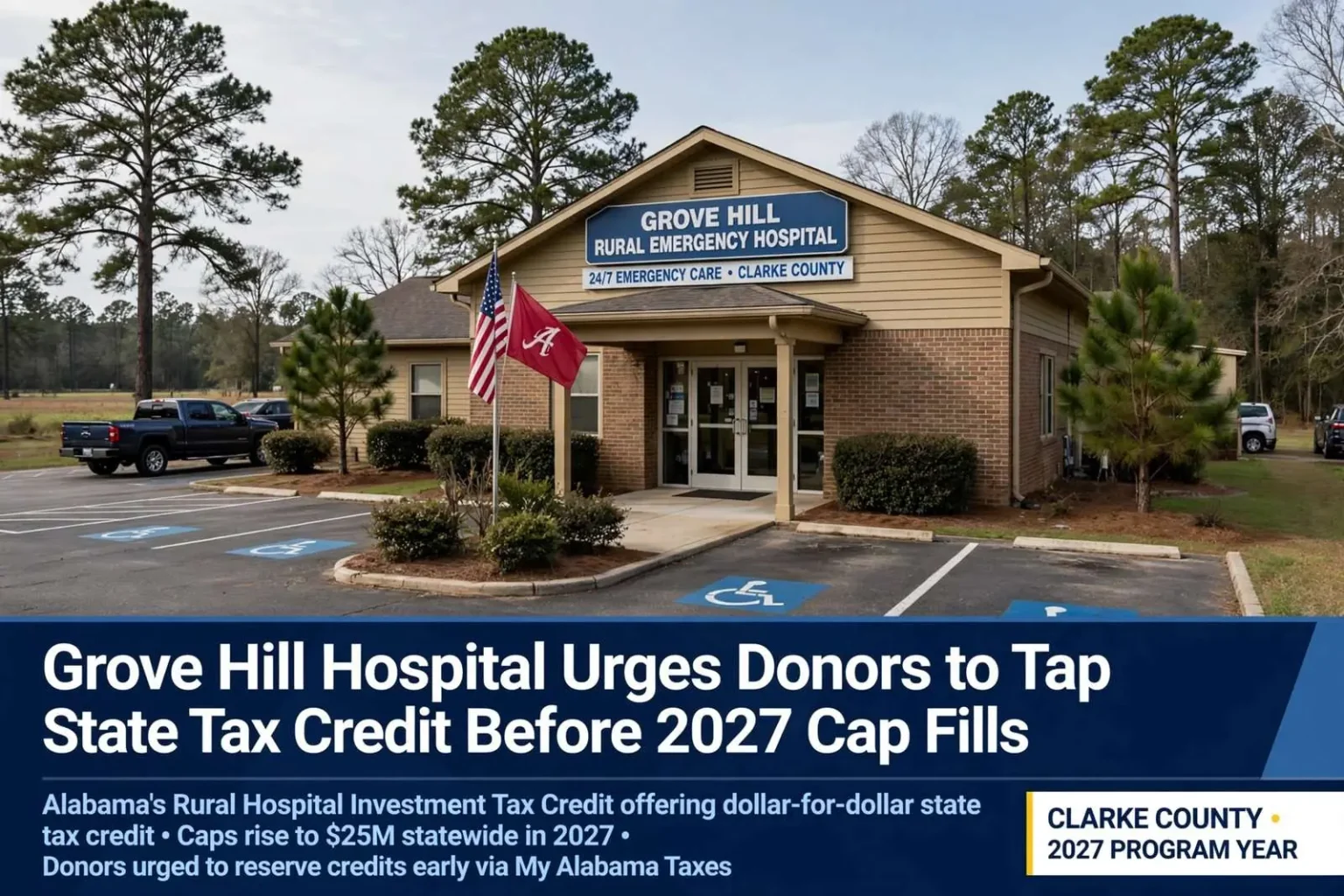
The Grove Hill Rural Emergency Hospital is encouraging individuals and businesses across south Alabama to support local healthcare by taking advantage of Alabama’s Rural Hospital Investment Tax Credit Program, a state incentive that rewards qualifying donations to participating rural hospitals. Under the program, eligible donors receive a dollar-for-dollar Alabama income tax credit for contributions made to participating rural hospitals, including the Grove Hill facility. In practice, that means every dollar donated can offset a dollar of state income tax owed, making it one of the more attractive options available to Alabamians who want to reduce their tax liability while supporting healthcare access in rural communities like Clarke County.
Hospital officials say the window to act matters as much as the decision to give. Demand for the credits has been strong since the program launched, and during the 2026 program year the statewide cap was reached within just 30 days. Donors who waited until well after the year opened found the credits gone for the season, with their contributions unable to be counted until a new allocation became available. With the caps set to rise and interest expected to grow further in 2027, officials are urging eligible donors to reserve their tax credits as early as possible once the new program year opens.
How the tax credit works
The Rural Hospital Investment Tax Credit Program allows Alabama taxpayers to make a qualifying contribution to a participating rural hospital and then claim a credit against their state income taxes equal to the amount donated. Because the credit is dollar-for-dollar, the net cost of a gift can be far lower than its face value, since the donor recovers the full amount through reduced state tax owed. Supporters of the program describe it as a way for taxpayers to redirect money they would owe the state anyway into hospitals that serve their own communities, rather than leaving those dollars in the state’s general fund.
The credits are limited by annual caps, both for each participating hospital and for the program statewide, and they are reserved on a first-come basis. That structure is designed to spread the benefit across multiple facilities while keeping the state’s total exposure predictable, but it also means that speed matters. A donation that is not matched to a reserved credit cannot be counted against the donor’s state tax bill under the program, so the reservation step is an essential part of the process rather than a formality.
Contribution caps are rising in 2027
Under the program, each participating hospital’s contribution cap will rise from $750,000 in 2026 to $1 million in 2027. The statewide program cap is also increasing, from $20 million in 2026 to $25 million in 2027. The larger caps mean more total dollars can flow to participating facilities in the coming year, and they give hospitals like Grove Hill a bigger ceiling of donor support to pursue during each annual window.
The increases also reflect how quickly the program has been absorbed by Alabama taxpayers. When the statewide cap was reached in roughly a month in 2026, it demonstrated that demand for the credits comfortably outstripped the supply available. Hospital officials expect that pattern to continue, if not intensify, in 2027 as more donors become familiar with the program and more participating hospitals promote it to their local supporters. The practical takeaway for anyone considering a gift is straightforward: waiting until late in the program year carries real risk of finding the credits exhausted.
How to reserve a credit
Donors looking to participate should use the Alabama Department of Revenue’s My Alabama Taxes system and select Grove Hill Rural Emergency Hospital as the recipient to reserve their credit. My Alabama Taxes is the department’s online portal for handling state tax accounts, filings and payments, and it is where the rural hospital credit reservations are processed. Once a reservation is confirmed, the donor completes the qualifying contribution and claims the credit on their Alabama income tax return for that year.
Because reservations are handled through the state’s system rather than through the hospital itself, donors should make sure the correct recipient hospital is selected at the time of reservation. A reservation directed to the wrong facility would route the credit away from Grove Hill, so donors intending to support the Clarke County hospital should confirm the facility’s name before submitting. Taxpayers with questions about how the credit interacts with their particular tax situation may also want to consult a tax professional, though the underlying mechanics of the program are designed to be simple: reserve, donate, claim.
What the money funds
Hospital officials said qualifying contributions help fund equipment, facility improvements and services that strengthen healthcare access for the surrounding community. That kind of support can be especially critical for rural hospitals operating with tighter margins than their urban counterparts. Reimbursement from insurance programs generally covers the cost of care that is already being delivered, but it rarely stretches to cover major equipment purchases, building upgrades or new services that a community needs, which is where philanthropic dollars and programs like the tax credit come into play.
For a facility like Grove Hill, contributions can translate into better-equipped emergency bays, updated diagnostic equipment, improved patient areas and expanded services closer to home. Every capability a rural hospital adds locally reduces the distance patients must travel for care, whether that is a routine emergency visit or a follow-up appointment that would otherwise require a long drive to a larger city. In a county where many residents live well away from the nearest urban medical center, that local access carries real weight.
Emergency care in Clarke County
Grove Hill serves as the county seat of Clarke County, a largely rural county in southwest Alabama, and the hospital has long been one of the community’s anchor institutions. The rural emergency hospital designation under which it now operates is a federal Medicare designation created to help small rural facilities that could no longer sustain inpatient services keep their doors open by focusing on emergency care and outpatient services. For communities across Alabama’s rural counties, that model has become a lifeline, preserving access to emergency treatment that would otherwise require lengthy ambulance transports to facilities in larger towns.
Across the state, rural hospitals have faced sustained financial pressure for years, driven by small patient populations, high rates of uninsured and publicly insured patients, aging facilities and the fixed costs of operating around the clock. Those pressures have contributed to closures and service reductions in rural communities across Alabama and the wider region. Programs that channel private donation dollars into rural facilities, backed by state tax incentives, are part of the response to that trend, and Alabama’s rural hospital investment credit is among the tools the state has put in place to keep rural healthcare viable.
Why timing matters for donors
The experience of the 2026 program year offers a preview of what donors should expect. When the statewide cap filled within 30 days, taxpayers who had planned to give later in the year were left without credits to claim, and hospitals lost the donations those taxpayers would have made. Officials in Grove Hill and at other participating facilities are treating the early sellout as a warning for 2027: the larger statewide cap of $25 million will still be finite, and if demand grows as expected, the window could close just as quickly or faster.
For businesses, the credit offers a way to pair community investment with tax planning. A contribution to the local hospital reduces state income tax owed dollar-for-dollar while keeping the money working inside the region the business serves. For individuals, it converts a planned charitable gift into one with a substantially lower net cost. In both cases, the key step is the same: reserve the credit through My Alabama Taxes early in the program year, before the caps are reached.
Looking toward the 2027 program year
Hospital officials are asking supporters to plan ahead now, even before the 2027 window opens. Knowing the reservation process, deciding on a contribution amount and being ready to act when the program year opens can make the difference between securing a credit and missing out. Once the new year begins, donors should move promptly through the My Alabama Taxes system to select Grove Hill Rural Emergency Hospital and lock in their reservation.
The stakes extend beyond individual tax returns. Every credit that goes unclaimed because a donor waited is support a rural hospital does not receive, and in communities like Clarke County, where the hospital stands between residents and emergency care that is otherwise dozens of miles away, that support is measured in more than dollars. The program gives Alabamians a direct financial stake in the survival of rural healthcare, and the hospital’s message to the community is simple: the credits are limited, the demand is proven, and early reservation is the only reliable way to be part of it.