Grove Hill Memorial Hospital closes front entrance over coronavirus concerns
Grove Hill Memorial Hospital has closed its front entrance and restricted visitors, including a ban on children under 16, as a precaution against the.
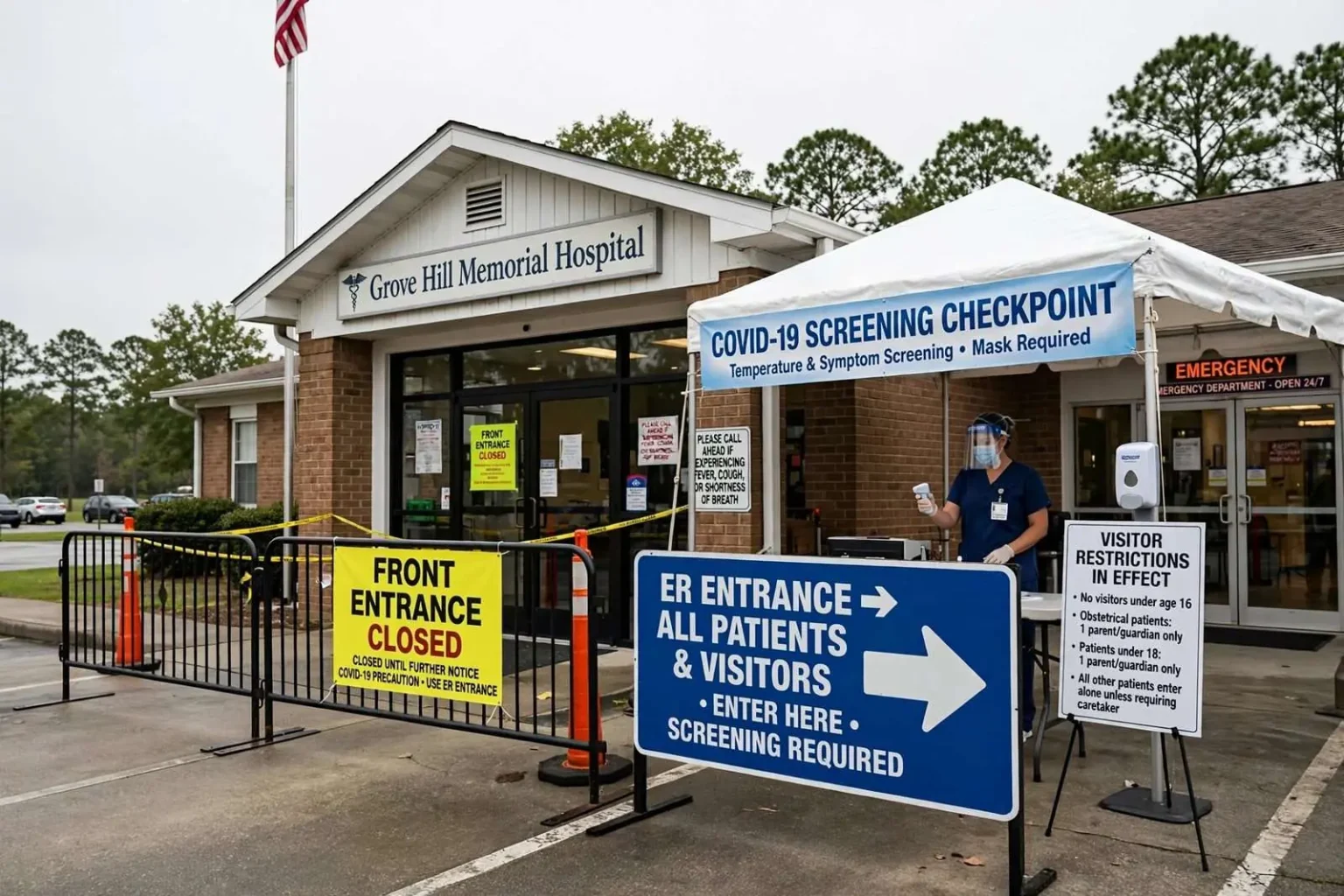
Grove Hill Memorial Hospital has closed its front entrance as a precaution against the coronavirus, and all traffic is now being directed through the emergency room entrance. The change means patients, visitors and anyone else with business at the hospital should plan to arrive through the ER entrance for the duration of the restriction.
The hospital announced a set of visitor rules that took effect along with the entrance change. No children under the age of 16 are allowed to visit or accompany patients. Obstetrical patients may be accompanied by one parent or guardian only. Patients under the age of 18 may be accompanied by one parent or guardian only. All other patients will enter alone, unless they require a caretaker or cannot be left alone for safety reasons.
Why hospitals restricted visitors
The visitor restrictions follow the playbook that hospitals across Alabama and the nation adopted as the coronavirus spread. Limiting who comes through the doors reduces the number of opportunities for the virus to enter the building, protects patients whose illnesses make them vulnerable to severe disease, and preserves protective equipment by keeping healthy people away from clinical areas. For a small rural hospital, where an outbreak among staff could quickly thin the ranks of caregivers, the math is even more compelling than at a large urban medical center.
Directing all traffic through the emergency room entrance serves the same goal. With one controlled entrance, the hospital can screen everyone who comes in — checking for fever, respiratory symptoms and travel or exposure history — rather than trying to monitor multiple doors. Screening at a single point also ensures that patients with possible COVID-19 symptoms are separated quickly from others, keeping waiting areas and clinical spaces safer for everyone else.
What the rules mean for patients and families
The rules reshape what a hospital visit looks like for Clarke County families. A patient coming in for a routine appointment or an outpatient procedure should expect to walk in without an entourage — a spouse, an adult child or a friend will generally have to wait outside or in the car. Exceptions are built in for those who genuinely need support: patients who require a caretaker, or who cannot be left alone for safety reasons, will still be permitted an escort.
For expectant mothers, the allowance of one parent or guardian means labor and delivery continues with the essential person present, while extended family waits elsewhere. Parents of young patients will be glad to see the one-parent rule mirrors that approach: a child under 18 can have one parent or guardian with them, but siblings — like all children under 16 — must stay home. Hospital officials urge families to arrange childcare and transportation in advance with those rules in mind, since arriving with extra people will not change the outcome at the door.
Grove Hill and rural health care
Grove Hill Memorial Hospital serves Clarke County, a largely rural county in southwest Alabama between the Tombigbee and Alabama rivers. As one of the county’s principal health care providers, the hospital handles everything from emergency care to outpatient services for residents of Grove Hill, Thomasville, Jackson and the surrounding communities. The nearest larger hospitals are a drive away, which makes the local facility the first stop in nearly every emergency in the county.
Rural hospitals like Grove Hill Memorial operate under pressures their urban counterparts rarely face: smaller staffs, older buildings, tight budgets and patient populations that skew older and sicker. Those realities make infection control doubly important. An outbreak that a large hospital might absorb could force a small hospital to divert patients or close units, so prevention measures — entrance screening, visitor limits and strict hygiene — are the front line of keeping rural health care running through the pandemic.
The broader picture across Alabama
Grove Hill Memorial’s move put it alongside hospitals across the state that adopted similar restrictions in the same period. Large systems in Mobile, Birmingham, Montgomery and Huntsville all limited visitors, closed cafeterias and common areas, and moved to single-entrance screening models. State health officials encouraged the measures as the number of Alabama cases climbed, and nursing homes and assisted living facilities went further still, closing their doors to outside visitors entirely to protect their residents.
The restrictions were never intended as permanent policy. Hospitals have consistently framed them as measures to be adjusted as conditions allow, loosened when the local outbreak subsides and reinstated when it surges. For rural facilities, the calculus also includes community size: in a county where many people know each other, a visit from even one infected person can touch a long chain of acquaintances, so early caution buys time for preparation.
How residents should approach care during the restrictions
Hospital leaders urge residents not to let fear of the virus keep them from seeking care. Emergencies — chest pain, stroke symptoms, severe injuries, difficulty breathing — require immediate attention regardless of the pandemic, and delays in treatment often make outcomes worse. Patients who are unsure whether a symptom warrants a visit can call ahead for guidance, and those arriving at the hospital should follow the signage to the ER entrance rather than trying the closed front door.
Patients with scheduled appointments should arrive on time, come alone where the rules require it, and bring a mask if they have one. Anyone with fever, cough or other respiratory symptoms should tell the screening staff immediately upon arrival so they can be directed appropriately rather than sitting in a general waiting area. Simple habits — hand hygiene, distance from others in waiting rooms, covering coughs — remain as important inside the hospital as anywhere else.
Supporting patients from outside the walls
For families shut out by the visitor rules, hospitals have promoted alternatives that keep patients connected without increasing risk. Phone calls and video chats let relatives check in on loved ones, and nurses serving as family liaisons can relay updates between medical teams and the people waiting at home. Families of hospitalized patients are encouraged to designate one point of contact who communicates with the hospital and shares news with everyone else, which spares staff from fielding repeated calls and keeps information accurate.
The pandemic has also underscored the importance of helping patients before they ever reach the hospital door. Community members can support elderly neighbors who live alone, help with grocery and pharmacy runs for those who should not go out, and check in on families with new babies now that delivery rooms are limited to one support person. In a small county like Clarke, those informal networks have always existed; the restrictions simply make them more necessary.
Grove Hill Memorial Hospital has not said how long the front entrance will remain closed, and residents should expect updates from the hospital as conditions evolve. For now, the message is straightforward: use the ER entrance, follow the visitor rules, and call ahead with questions. The measures may be inconvenient, but they are the price of keeping patients, staff and the community safe while the coronavirus works its way through Alabama.
What screening at the ER entrance looks like
Screening stations became a familiar sight at hospital entrances across Alabama, and the ER entrance at Grove Hill Memorial now serves that function for everyone arriving. Staff typically ask a short series of questions — whether the visitor has a fever, cough or shortness of breath, and whether they have had contact with a known case — and may check temperatures at the door. The process takes only moments, but it creates the record and the separation that keep the hospital’s interior protected.
Patients who screen positive for symptoms are usually masked immediately and routed to a designated area away from other patients, where staff wearing appropriate protective equipment can evaluate them. Those who screen negative proceed into the hospital for their care. The system depends on honesty at the door, which is why hospitals emphasize that disclosing symptoms is not a reason to be turned away — it is how patients get treated safely while others are protected.
Preparing rural facilities for a surge
Beyond visitor rules, rural hospitals spent the early pandemic weeks preparing for the possibility of a surge of patients. That preparation included stockpiling protective equipment, reviewing ventilation and isolation capacity, cross-training staff, and coordinating with the Alabama Department of Public Health and larger hospital systems on transfer plans for the sickest patients. Telehealth expanded rapidly, letting providers evaluate patients by phone or video for complaints that did not require an in-person visit, thereby keeping those patients out of waiting rooms altogether.
County health departments played their part as well, coordinating testing, answering resident questions and communicating changing guidance to schools, churches and employers. For communities like Grove Hill, the hospital and the health department together form the backbone of the local response, and the entrance restriction is one visible piece of a much larger effort happening behind the scenes.
Residents with questions about the hospital’s current policies should contact Grove Hill Memorial Hospital directly before arriving, since rules may be adjusted as circumstances change. The hospital’s leaders have thanked the community for its patience with the restrictions, noting that the front entrance will reopen when it is safe to do so. Until then, all patients and visitors should use the emergency room entrance and follow the visitor limits now in effect.