Gulf Coast Exploreum’s Cadaver Exhibit Controversy Fizzles Into a Ticket-Selling Hit
A cadaver exhibit at the Gulf Coast Exploreum drew early controversy in Mobile, but the concerns didn't hold up to scrutiny, and the exhibit has since become a strong draw for the science center and local artists alike.
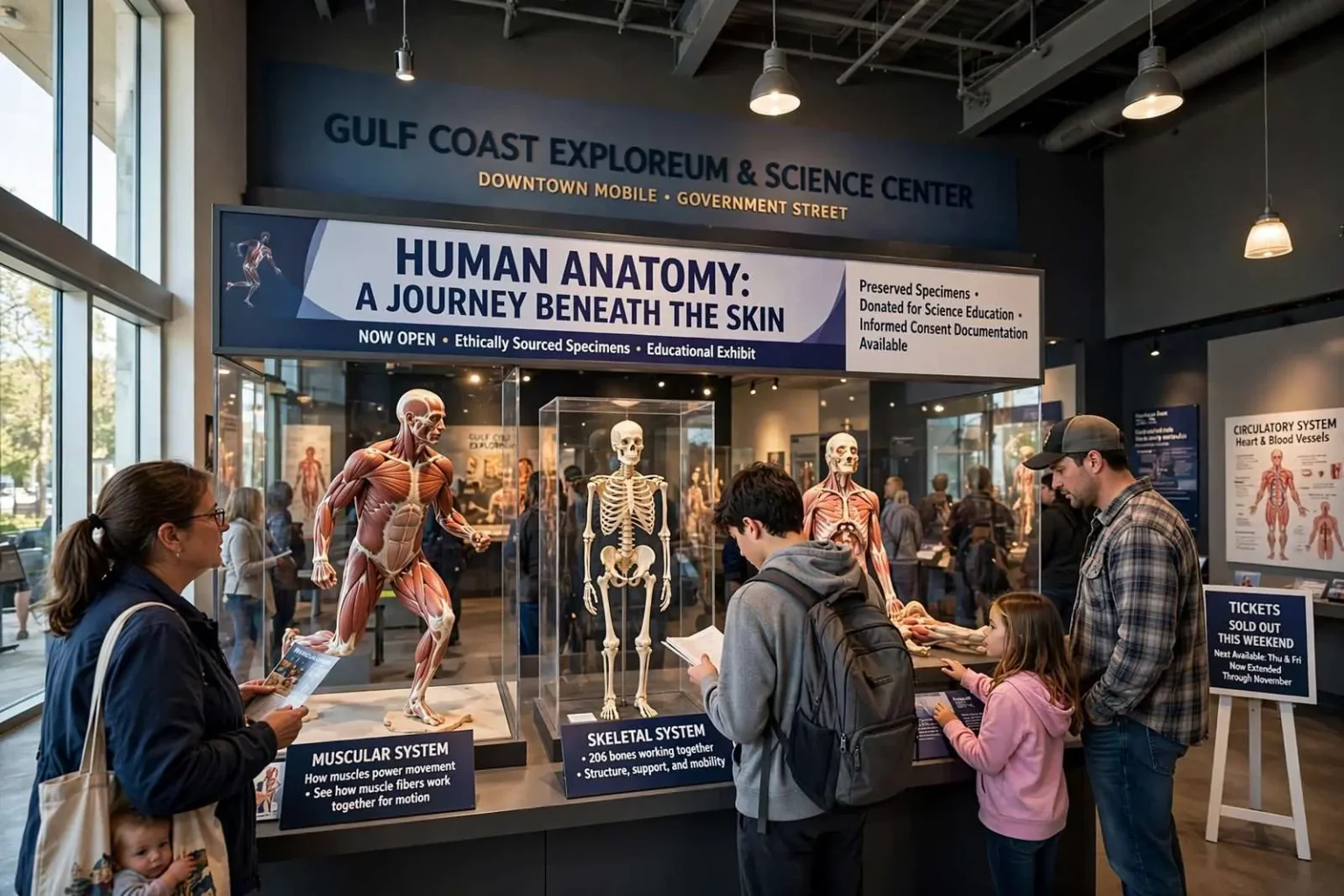
An anatomical exhibit featuring preserved human cadavers at the Gulf Coast Exploreum in downtown Mobile stirred up a burst of local controversy when it was first announced, but the uproar turned out to be short-lived and largely unfounded. Once the facts behind the exhibit were examined, much of the initial outrage evaporated, and the Exploreum has since turned the attention, controversy included, into a genuine box-office success.
The reaction followed a course that has become familiar wherever exhibits of this kind travel. News that real human remains would be displayed inside a family science center prompted questions on local social media, concerned phone calls to the venue, and debate about whether the show belonged in a museum visited daily by school groups. But as the science center explained what the exhibit contained and how the specimens had been obtained, the temperature of the conversation dropped quickly, and the conversation shifted from whether the exhibit should be shut down to when tickets should be purchased.
Exhibits built around real or realistic human anatomy have proven controversial in cities across the country, often drawing criticism over how the bodies were sourced, whether proper consent was obtained, and whether the format amounts to education or spectacle. Similar shows have been protested, investigated, and debated in major markets from coast to coast, and the questions raised in Mobile mirrored those raised elsewhere: whose bodies are these, did they agree to be displayed, and is there a difference between studying anatomy and gawking at it.
Why Cadaver Exhibits Draw Fire
The concerns are not frivolous, and they explain why the genre attracts scrutiny wherever it goes. Human remains carry cultural and religious weight, and many residents reasonably expect any institution displaying them to account for the chain of custody. In several cities, critics have pressed for documentation that the individuals whose bodies were preserved gave permission while living, and museums and science centers have responded by making sourcing information available to visitors and to reporters who ask.
In Mobile’s case, once those specific concerns were checked against the facts of this particular exhibit, the objections that had fueled the initial backlash did not hold up to scrutiny. The institution answered the questions that mattered, the exhibit opened as scheduled, and the audience that some feared would be repelled turned out to be curious instead. Attendance figures and ticket sales reported by the science center since the opening tell the story: the show that was supposed to be a public relations problem became one of its more successful recent programs.
Rather than shy away from the attention, the Exploreum leaned into it. The science center has reported strong attendance and ticket sales tied directly to the exhibit, turning what started as a public relations headache into a draw that brought visitors downtown who might not otherwise have made the trip. Controversy, even when it fades quickly, tends to drive curiosity and foot traffic — a pattern museum professionals across the country know well, and one that played out in Mobile almost exactly as expected.
What Visitors Actually See
Exhibits of this kind present preserved human specimens arranged by body system — the skeletal structure, the muscular layers, the nervous system, the circulatory network — so that visitors can see anatomy that is usually hidden from view. Preservation techniques keep the tissue stable at room temperature and allow specimens to be posed in lifelike positions, from a runner mid-stride to a figure holding a piece of the organ systems on display. Interpretive text explains what each specimen shows and how the corresponding system functions in daily life.
For many visitors the experience is less macabre than educational. Teachers have long used anatomy displays to reinforce lessons in health and biology, and families touring the galleries routinely come away with a more concrete understanding of how the body works — what smoking does to lungs, how joints carry weight, where the major organs sit in relation to one another. Medical and nursing students in many communities have also visited such exhibits to supplement classroom study, seeing in three dimensions what textbooks render in two.
That educational framing is precisely what distinguishes a science center exhibit from a carnival act, and it is the argument that ultimately carried the day in Mobile. The Exploreum’s staff made the case that the display belonged in the same tradition as the science center’s other hands-on learning galleries, and once residents saw the exhibit for themselves, the distinction became clear enough that organized opposition disappeared.
A Platform for the Local Arts Community
The Exploreum has also used the exhibit’s run as a launching point for additional programming aimed at the local arts community, giving area artists a platform connected to the exhibit’s themes of anatomy, mortality and the human form. The extension turns a single traveling exhibit into an ongoing local event, stretching its reach well past the initial installation and giving Mobile’s creative community a tie-in they might not otherwise have had.
Programming built around the human form has deep roots in art education. Life drawing has anchored art instruction for centuries, and exhibitions that put anatomy on display give painters, sculptors, and illustrators a reason to revisit the figure in their own work. By opening that door, the science center positioned itself as more than a venue for school field trips — it became a collaborator with working artists, and the exhibit’s themes of mortality and the body gave those artists material with genuine emotional range.
The collaboration also reflects a broader institutional strategy. Science centers that host headline exhibits increasingly build complementary programming around them — lectures, workshops, artist partnerships, themed evenings — to extend each show’s life and give repeat visitors something new. The Exploreum’s approach with the cadaver exhibit followed that playbook, converting a finite traveling installation into a season of local activity.
A Case Study in How Controversy Cools
The episode is a reminder of how quickly a controversy over a museum exhibit can shift once residents get a fuller picture of what is actually being shown and how it was produced. Initial outrage often forms before the facts are available, fed by headlines and secondhand descriptions, and it tends to dissipate when the institution in question engages directly rather than defensively. In Mobile, the science center’s willingness to explain the exhibit — rather than quietly retreat from it — is what converted a potential boycott into a sellout.
There is a practical lesson in that for cultural institutions across the Gulf Coast. Sensitive exhibits will always prompt hard questions, and the institutions that answer them transparently, before and after opening day, are the ones that emerge with their reputations and their budgets intact. The Exploreum’s cadaver exhibit ended its run as a success story, but it began as a test of whether the institution could withstand public scrutiny — and it passed.
The Exploreum itself is no stranger to high-profile traveling exhibits. The downtown science center, a fixture of Mobile’s Government Street corridor, has built its calendar around rotating blockbusters that supplement its permanent galleries, and each major arrival brings a fresh wave of visitors from across the Gulf Coast — families from Baldwin County, tour groups from the Florida Panhandle, and school field trips from across south Alabama and Mississippi. Exhibits that generate buzz, even the uncomfortable kind, fit squarely within that model.
The lasting takeaway for visitors is simply that the show delivered what the science center promised: a serious, science-first look at human anatomy, presented with the same care the Exploreum brings to the rest of its programming. The controversy made people pay attention; the content itself is what made them buy tickets, bring their children, and tell their neighbors to go before the run ended.
The economics of the museum business explain why institutions court these shows despite the headaches. Traveling anatomical exhibits carry substantial leasing fees, but they reliably outdraw standard offerings, and strong attendance supports everything else a science center does — memberships, education programs, and the permanent galleries that do not make headlines. A hit exhibit subsidizes the quieter mission work, which is part of why the Exploreum’s decision to press forward was sound business as well as sound science communication.
For Mobile’s arts community, the tie-in programming also carries a practical benefit: exposure. Artists whose work appears in connection with a high-traffic exhibit reach audiences that gallery openings rarely assemble, and themes as rich as anatomy, mortality and the human form invite ambitious submissions. The result is a partnership in which the traveling show supplies the traffic and local creatives supply the response — an arrangement that leaves both sides better off than they would have been alone, and that gives the city one more example of its cultural institutions working together rather than in isolation.
The Exploreum’s handling of the episode also mattered to downtown Mobile’s broader visitor economy. Museum attendance ripples outward — a family that drives in for a science center afternoon tends to spend on lunch, parking, and other attractions while it is there, and a exhibit strong enough to anchor a weekend trip benefits restaurants and hotels well beyond the venue’s ticket counter. Institutions that draw regional crowds function as anchors for the surrounding blocks, which is one more reason the initial calls to cancel the show ran against the city’s own interests.