Gulf Restoration Network’s Aaron Viles Headlined Sierra Club Meeting at 5 Rivers After the BP Spill
GRN campaign director Aaron Viles spoke at 5 Rivers in Spanish Fort in August 2010 about monitoring BP spill cleanup and Gulf restoration.
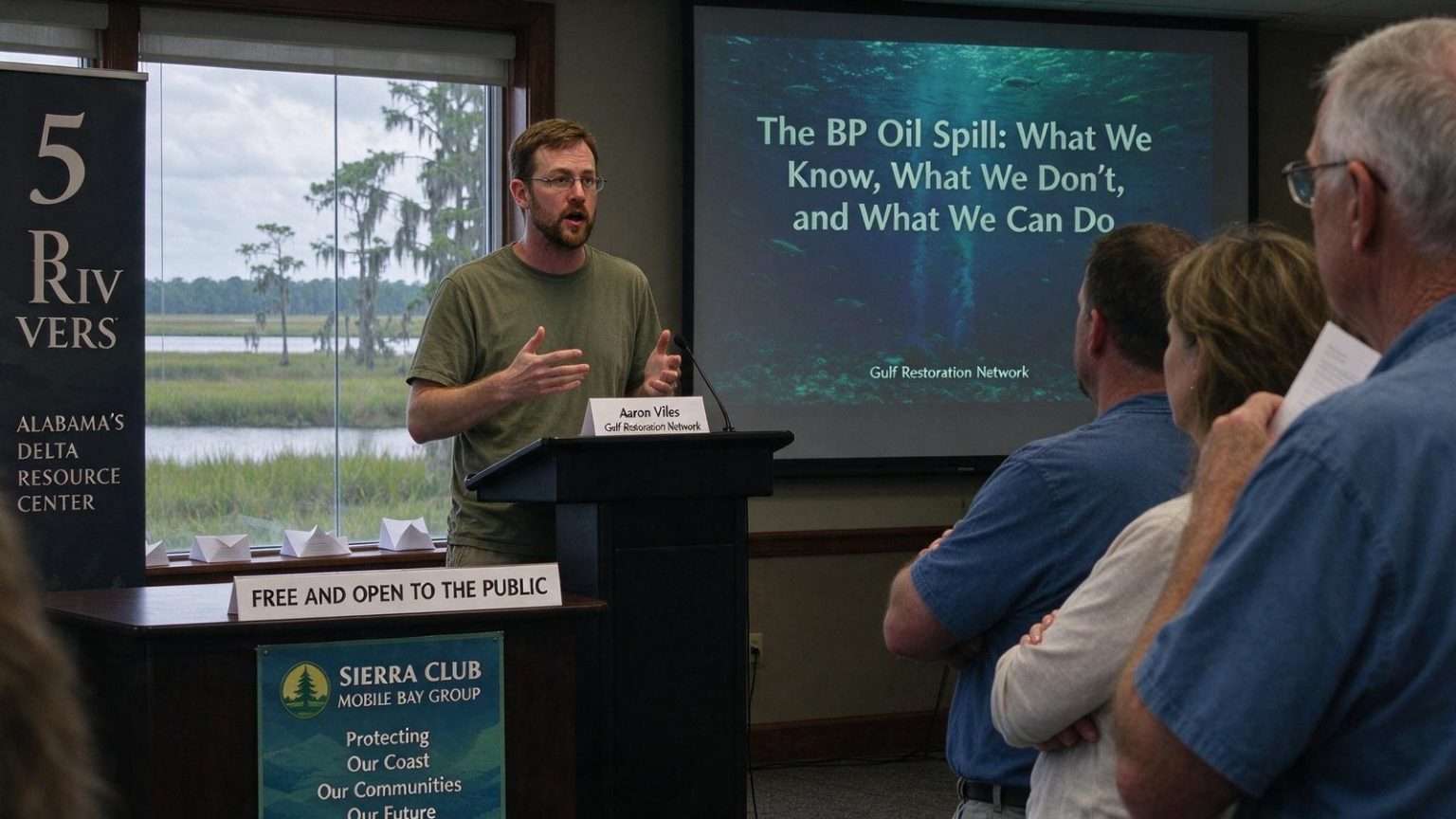
Less than four months after the BP Deepwater Horizon disaster began fouling Gulf waters, the Mobile Bay Group of the Sierra Club turned its August 3, 2010 meeting over to one of the region’s most vocal environmental watchdogs. Aaron Viles, campaign director of the Gulf Restoration Network, led the program at 5 Rivers, Alabama’s Delta Resource Center in Spanish Fort — the facility on the Mobile Bay Causeway across from Meaher State Park.
Admission was free and the general public was invited, a choice that reflected the moment. The disaster had dominated Gulf Coast life since the rig explosion in April, and residents had questions that press conferences weren’t answering: where the oil was actually going, whether the cleanup was working, and who was going to make the Gulf whole when the cameras left. Viles had built a career on those questions, and the meeting gave locals a direct line to someone tracking them full time.
The venue itself carried meaning. 5 Rivers sits at the confluence of the Mobile, Tensaw, Apalachee, Blakeley and Spanish rivers, where the Mobile-Tensaw Delta meets Mobile Bay — the exact ecology the spill threatened and the reason so many area residents felt the disaster personally. A conversation about the Gulf’s future was held, fittingly, within sight of the water it concerned.
Watching the Cleanup — and the Government
Viles directed GRN campaigns on sustainable Gulf fisheries, climate issues and habitat protection, including the cypress forests of the Gulf region. The organization had spent years holding agencies and industries accountable on those fronts, which positioned it to respond quickly when the Deepwater Horizon blowout turned the Gulf into the largest environmental story in the country.
In the wake of the spill, the organization was independently monitoring cleanup and containment work, pushing for a more effective and transparent response from government and industry. Independent monitoring mattered because official accounts and on-the-water reality did not always match; watchdog groups documented where booms were missing, where dispersant questions went unanswered, and where reports of oil and tar balls arrived faster than official confirmation did.
GRN was also advocating for a Citizens Advisory Committee that would let tourism, fishing and environmental communities keep watch on the oil industry. The proposal grew from a long-standing frustration: the people whose livelihoods and coastlines depend on the Gulf had no formal seat at the table when offshore operations were approved or policed. A standing citizens’ committee was the organization’s answer — a way to institutionalize scrutiny rather than relying on the burst of attention that follows a catastrophe.
Restoration Before the Spill Was Even Over
Even with oil still coming ashore in the summer of 2010, GRN was already working the restoration side of the disaster. Viles’s organization was engaging with Navy Secretary Ray Mabus, the former Mississippi governor whom President Obama tasked with drafting a new Gulf Coast restoration plan as the spill stretched on.
Viles hoped Mabus would bundle together existing restoration plans that had gone unfunded before the disaster, so money would not be diverted from long-promised projects. The logic was practical: the Gulf’s ecological problems — marsh loss, fisheries collapse, delta degradation — predated the spill by decades, and a restoration effort that treated only the oil damage would leave the underlying decline untouched.
The Sierra Club’s Mobile Bay Group, which hosted the evening, is the local arm of the national conservation organization, drawing members from Mobile and Baldwin counties and meeting regularly on environmental issues affecting the two-county area. Putting its August program behind Gulf spill accountability was consistent with the group’s history of hosting scientists, agency officials and advocates on the issues shaping the coast.
What the Gulf Restoration Network Does
The Gulf Restoration Network, founded in 1994, operates as a network of environmental groups and individuals across the five Gulf states, concentrating on issues no single community can fight alone: offshore drilling, wetlands loss, water quality, and the health of Gulf fisheries. Its approach combines on-the-ground monitoring with policy advocacy, and it has a reputation for showing up where official oversight is thin.
The cypress forests Viles campaigned to protect illustrate the model. Cypress-tupelo swamps along the Gulf Coast act as natural storm buffers and nurseries for marine life, but logging and development had been stripping them faster than they regenerate. GRN’s campaign pressed regulators and corporations on the harvesting practices that were quietly erasing a coastal defense at exactly the moment the coast needed every buffer it had.
That same instinct — watch closely, document everything, refuse to accept the comfortable answer — carried into the spill response. Organizations like GRN kept pressure on for accurate oil flow estimates, for transparency about dispersant use, and for cleanup claims that matched what fishermen and coastal residents were reporting from their own boats and beaches.
The Mobile-Tensaw Delta at Stake
Hosting the meeting at 5 Rivers put the spill’s stakes on display. The Mobile-Tensaw Delta is North America’s second-largest river delta after the Mississippi, an enormous web of bottomland hardwoods, cypress swamps, marsh and open water that funnels the Alabama River system into Mobile Bay. It supports extraordinary biodiversity and anchors the commercial and recreational fisheries that Mobile Bay’s economy runs on.
The delta’s connection to the open Gulf is exactly what made the disaster a local emergency. Water moves between the bay and the Gulf with the tides; larval fish, shrimp and crabs move with it. Oil entering the marine food web anywhere along that chain threatened resources that reach from the Causeway to the floodplain forests fifty miles inland.
Meaher State Park, directly across the Causeway from the 5 Rivers center, gives the public one of its few windows into that landscape — boardwalks over the marsh and views up the Mobile River shipping channel. For the audience gathered there, the abstract discussion of restoration funding was happening in front of the resource itself.
The Mabus Plan and the Fight Over Restoration Money
President Obama assigned Navy Secretary Ray Mabus — a Mississippi Gulf Coast native and former governor — to lead development of a long-term Gulf restoration plan, a signal that the administration intended the response to outlast the well’s capping. For environmental advocates, the assignment raised an immediate question: would the plan fund the Gulf’s pre-existing recovery needs, or narrowly address oil damage while older promises went unfunded again?
Viles’s hope was the broader one — that Mabus would bundle the existing restoration plans, including the multi-state efforts drafted before the disaster, into the new framework. The Gulf had never lacked for plans; it had lacked money. Bayou and delta restoration proposals had sat on shelves for years awaiting federal commitment, and advocates feared that a spill-specific plan would simply repeat the pattern with new paperwork.
The eventual debate over spill money — civil penalties, natural resource damages, the distribution of funds among the five Gulf states — ran along exactly the lines GRN was drawing that summer. Coastal Alabama’s share, and whether projects like delta and bay restoration received priority, became the local chapter of a five-state negotiation that played out for years after the August 2010 meeting.
Why a Local Sierra Club Meeting Mattered
In the months after the spill, Gulf Coast residents were flooded with information — official statements, media coverage, competing claims about the size of the flow and the safety of the seafood. Community meetings cut through that noise by putting advocates with firsthand knowledge in front of the people living with the consequences, and by letting residents ask questions no press release anticipated.
For the Mobile Bay Group, hosting Viles at 5 Rivers was part of its regular work: connecting local members with the scientists, agency staff and advocates shaping the decisions that affect Alabama’s coast. The group’s meetings through that period tracked the spill’s arc — from the early response, through the capping of the well, into the long restoration conversation that followed.
The August 3, 2010 gathering landed at a hinge point in that arc: the well had been capped days earlier, the restoration plan was being drafted, and the decisions that would define the next decade of Gulf policy were being made in rooms where watchdog groups like GRN were determined to have a voice — and to make sure the public did too.
Four Months of a Disaster That Never Left the News
The timeline matters for understanding the mood of that August meeting. The Deepwater Horizon rig had exploded on April 20, 2010, killing eleven workers and opening the deepest offshore oil spill in United States history. For nearly four months afterward, Gulf Coast communities watched oil estimates climb, booms deployed and fail, and fisheries close zone by zone — a season of bad news interrupted only by the capping of the well in July.
By the time the Mobile Bay Group convened its meeting, capping had changed the story from “how do we stop it” to “what do we do about it” — a shift that made accountability conversations more urgent, not less. The oil already in the water column, on the marshes, and on the beaches still had to be accounted for, and the restoration framework being drafted in Washington would decide how the damage got addressed.
That context explains why a free public meeting in Spanish Fort drew the attention it did. Residents were not being asked to learn about a distant issue; they were being asked to weigh in on decisions that would shape their coast for a generation.
The Citizens Advisory Committee Idea
The committee GRN advocated deserves a closer look, because it addressed a structural gap rather than a single failure. Gulf Coast communities had watched offshore drilling expand for decades with little formal role in oversight — no standing body through which fishermen, tourism operators and environmental groups could monitor industry conduct between disasters.
After the Exxon Valdez spill in Alaska, regional citizens’ advisory councils were created to give local communities exactly that oversight role in Prince William Sound, and they are widely credited with improving safety culture there. GRN’s proposal translated that model to the Gulf: a permanent, funded body representing the people whose livelihoods ride on the industry’s performance, with real access to information and a real ability to raise alarms.
The argument had special force in mobile-area communities, where the seafood industry, charter fishing fleets and coastal tourism all depend on the same waters the offshore industry uses. Those constituencies are not opposed to responsible energy production, advocates argued — they simply want a voice in protecting the resource everything else depends on.
What Residents Took From the Evening
Meetings like this one serve two audiences at once. For the Sierra Club members and visitors in the room, the evening offered a candid briefing on what independent monitors were actually seeing — the gaps between official assurances and conditions on the water, and the policy choices that would follow. For GRN and organizations like it, each public meeting built the constituency that watchdog work requires: residents informed enough to call agencies, attend hearings, and demand answers when the response lost momentum.
That exchange — information for engagement — is the quiet machinery of environmental accountability, and it runs on evenings like the one at 5 Rivers on August 3, 2010: a local conservation group, a regional advocate, a public hall on the edge of the delta, and a community with more at stake in the Gulf’s recovery than anyone in Washington.