Gulf Shores Surf Shops Say Business Is Cratering as Oil Spill Claims Drag On
Blonde John's and other Gulf Coast surf shops say sales have dropped as much as 80% amid the BP oil spill, while owners describe a slow, confusing claims.
Surf and skate retailers along the Alabama and Florida Panhandle coast say the BP oil spill has gutted their busiest season of the year, and that a slow, confusing claims process is making a bad summer worse.
For businesses that live on beach traffic, summer is not just a season — it is the fraction of the year that pays for the rest of it. Retailers in Gulf Shores, Pensacola, Destin and the beach towns between them say the months after the Deepwater Horizon disaster began washing oil toward the coast have erased the growth they counted on, and that the promised compensation machinery has been slow, opaque and, in their telling, arbitrary.
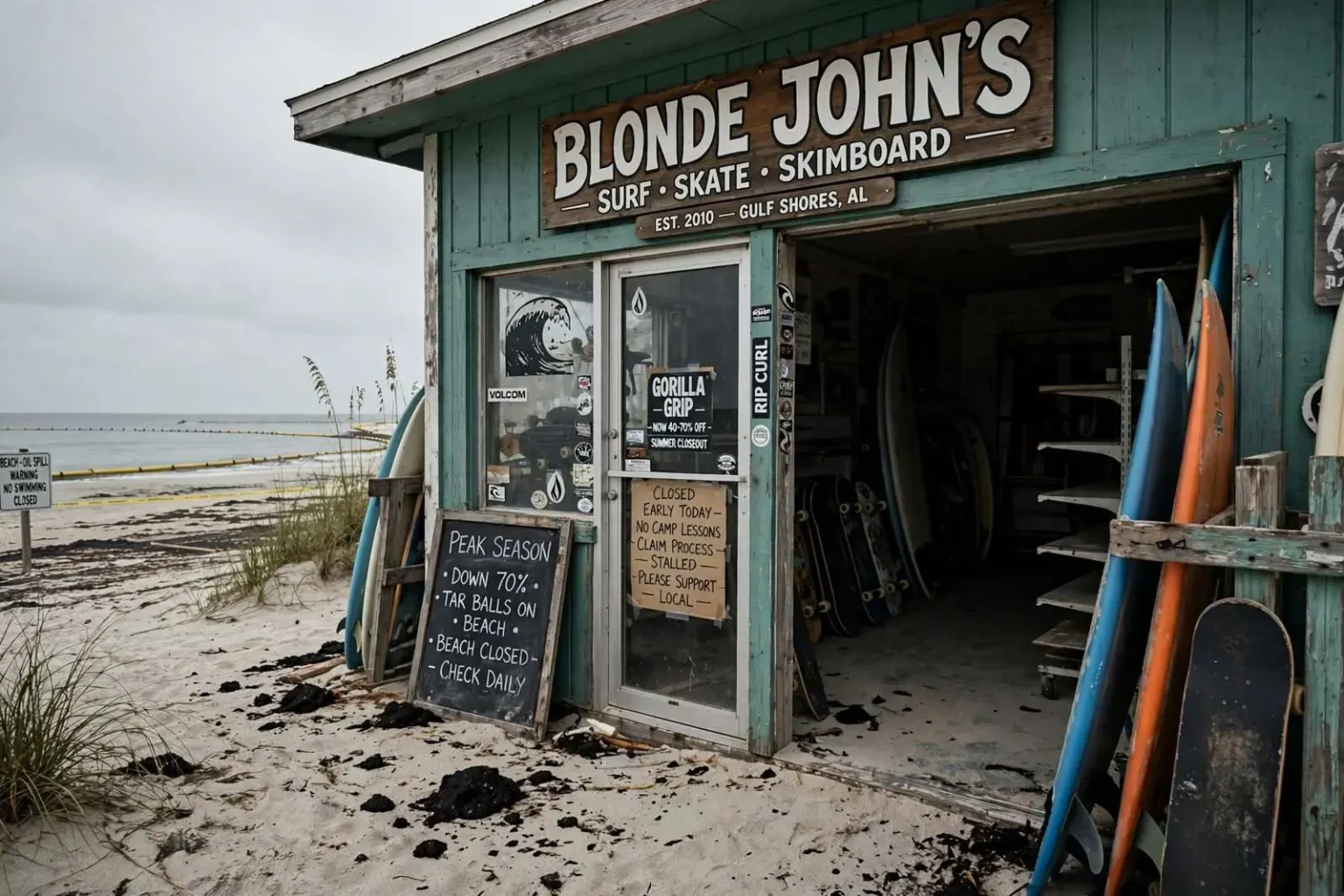
At Blonde John’s, a surf, skate and skimboard shop in Gulf Shores, Alabama, owner Johnny Mcelroy said business is down anywhere from 40 to 70 percent depending on the day, during what is normally his peak selling period. The swing from day to day tracks the tarballs and closures that come and go with the winds and currents, leaving owners unable to plan inventory, staffing or payroll from one week to the next.
Mcelroy, who has run the shop for a decade and says he had seen roughly 25 percent annual growth every year until now, described the state of his usually pristine beach in blunt terms, saying it looked fouled and unrecognizable compared to a normal summer. Ten years of steady expansion — the kind of compounding growth that turns a small surf shop into an institution — stopped overnight, and the trajectory of the business reversed for the first time in its history.
He said the downturn has been severe enough that he has considered whether he can afford to keep the business where it is. That question — survival, not profit — is the one Gulf Coast retailers say they never expected to be asking in June.
Regional Chain Also Hurting
Innerlight Surf and Skate Shop, which operates stores in Gulf Shores as well as Pensacola, Destin and Gulf Breeze, Florida, reported that business was mostly flat through last month, before oil made landfall on Florida beaches. The chain’s early summer had been deceptively normal — shoppers still browsing, camps still forming — until the first oil reached the Panhandle sand and the vacation math changed across four store locations at once.
Pensacola store manager Shannon Hampton said some Innerlight locations are now down 50 percent, with others down 30 to 40 percent. Once surf-camp cancellations and no-shows are factored in, she said, overall business is off by about 80 percent. The camps matter more than their headline numbers suggest: they are weeklong commitments that bring children and their parents into the stores repeatedly, and when they cancel, the ripple runs through board sales, rentals, lessons and everything else on the floor.
The pattern Hampton describes — a moderate decline in walk-in sales masking a catastrophic decline in program revenue — is the story of the season for many beach retailers, whose public numbers rarely separate the two streams until something like this forces the accounting.
The geography compounds the problem for a chain like Innerlight. A single spill response zone now stretches across four store locations in two states, each with its own beach conditions, its own closure notices and its own day-to-day swings in customer confidence. A shop that could once advertise the whole Panhandle coast to its summer customers now finds the news doing the advertising instead, and the news is about oil.
Further east, Kevin Faoutas of Aqua Surf Shop in Miramar, Florida, said his shop was also down roughly 80 percent at one point, and that BP’s claims process has been especially frustrating. Miramar Beach sits in the heart of the Destin-area tourist corridor, where summer traffic normally doubles a shop’s floor count in a single afternoon.
Faoutas said he waited five to six weeks before reaching a BP adjuster about a $30,000 monthly-loss claim, only to be told the claim had been forwarded to a specialized large-loss office in Louisiana. The routing added another layer of delay to a process that already required a small business owner to document, month by month, exactly what a spill had taken from him.
When he followed up, he said, he was told he would receive a check for just $1,200.
The gap between a $30,000 claim and a $1,200 check is the arithmetic that has coastal business owners questioning how BP is calculating losses. Faoutas said the adjuster indicated BP had based the payout on his 2009 sales figures — a down year for his business because of the broader economy — rather than his stronger 2010 numbers, which he said were tracking closer to his pre-recession 2008 season. In other words, the baseline BP used to measure his loss was the worst recent year of the recession, not the year he was actually having when the spill arrived.
That choice of baseline is not a rounding error. A claims system that measures the shortfall against a depressed benchmark mechanically shrinks every payout, and retailers say it does so in the year they most need the compensation to be honest. The 2010 season, before the spill, was on pace to be among the best of the recovery; measuring a spill-erased summer against the trough of 2009 turns a devastating loss into a modest one on paper.
Hampton said Innerlight ran into similar confusion after filing a claim for lost surf-camp revenue. She said the shop began filing claims June 16 and did not get its first meeting with a BP official until this past week — more than a month of accumulating losses with no contact from the party responsible for paying them.
She described the paperwork as difficult to parse without digging through old business records, reconstructing seasons and receipts and camp rosters to satisfy a process whose requirements seemed to shift as she went. For a store manager running four locations’ worth of summer programs, the claims work became a job of its own.
Vendors Reaching Out, but Bills Still Due
Behind the sales numbers sits the quieter problem of payables. Mcelroy said several of Blonde John’s suppliers, including FCS, Gorilla Grip, Volcom and Rip Curl, have reached out directly as he has fallen behind on payments, while he said other larger companies have been less responsive. In the surf industry, where brands and shops trade on decades of personal relationships, the vendors who call are the ones who intend to be paid eventually — and who are willing to wait for the season to be made right.
He credited the vendors who have worked with him for helping keep the shop afloat. A surf shop’s inventory is financed on the industry’s faith that summer will come, and a summer that does not deliver tests that faith across an entire supply chain — from board manufacturers to apparel houses to the small shops that give the brands their storefront presence on the coast.
The oil, meanwhile, has changed even the parts of the summer that survived. Mcelroy said Hurricane Alex, which passed through the Gulf in late June, brought heavy surf along with currents and winds that pushed visible oil away from his local beaches for a stretch. Storms that would normally be unwelcome news for beach towns instead produced the cleanest water of the season, however briefly, by stirring the Gulf and moving the slick offshore.
He has continued surfing at Alabama Point, a point break on the west side of Perdido Pass separating Alabama from Florida, one of the few reliable breaks on the upper Gulf Coast where a swell meets a jetty and produces a rideable wave. Even there, he said, the spill is never far from his mind while he is in the water, comparing the low-level anxiety to knowing sharks are nearby: manageable, but impossible to fully ignore, and now simply part of the routine for coastal surfers trying to hold onto both their businesses and their way of life.
The comparison captures what retailers say the summer has become. The water is still swimmable some days, the beaches still open some mornings, the waves still break on schedule — and yet every one of those ordinary pleasures now carries an asterisk, and the customers who would normally fill the shops are reading headlines instead of checking the surf report.
What the season decides
Retailers along the coast say the next few weeks will tell them whether they can hold on. Peak season runs through early August, and every week of closures and cancellations compounds the shortfall that claims are supposed to replace — if the claims, as the owners tell it, ever pay what the season was actually worth.
For now, the shops remain open, the vendors remain patient where they can, and the owners keep filing paperwork. What they thought they were doing this summer was selling boards. What they are doing, they say, is documenting a loss.