

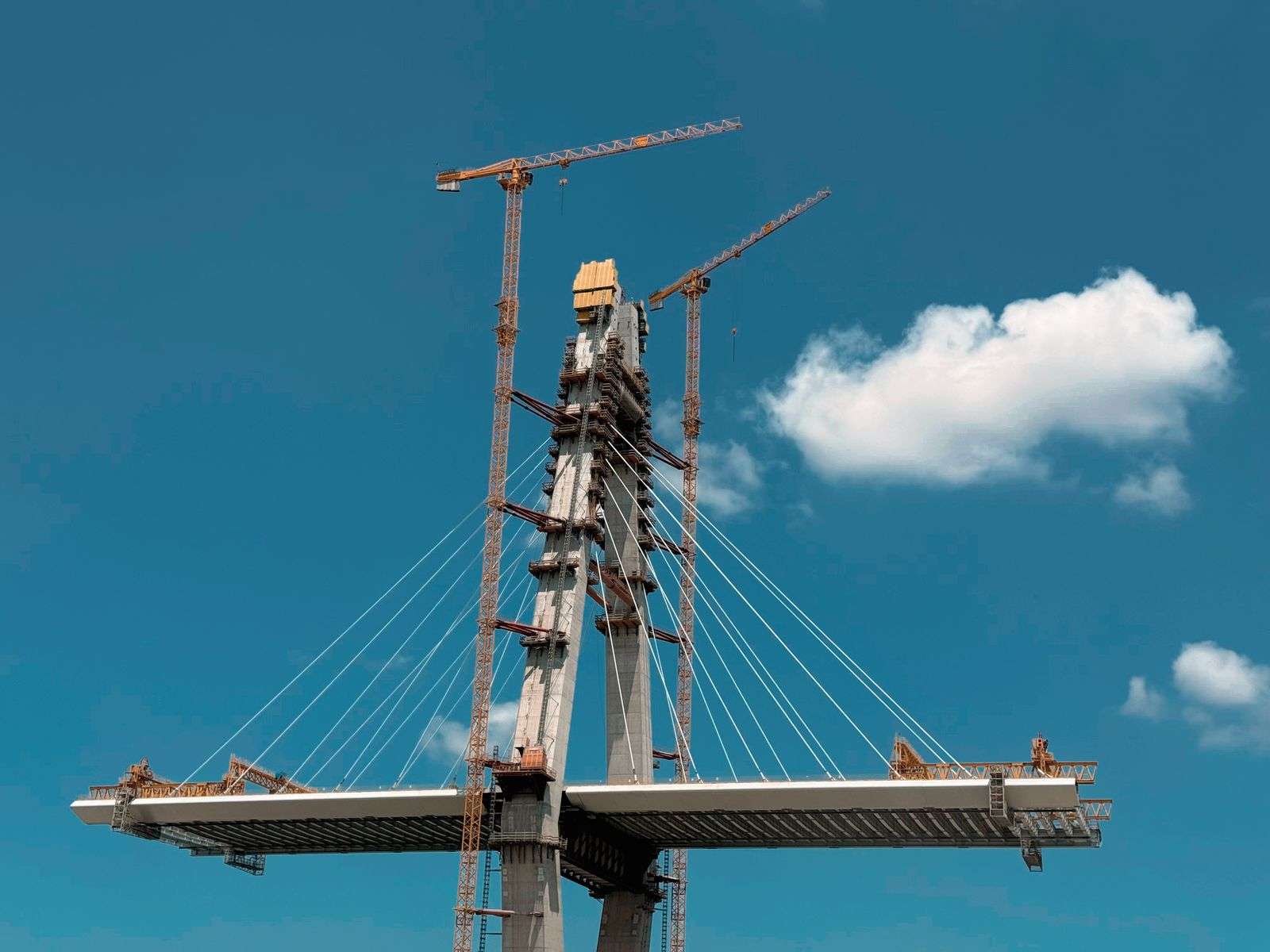
Gulf Shores has reached a major construction milestone on its first-ever pedestrian bridge, a $24 million span that will carry walkers and cyclists over the Intracoastal Waterway without competing with vehicle traffic on the busy Highway 59 bridge. Crews have now finished setting both the north and south support towers for the Waterway Village Bridge, each rising 75 feet into the air and containing 144 stairs, marking one of the most visible phases of the project to date.
The bridge is a joint venture between the City of Gulf Shores and the State of Alabama, reflecting a broader push along the Gulf Coast to fund infrastructure that separates pedestrians and cyclists from increasingly congested highway corridors. Highway 59 is one of the most heavily traveled routes in Baldwin County, especially during the spring and summer tourist season, and city officials have identified the corridor as a priority for safety improvements for several years.
Engineering Highlights: Towers, Glass Flooring and Accessibility
With the towers now standing, the next major phase of construction involves installing a structural glass floor this fall, a design choice that will let pedestrians look straight down at the water flowing beneath them as they cross. Project engineer Jenny Wolfschlag said the glass flooring is meant to be both functional and a draw for visitors. “The structural glass flooring will allow people to walk over it, but also allow people to see all the way down to the water underneath,” Wolfschlag said. Once the glass flooring is complete, work will shift to building the plazas at each end of the bridge, which will serve as gathering spaces and connection points to the surrounding Waterway Village area.
According to Wolfschlag, the bridge is intended to give both pedestrians and bicyclists a way to safely travel across the waterway without having to intermingle with vehicle traffic on the Highway 59 bridge, a corridor that carries significant car, truck and boat-trailer traffic throughout the year. Accessibility has also been built into the design: an elevator large enough to accommodate bicycles will offer an alternative to the 144-stair climb on each tower, and the bridge is expected to remain open around the clock once completed.
Connecting Waterway Village’s Business Community
The bridge’s location was chosen specifically to link two well-known destinations on opposite banks of the Intracoastal Waterway. On the south end, the span will connect near Tacky Jacks, while the north end will link to the area near Lulu’s Gulf Shores, two of the most recognized restaurant and entertainment venues in the Waterway Village district. The general manager of Tacky Jacks described the bridge as a family-oriented amenity that should encourage more foot traffic and outdoor activity between the businesses on both sides of the water.
City leaders and local business owners have pointed to similar waterfront pedestrian projects in other coastal communities as evidence that dedicated crossings can boost walkability, extend visitor stays and support small businesses by making it easier for people to move between shops, restaurants and attractions without needing a vehicle. For Gulf Shores, a city whose economy leans heavily on tourism and outdoor recreation, the bridge is expected to become both a functional transportation link and a scenic destination in its own right.
Project Timeline and What Comes Next
With the tower installation complete, the project moves into its glass-flooring and plaza-construction phases over the coming months. Barring delays common to large infrastructure builds, particularly given the coastal environment and the potential for tropical weather during hurricane season, the pedestrian bridge is expected to open to the public by early January 2027.
As construction continues, residents and visitors can expect to see ongoing activity around the Waterway Village site, including material deliveries, crane operations and periodic lane or path adjustments near the crossing. The City of Gulf Shores has indicated it will continue to provide updates as work progresses toward the bridge’s anticipated opening date.
The Waterway Village Bridge is the kind of project that tends to be remembered as a turning point in how a coastal community thinks about its public spaces. Pedestrian and bicycle infrastructure of this scale — a $24 million span across the Intracoastal Waterway with 75-foot towers, a structural glass floor, and 24-hour access — has historically been more common in larger cities than in beach towns like Gulf Shores. The fact that the city and the state have committed to that level of investment reflects how much the perception of what a coastal tourism economy needs has evolved over the past two decades.
The Intracoastal Waterway itself is a federally maintained navigation channel that stretches along the Gulf Coast and up the Atlantic Seaboard, providing a protected route for commercial barge traffic, recreational boating, and other vessel movements. In the Gulf Shores area, the waterway is crossed by the Highway 59 bridge, which carries the bulk of vehicle traffic between the mainland and the peninsula, and by a series of smaller bridges and causeways in the surrounding communities. Until the Waterway Village Bridge is complete, the only way for pedestrians and cyclists to cross the waterway in the immediate area has been to share a lane with vehicle traffic on the existing bridge, which is a particular challenge during the busy summer months when boat trailers and beach-bound cars crowd the corridor.
The decision to include a structural glass floor in the bridge design is unusual for a pedestrian bridge of this size, and it speaks to the way the project is being framed as both a transportation link and a destination in its own right. Glass-floored observation bridges have become popular tourist attractions in a number of places around the world, and they tend to draw visitors who are interested in the experience of standing over the water as much as they are in crossing from one side to the other. For Gulf Shores, which is already one of the most visited tourism markets on the northern Gulf Coast, the bridge is expected to add a new kind of attraction to the local mix, one that does not depend on the beach itself but on the views and the unusual experience of crossing the water.
Accessibility was clearly a priority in the bridge design. The 144-stair climb on each tower would be a significant barrier for many visitors, including families with small children, people with mobility limitations, and anyone carrying groceries or beach gear between the two sides of the waterway. The decision to include an elevator large enough to accommodate bicycles addresses that concern directly, and it means that the bridge will be genuinely useful as a transportation link, not just a scenic overlook. Round-the-clock access also reflects a practical understanding of how the area is used: many of the businesses in the Waterway Village district operate into the late evening during the tourist season, and visitors who want to walk between restaurants and entertainment venues should not be limited to daytime hours.
The location of the bridge, connecting Tacky Jacks on one side to Lulu’s Gulf Shores on the other, places it at the heart of one of the most active commercial and entertainment districts in the area. Both venues are well-known Gulf Coast restaurants that have helped define the Waterway Village identity over the past two decades, and the bridge gives them a direct pedestrian connection that did not previously exist. The general manager of Tacky Jacks has described the bridge as a family-oriented amenity, and that framing is consistent with the broader direction of tourism development in Gulf Shores, which has increasingly emphasized walkability, outdoor activity, and family-friendly attractions over more car-dependent forms of tourism.
The plazas planned at each end of the bridge will also be important. Public plazas of this kind tend to serve multiple functions in a coastal community: they provide gathering space for events, rest areas for visitors who want to enjoy the views, and visual connections between the bridge and the surrounding businesses. The combination of plazas, elevators, and accessible design suggests that the bridge is intended to function as a piece of public infrastructure in the fullest sense, not just a single-purpose crossing. Cities that have invested in similar projects — Charleston, South Carolina, and Savannah, Georgia, are two commonly cited examples along the southeastern coast — have found that well-designed pedestrian bridges can reshape the surrounding neighborhood for decades after they open.
The January 2027 opening target is contingent on a number of variables, including weather, supply chain conditions, and the kind of unexpected issues that often arise on large infrastructure projects. The Gulf Coast’s hurricane season, which runs through November, always adds uncertainty to construction schedules, and a single significant storm can set a project back by weeks or months. The project team has indicated that it will continue to provide updates as the glass-flooring and plaza phases progress, and residents and visitors can expect to see ongoing activity in the area until the bridge is complete.
For the broader Baldwin County community, the Waterway Village Bridge represents an investment in a different kind of coastal economy. The traditional beach tourism model — drive to the beach, park near a hotel or condo, spend the day on the sand, drive home — has been the dominant force in the area for decades, and it remains a major part of the local economy. The Waterway Village Bridge, and the broader investments in walkability and pedestrian infrastructure that accompany it, suggest a more diversified model in which visitors are encouraged to explore the area on foot, to spend time in multiple businesses during a single visit, and to experience the natural and built environment in ways that do not require a car. That kind of model tends to support a wider range of small businesses, to extend visitor stays, and to create a stronger sense of place that keeps people coming back year after year.