Florida Panhandle Okaloosa County
Health Advisories Issued for Three Okaloosa County Parks
The Florida Department of Health in Okaloosa County issued health advisories for three parks after fecal pollution was detected in the water.
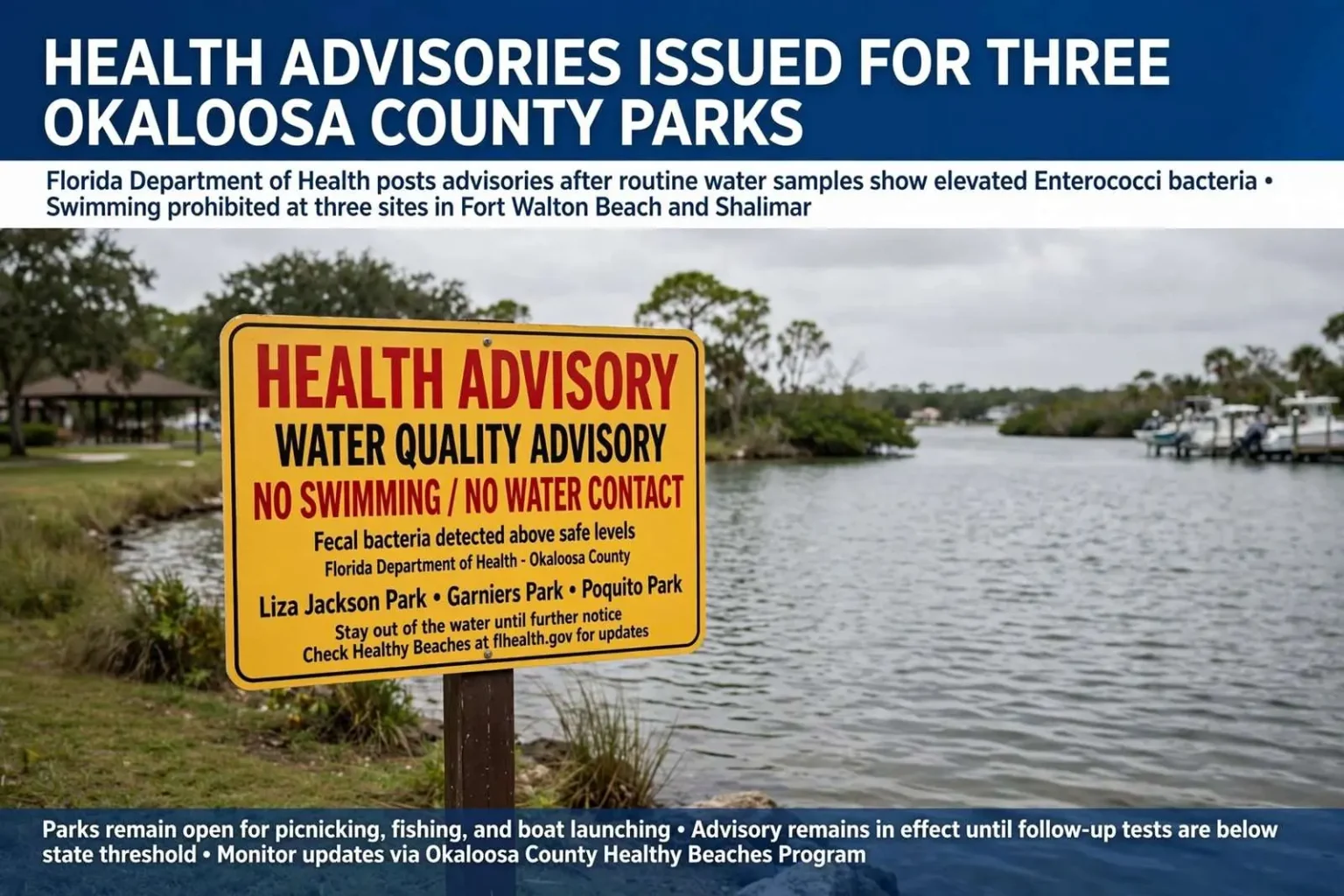
The Florida Department of Health in Okaloosa County has issued health advisories for three parks after water samples showed traces of fecal pollution. Advisories have been posted for Liza Jackson Park and Garniers Park in Fort Walton Beach, as well as Poquito Park in Shalimar. Residents and visitors are advised not to enter the water at those locations. The department maintains a “Healthy Beaches” program that tracks sampling results and maps for Okaloosa County’s monitored sites.
The advisories are the product of routine monitoring, not a single pollution event. As part of the Healthy Beaches program, health department staff collect water samples at fixed locations around the county on a regular schedule and test them for indicator bacteria associated with fecal contamination. When a sample comes back above the state’s threshold, the department posts an advisory at the site and updates its public listings so that swimmers know which waters to avoid.
That is what happened at the three parks, two of them in Fort Walton Beach and one in neighboring Shalimar, all of them sitting on the waters of the Choctawhatchee Bay system. The traces of fecal pollution found in the samples signal the possible presence of organisms that can make swimmers sick, particularly if water is swallowed or enters cuts and open wounds. The department’s advice for the posted locations is straightforward: stay out of the water until sampling shows the levels have fallen.
The sites under advisory
Liza Jackson Park is one of Fort Walton Beach’s best-known public parks, sitting on the shore of the Santa Rosa Sound with a boat ramp, picnic areas, playgrounds, and one of the area’s popular swimming spots. On warm weekends the park fills with families and boaters, and its shoreline is a regular destination for people looking for calm water away from the open Gulf beaches. That popularity is precisely why an advisory there matters so broadly.
Garniers Park, also in Fort Walton Beach, sits on the waterfront as well and serves the neighborhood around it as a place to launch a boat or put a foot in the water. Poquito Park in Shalimar, the third site, is a smaller community park on the water in one of Okaloosa County’s tight-knit bayfront towns. All three share the same basic situation: public parks where people routinely enter the water, now posted with warnings against doing so.
The parks themselves remained open. An advisory affects the water, not the playgrounds, shelters, and boat ramps, and residents could continue to use the land-side amenities. The restriction that matters is against entering the water, and the signs posted at each site spell that out for anyone arriving without having checked the county’s listings first.
What the testing measures
The Healthy Beaches program tests for Enterococci bacteria, intestinal organisms that live in the gut of warm-blooded animals and that serve as an indicator of fecal pollution in water. Enterococci do not usually make swimmers sick themselves; rather, their presence signals that fecal material is getting into the water, which raises the odds that pathogens capable of causing illness are present too. Health departments across Florida and the country use this indicator because it is far cheaper and faster than testing for every possible pathogen directly.
The sources of such contamination are usually close to home. Stormwater runoff after rain carries waste from pets, birds, and wildlife into the water; aging sewer lines can leak; septic systems in low-lying areas can seep during wet weather; and boat discharge contributes in busy harbors. None of these sources requires an industrial accident or a spill, which is why bacteria levels at bay and sound beaches can rise and fall with the weather rather than with any single event.
That variability is why the program samples on a schedule and why advisories carry their own expiration logic. A posted advisory reflects the most recent sample. Once follow-up testing shows the bacteria count back below the threshold, the department lifts the advisory and the site returns to its normal listing. Water quality at a bay park can therefore change from one week to the next, and the map the department maintains is the authoritative, current picture.
The waters of Okaloosa County
Okaloosa County occupies a stretch of the Florida Panhandle anchored by Fort Walton Beach, Destin, and the Eglin Air Force Base reservation, and its public waters fall into two very different categories. The Gulf beaches along the barrier island draw the crowds and post some of the clearest water in the country, while the interior waters, the Choctawhatchee Bay and the Santa Rosa Sound, provide the calm, shallow swimming and boating areas where parks like Liza Jackson, Garniers, and Poquito sit.
The bay system’s geography matters for water quality. Choctawhatchee Bay is a large, mostly enclosed estuary fed by rivers and connected to the Gulf through Destin’s East Pass. Water in the bay does not flush as quickly as water on the Gulf side, so whatever runs into it after a rain tends to stay concentrated for a while, particularly in the pockets and coves where public parks are often built. The Sound, between the bay and the barrier islands, exchanges more freely but still receives the runoff of the developed shoreline around Fort Walton Beach.
The result is a monitoring challenge distinct from the open Gulf. Beaches on the Gulf benefit from constant renewal by the tides, while bay and sound parks depend more on local conditions: rainfall, wind, and the state of the storm drains and sewer systems in the neighborhoods around them. That is why the Healthy Beaches program samples multiple sites across both settings rather than assuming that one reading represents the county.
Why the advisories matter to residents
Swimming in water with elevated fecal bacteria carries real, if usually modest, risks. The most common outcomes are gastrointestinal illness from accidentally swallowing water, ear and eye infections, and infections of open cuts and scrapes. Children, who swallow more water when they play, and people with compromised immune systems face the greater danger. Health departments post advisories so that families can make that decision with the facts in hand rather than in ignorance.
For Okaloosa County, the advisories also touch the local economy. The region’s identity and livelihood rest on its waters, and while the Gulf beaches and the fishing fleet around Destin get most of the attention, the bay parks are where a large share of local families swim on an ordinary weekend. Keeping those waters clean and keeping the public informed when they are not is part of the basic infrastructure of a tourist county.
The advisories also serve as a quiet signal about the watershed itself. Elevated bacteria readings at multiple parks at once often follow heavy rain, when stormwater flushes the developed landscape into the bay. Residents who see their neighborhood park posted can connect the result to upstream habits, from picking up pet waste to maintaining septic systems, that collectively determine what the next round of samples shows.
Using the Healthy Beaches information
The department’s “Healthy Beaches” program exists to make this information usable. Its listings and maps cover every monitored site in Okaloosa County and show the latest results, so a family planning a Saturday at Liza Jackson Park or a boater launching at Garniers can check the status before leaving the house. The signs posted at the parks themselves repeat the message for people who arrive without checking, and the department lifts advisories promptly when follow-up samples come back clean.
The practical guidance during an advisory is limited but important: stay out of the water at the posted locations, and especially keep children and anyone with open wounds out. Fishing, boating, and picnicking are unaffected, and eating fish caught in the area is not the concern the advisory addresses; the risk comes from swallowing or contact with the water itself.
Advisories like the ones at these three parks typically last only as long as the bacteria levels do, and levels fall as weather dries and the water turns over. The department’s regular sampling continues through it all, and the public’s best protection is simply to check the map, respect the signs when they are posted, and return to the water when the county’s testers say the parks are clean again.
A routine system working as designed
It is worth stepping back to see what the advisories at Liza Jackson, Garniers, and Poquito parks actually represent. They are not evidence of a county in crisis; they are evidence of a monitoring system doing its job. Water samples were collected on schedule, tested, found to exceed the threshold, and the results were published and posted within days. The same system that flagged the problem is the one that will announce when it clears.
Communities that lack such programs do not know their water is contaminated, which means their residents swim in it anyway. Okaloosa County’s residents, by contrast, get a clear signal, posted signs, and a public map. The program’s quiet regularity, samples collected week after week at the same sites, is what makes the advisories trustworthy, because each reading sits in a long record that shows what is normal for that spot and what is not.
For the parks involved, the advisory period will end the same way it began, with a laboratory result and an update from the health department. In the meantime, the playgrounds and picnic shelters remain open, the boat ramps remain busy, and the water will be there, ready for swimmers, as soon as the samples say it is safe.