

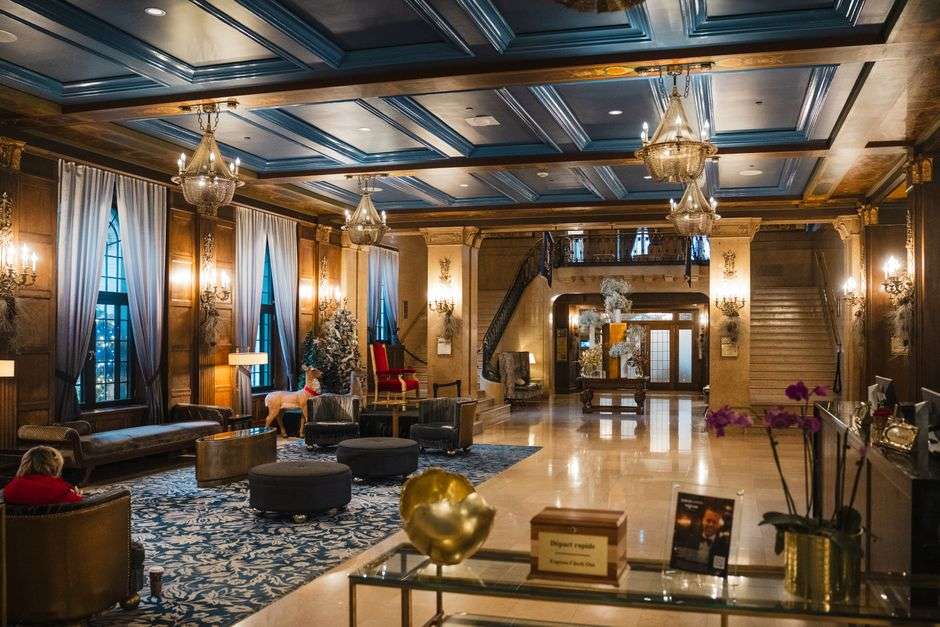
A wave of change is coming to one of downtown Mobile’s most storied buildings. The historic Admiral Semmes Hotel at the corner of Government and Joachim streets has opened its doors to the public for a 15-day sale of gently used furniture, marking the first visible step toward a full renovation of the property.
The sale, which began at 10 a.m. and runs through Oct. 31, is being handled by Hotel Content Liquidators LLC, an Atlanta-based firm that specializes in clearing out hotel inventory ahead of remodeling projects. Shoppers can browse guestroom furniture, lobby pieces, bar and restaurant fixtures, banquet furniture and other accessories once used throughout the hotel.
Sale hours are set for 10 a.m. to 6 p.m. Monday through Saturday and noon to 5 p.m. on Sunday, with discounts on some items reaching as much as 80 percent off original cost. Organizers describe the event as a tag sale rather than an auction, meaning every item carries a set price and is sold as-is, where-is. Buyers have three days after purchase to arrange pickup, and the sale accepts cash along with Visa, MasterCard, Discover and American Express.
“The liquidation sale is a tag sale, not an auction. All items will be priced and sold as is and where is,” said Nicole Schlicher, co-owner and project manager for Hotel Content Liquidators.
This initial round of sales represents only the first of three planned liquidation phases at the hotel, according to organizers, and inventory is limited as a result. Dates for the second and third phases have not yet been announced, but more furniture and fixtures are expected to become available in the coming months as the property is further cleared out.
Built in 1940, the Admiral Semmes Hotel has long served as a gathering place for Mobile residents, hosting wedding receptions, business functions and dinners before performances by the Mobile Symphony. Its location in the heart of downtown has made it a familiar backdrop for generations of local celebrations.
“Nearly everyone I meet has made memories at the Historic Admiral Semmes Hotel, whether it was attending a loved one’s wedding reception or enjoying dinner and drinks before a night at the Mobile Symphony,” said Stephanie Ward Bondora, the hotel’s director of sales. “This sale is the first step in the remodel process, and we look forward to the renovation as it will inject new life into this corner of Government and Joachim.”
The furniture liquidation is expected to pave the way for renovation work at the aging hotel, part of a broader push to revitalize downtown Mobile’s historic commercial core. Property owners and city boosters alike have pointed to the renovation as a sign of continued investment in the district surrounding Government Plaza.
Shoppers interested in the remaining days of the sale are encouraged to visit the hotel in person during posted hours to view available inventory before it sells out.
Mobile is the county seat of Mobile County in southwest Alabama and the state’s only saltwater port. Situated where the Mobile River meets Mobile Bay near the northern Gulf of Mexico, the city has long served as a commercial and cultural gateway between Alabama and the wider Gulf Coast. Founded in 1702 as Fort Louis de la Louisiane and ruled in turn by France, Britain, and Spain before joining the United States in 1813, Mobile carries a layered heritage distinct from the rest of the state.
Today Mobile anchors a metropolitan area spanning Mobile County and neighboring Baldwin County, and it remains a center for shipping, aerospace, healthcare, and higher education in the region. Its downtown and waterfront have seen sustained revitalization, while historic neighborhoods preserve architecture from its colonial and antebellum past. The city’s identity is shaped as much by its working port and industrial base as by its festivals and food culture, making it a frequent focal point for news about growth and change in southern Alabama.
The history of South Alabama is shaped by its position at the crossroads of cultures and waters. Indigenous peoples, including the Muscogee (Creek) and Choctaw, lived in the region for centuries before European colonization by French, British, and Spanish powers.
The cotton economy and the Civil War left deep imprints, as did the Civil Rights Movement, in which Alabama played a defining role. Understanding present-day debates in the region often requires appreciating this layered past, in which port commerce, racial history, and coastal geography have long intertwined.
That inheritance is visible in the architecture, street names, and institutions of the area. Public memory of the past informs contemporary conversations about growth, equity, and identity, and it frequently surfaces in coverage of local events and policy.
Local government in the Mobile area operates through a combination of mayor-council or commission structures at the municipal level and a county commission in Mobile County, with elected officials handling budgets, public safety, infrastructure, and zoning. Baldwin County has its own commission and a collection of incorporated municipalities.
Decisions made in council chambers and commission meetings affect roads, school funding, economic development, and quality of life, which is why coverage of local government is a staple of regional journalism. The interplay between city, county, and state authorities often determines how effectively the area can address shared challenges.
Because many services residents rely on are delivered at the local level, the choices of elected officials have direct, everyday consequences. Budget priorities, in particular, reveal a community’s values and shape the trajectory of growth and public welfare for years to come.
The economy of the Mobile region is diversified across shipping and logistics, aerospace and shipbuilding, healthcare, tourism, and manufacturing. The Port of Mobile is one of the nation’s busiest seaports and a cornerstone of the local and state economy.
Major employers in aviation and defense contribute to a skilled workforce, while economic-development organizations aim to attract investment and jobs through incentives and infrastructure improvements. Small businesses, from restaurants to professional services, form the backbone of neighborhood commerce.
The health of the regional economy is a frequent subject of public discussion and reporting. Workforce development, recruitment of industry, and the fortunes of local retailers all feed into a broader picture of how the Gulf Coast competes and adapts in a changing national economy.
Baldwin County sits directly east of Mobile County across Mobile Bay and is the largest county in Alabama by land area. It encompasses the Eastern Shore communities of Daphne, Fairhope, Spanish Fort, and Foley and stretches south to the beaches of Gulf Shores and Orange Beach along the Gulf of Mexico.
Long among the fastest-growing counties in the state, Baldwin blends suburban development near the bay with tourism-driven coastal economies. Its proximity to Mobile and its position on the Eastern Shore make it a recurring subject of regional news covering growth, infrastructure, schools, and the balance between development and coastal preservation.
Mobile Bay is a shallow estuary in southern Alabama where freshwater from the Mobile, Tensaw, and other rivers mixes with saltwater from the Gulf of Mexico. It is among the largest estuarine systems in the United States and supports commercial and recreational fishing, shipping through the Port of Mobile, and wetlands that buffer the coastline from storms.
The bay’s Eastern Shore, in Baldwin County, includes Daphne, Fairhope, and Spanish Fort, while the Western Shore lies in Mobile County. Its ecology and economy have guided settlement for centuries, and the bay figures in regional debates over development, navigation, and conservation. Events on either shore are routinely covered as part of the interconnected life of the Mobile metro area.
The Gulf of Mexico borders Alabama’s southern edge and defines much of the state’s coastal identity. Alabama’s Gulf coastline, centered on Dauphin Island, Gulf Shores, and Orange Beach, supports a tourism industry built around beaches, charter fishing, and marine recreation, while offshore waters host shipping lanes and energy interests.
The Gulf’s warm, shallow shelf and exposure to hurricanes make weather and disaster preparedness recurring concerns for communities from Mobile to Baldwin County. The marine environment also underpins commercial seafood harvests that have sustained Gulf Coast families for generations, tying the region’s economy and culture closely to the water.
Alabama is a state in the southeastern United States bordered by Tennessee, Georgia, Florida, the Gulf of Mexico, and Mississippi. Often called the Heart of Dixie, it spans Appalachian foothills in the north and flat coastal plains in the south. Its largest cities include Birmingham, Montgomery, Huntsville, and Mobile.
Alabama’s history encompasses Indigenous roots, Spanish and French colonial settlement, a cotton-plantation economy, the Civil War and Reconstruction, and the Civil Rights Movement of the 1950s and 1960s, followed by a shift toward manufacturing, aerospace, and technology. Local news across the state frequently reflects this mix of tradition and change.
The Federal Bureau of Investigation is the principal investigative arm of the United States Department of Justice, tasked with protecting the country against terrorist threats, foreign intelligence operations, cyber attacks, and major criminal activity. Established in 1908, the bureau operates a network of field offices across the country, each responsible for federal law-enforcement matters within its region.