

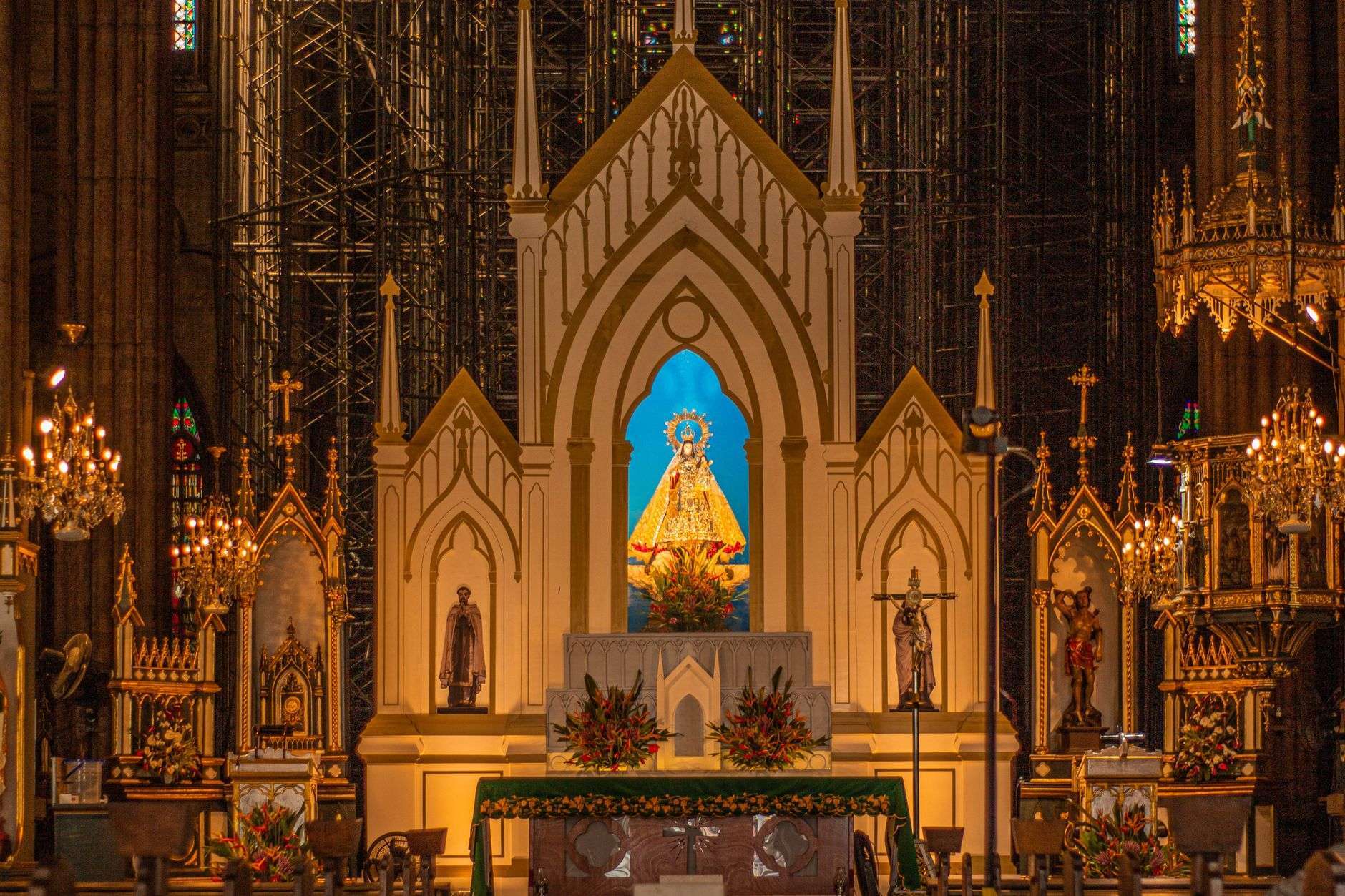
MOBILE, Ala. — Judges, attorneys and others who work in the law are invited to the annual Red Mass in Mobile this Friday, when Archbishop Mark S. Rivituso, the Archbishop of Mobile, will celebrate the centuries-old liturgy at the city’s cathedral.
The Mass begins at 12:10 p.m. Friday, Sept. 25, at the Cathedral-Basilica of the Immaculate Conception, 2 S. Claiborne St., in downtown Mobile. It is offered to honor members of the legal profession and to pray for them as they carry out their work.
The local chapter of the St. Thomas More Society, an organization of legal professionals in the Archdiocese of Mobile, is organizing the service. The Red Mass is traditionally held each year in the archdiocese and is timed to coincide with the start of the judicial year.
At a Glance
- What: Red Mass for members of the legal profession
- When: 12:10 p.m. Friday, Sept. 25, 2026
- Where: Cathedral-Basilica of the Immaculate Conception, 2 S. Claiborne St., Mobile
- Celebrant: Archbishop Mark S. Rivituso, Archbishop of Mobile
- Organizer: Local chapter of the St. Thomas More Society
A Tradition Dating to the 13th Century
The Red Mass is one of the oldest continuing traditions linking the Catholic Church and the legal world. Its roots reach back to Europe in the High Middle Ages, and the first recorded celebration took place at the cathedral in Paris in 1245. The practice spread to England, where it became associated with the opening of the courts each term.
The name comes from two sources. Priests celebrating the Mass wear red vestments, the liturgical color that symbolizes the Holy Spirit, recalling the tongues of fire that Christian scripture describes descending on the Apostles at Pentecost. Historically, the name also reflected the scarlet robes worn by the royal judges who attended the service.
The Mass is a votive Mass of the Holy Spirit. Participants pray for the gifts traditionally associated with the Holy Spirit, among them wisdom, understanding, counsel and fortitude, to guide those responsible for administering justice.
The Red Mass in the United States
The first Red Mass in the United States was held in 1877 at Saints Peter and Paul Church in Detroit. After the tradition there was revived in 1912, it continued annually and is considered the oldest continuously held Red Mass in the country. New York held its first in 1928, and Washington, D.C., followed in 1939.
The Washington service, organized by the John Carroll Society, is the best known. Held each fall at the Cathedral of St. Matthew the Apostle since 1953, it takes place shortly before the U.S. Supreme Court opens its term on the first Monday in October and has drawn Supreme Court justices, members of Congress and, on occasion, the president.
Today Red Masses are celebrated in dioceses across the United States and in countries including Canada, Ireland, Scotland, Australia and the Philippines. Many are organized by lawyers’ guilds or societies named for St. Thomas More.
Who Was St. Thomas More?
St. Thomas More, the patron saint of lawyers and civil servants, is the namesake of the society organizing Friday’s Mass.
Born in London in 1478, More trained as a lawyer and rose to become one of the most prominent figures of Tudor England. He served in Parliament, wrote the influential book “Utopia” and became Lord Chancellor, the highest legal office in the kingdom, under King Henry VIII.
More resigned as chancellor in 1532 amid the king’s break with Rome. He later refused to swear an oath accepting Henry as supreme head of the Church in England, was convicted of treason and was beheaded in London on July 6, 1535. He is remembered for saying on the scaffold that he died “the king’s good servant, but God’s first.”
The Catholic Church canonized More in 1935, alongside St. John Fisher, who was executed the same year for the same refusal. In 2000, Pope John Paul II named More the patron of statesmen and politicians. His example of holding to conscience while serving in public life is a central reason legal societies around the world have adopted his name.
About Archbishop Rivituso
Archbishop Rivituso has led the Archdiocese of Mobile for just over a year. Pope Leo XIV appointed him on July 1, 2025, and he was installed on Sept. 3, 2025, in a Mass at the Cathedral-Basilica presided over by Cardinal Christophe Pierre, the apostolic nuncio to the United States. He succeeded Archbishop Thomas J. Rodi, who led the archdiocese for 17 years.
A native of St. Louis, Rivituso was born Sept. 20, 1961. He studied at Cardinal Glennon College Seminary and Kenrick Seminary in the St. Louis area and was ordained a priest on Jan. 16, 1988. He later earned a licentiate in canon law, the church’s system of law, from Saint Paul University in Ottawa, Ontario.
That training in church law gives him a particular connection to Friday’s audience. Before coming to Mobile, he served in parishes and in the Archdiocese of St. Louis’ tribunal, its church court, and was named a prelate of honor in 2005. He was appointed an auxiliary bishop of St. Louis in March 2017 and was ordained a bishop that May.
Rivituso is the third archbishop of Mobile and the 10th bishop to lead the local church since the diocese was established. His episcopal motto is “Caritas Christi urget nos,” Latin for “The love of Christ impels us.”
The Archdiocese of Mobile
The Diocese of Mobile was established in 1829 by Pope Pius VIII, with Michael Portier as its first bishop. Pope John Paul II elevated it to an archdiocese on Nov. 16, 1980.
Today the archdiocese covers 28 counties across the southern half of Alabama, spanning roughly 23,000 square miles and including Mobile, Baldwin and Montgomery counties. As a metropolitan see, it heads an ecclesiastical province that includes the Diocese of Birmingham and the Mississippi dioceses of Biloxi and Jackson.
A Historic Setting
Friday’s Mass will take place in one of Mobile’s most recognizable landmarks. The parish that became the cathedral traces its history to July 20, 1703, making it the first Catholic parish established on the Gulf Coast. It moved to the present site of Mobile in 1711.
Bishop Portier laid the cornerstone of the current building in 1835. Designed by architect Claude Beroujon in the style of a Roman basilica, the church was delayed by the financial Panic of 1837 and was not consecrated until 1850. A classical portico with Doric columns was added in the 1870s, and the twin towers, rising 103 feet, were completed in 1884.
The cathedral’s main stained glass windows were made by Franz Mayer and Co. of Munich and installed between 1890 and 1910. A fire in 1954 caused heavy damage, destroying several windows, which were sent back to Munich for repair during the restoration that followed.
Pope John XXIII designated the church a minor basilica in 1962, a title given to churches of special historical or spiritual importance. The building underwent another major renovation in the early 2000s.
Planning to Attend
The Cathedral-Basilica is in the heart of downtown Mobile, a short walk from the city’s state and federal courthouses and many of its law offices, and the Mass is set for the lunch hour on a weekday.
Those with questions about the Red Mass may contact the Archdiocese of Mobile or the Cathedral-Basilica parish office.