History Museum of Mobile Sets October Opening for ‘Mobile in the Gilded Age’
The museum’s next major exhibition uses gowns, inventions and everyday objects to trace how commerce, technology and social change remade Mobile between the late 1800s and the early 1900s.
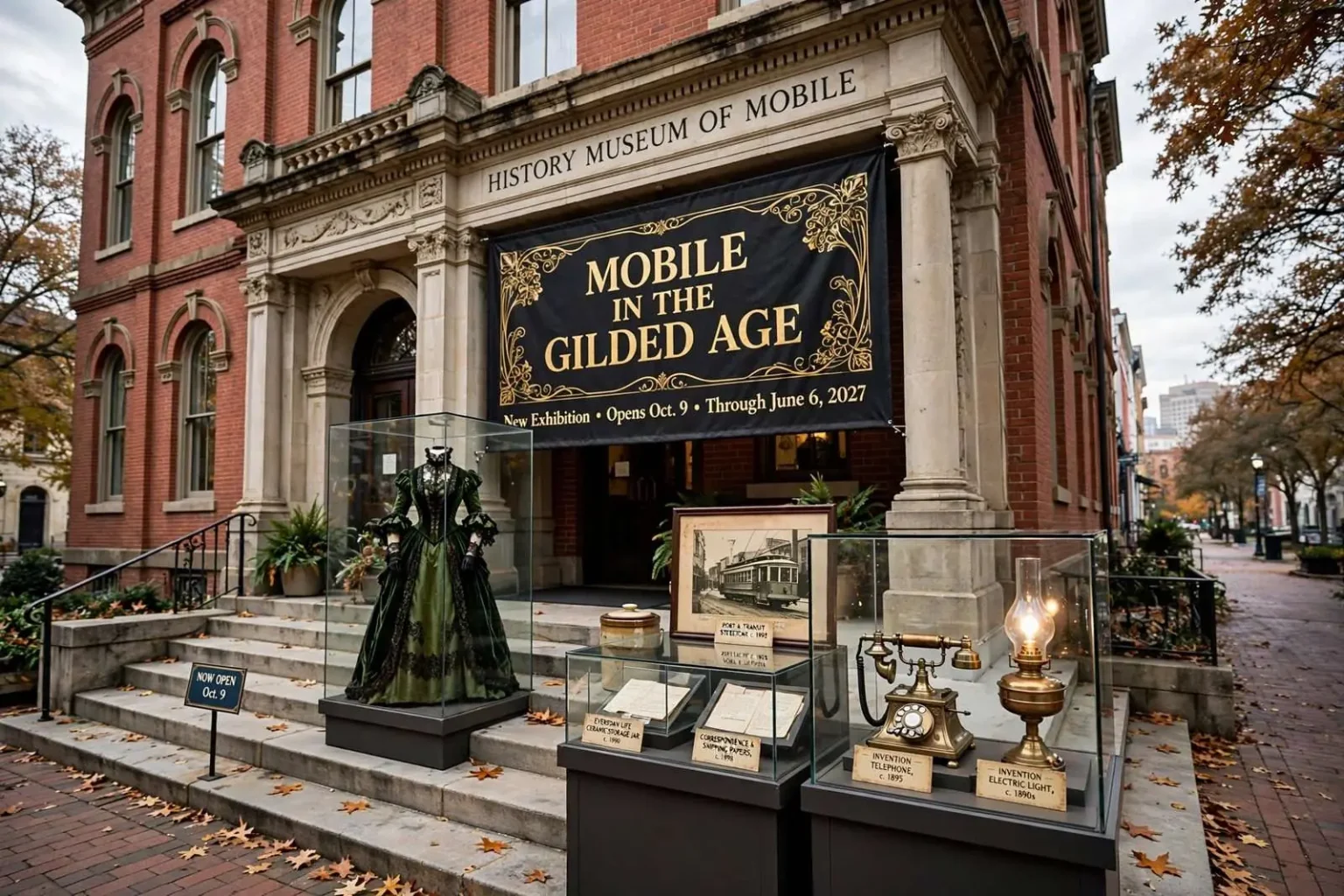
MOBILE — The History Museum of Mobile has announced its next major exhibition, “Mobile in the Gilded Age,” a look at the stretch of decades in which the city was remade by new commerce, new machines and new ways of organizing public life.
The exhibition opens Oct. 9 and runs through June 6, 2027 — a nearly eight-month run that will carry it through the school year and both of the museum’s busiest visitor seasons.
What the Exhibition Covers
The show examines the period from the late 1800s through the early 1900s, which the museum describes as a time of rapid and profound change. Its three announced threads are expanding commerce, new technologies and changing social institutions, and the question it puts to visitors is how those forces reshaped Mobile and the daily lives of the people who lived here.
That framing matters, because it is the difference between a display of old things and an argument about a city. Commerce, technology and institutions are the three levers that determine what a person’s ordinary day looks like: what work is available, how long it takes to get anywhere, who is allowed in which room, and what a household can buy.
Where the Name Comes From
The term “Gilded Age” is not a neutral label historians inherited from the period itself. It comes from an 1873 novel by Mark Twain and Charles Dudley Warner, “The Gilded Age: A Tale of Today,” and the metaphor is deliberately unflattering: gilding is a thin layer of gold applied over a cheaper metal underneath.
The name stuck because it captured a genuine contradiction in American life between roughly the end of Reconstruction and the turn of the century. It was an era of extraordinary construction and invention — railroads, electric light, the telephone, streetcars, mass-produced consumer goods — and simultaneously one of severe inequality, hard industrial labor and political corruption. Any exhibition using the term is signaling that it intends to show both the shine and what was under it.
Gowns, Inventions and Everyday Things
The museum says the story will be told through historic objects, and it has named three categories: gowns, inventions and items from everyday life.
Those three do distinct jobs in an exhibition. Formal dress is a direct record of wealth, taste and social ritual — who was being seen, at what kind of event, in clothing that took how many hours of someone’s labor to produce. Inventions mark the arrival of technologies that changed the pace of ordinary life. And everyday objects — the tools, containers, furnishings and household items that nobody thought worth saving at the time — are usually the rarest and most revealing category, because they document how the majority of people actually lived rather than how the wealthiest presented themselves.
Read together, the three give visitors a way to compare a period’s self-image against its ordinary reality, which is exactly what the Gilded Age label invites.
Why This Period Matters to a Port City
Mobile spent the era in question as a working Gulf port, and port cities tend to feel national economic shifts early. Goods, money, technology and people arrive at a wharf before they reach the interior, and the businesses, banks and shipping interests that grow up around a harbor shape a downtown’s architecture and its social hierarchy at the same time.
Much of what a visitor recognizes today as historic Mobile — commercial blocks, ornate residential architecture, civic and cultural institutions that still carry their original names — dates from or was reshaped during this window. An exhibition on the period is, in practice, an explanation of why parts of the city look the way they do.
An Eight-Month Run
Opening in October and closing in June gives the exhibition an unusually long life for a major show. It will be up for fall visitors, through the winter holidays, across the spring field-trip season and into the beginning of summer travel.
That length also changes how people can use it. A run of this size can support repeat visits, school curricula built around it and related programming over multiple seasons, rather than the compressed six-to-eight-week window that traveling exhibitions often get.
Hours, Admission and the Free Sunday
The History Museum of Mobile is open Monday through Saturday from 9 a.m. to 5 p.m. and Sunday from 1 to 5 p.m. Admission is free on the first Sunday of each month.
Free days are a standard tool for museums trying to widen who walks through the door, and a monthly one is worth planning around for families, students and anyone who would rather sample a long exhibition more than once than try to absorb it in a single visit.
If You Go
“Mobile in the Gilded Age” opens Oct. 9 at the History Museum of Mobile and remains on view through June 6, 2027.