

One of the strangest and most fascinating little museums in America sits in the middle of Foley, Alabama, in a modest building at 111 West Laurel Avenue, on the corner of highways 59 and 98. The Holmes Medical Museum was Baldwin County’s first hospital — and for years its only one — and today it preserves the building, the equipment, and the stories of an era when a south Alabama “hospital” was a handful of rooms and a doctor who compounded his own medicines.
From Hospital to Museum, Barely Changed
Officially the Sibley Holmes Memorial Hospital, the facility was started by Dr. Sibley Holmes in the 1930s, though he passed away before its official opening. The hospital was carried on by his grandsons, Dr. W.C. Holmes and Dr. Jimmy Holmes — both surgeons themselves — who operated it until 1958, when they became the first surgeons at the new South Baldwin Regional Medical Center and the little hospital closed its doors.
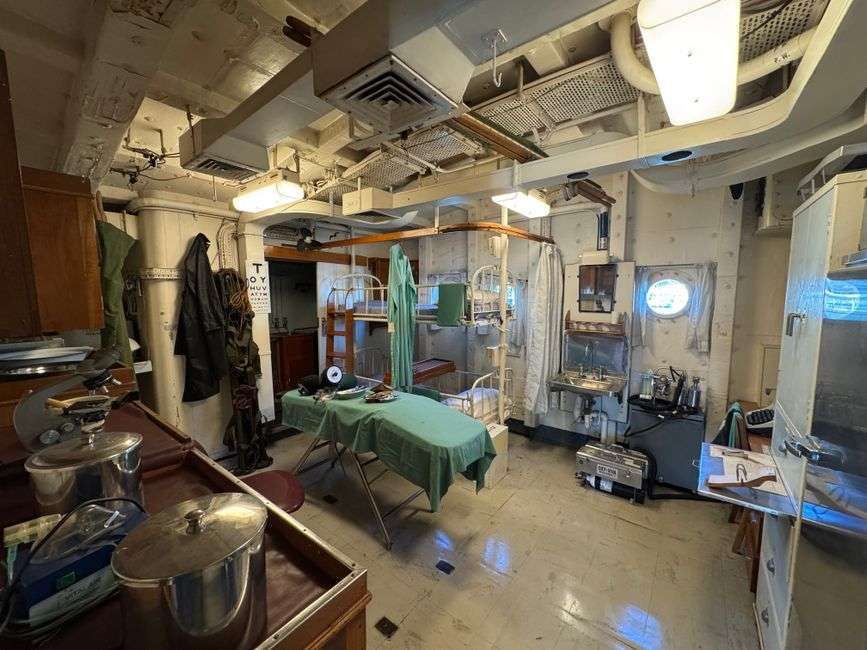
Here is what makes the museum remarkable: little has changed since that day in 1958. The surgical room, the x-ray room, the newborn incubator, and the patient wings all survive in their period condition — a walk-through time capsule of mid-century rural medicine. Beyond maintenance and structural repairs (including a closure to fix Hurricane Sally damage in 2020), the building looks much as it did in the 1930s and 1940s.
State of the Art, 1935
What was then cutting-edge is now, to modern eyes, somewhere between fascinating and alarming. The vintage X-ray machine draws the most double-takes from visitors — more than one physician has remarked that it looks less like medical equipment than an instrument of torture. The waiting room still holds its ancient ashtrays, a reminder that smoking was once not merely tolerated but expected in a place of healing.
The pharmacy is the museum’s best window into how medicine used to work. The doctors themselves compounded medicines for their patients, mixing formulations by hand among shelves of medical vials, mortars, and pestles. A complete skeleton hangs nearby — “hanging around,” as the docents put it — and is reliably the favorite stop for younger visitors.
Working physicians, nurses, and students in the modern medical field find the place especially compelling: it is a working record of what rural doctors did with what they had, and how recently “what they had” was so little.
The Docents and the Stories
The museum’s docents carry the other half of the collection: the stories of Baldwin County’s early days, told with the rehearsed ease of people who love the material. Some of the county’s older residents come specifically to see the place where they were born — a sentence that itself explains why the museum exists. For decades, in a county of farms and fishing camps, this building was where life in Baldwin County began.
Volunteer guides like the museum’s longtime docent Bill Swanson have given generations of visitors personal tours, and the stories range from the medical (what surgery looked like before antibiotics) to the local (which families came down from which crossroads, and how they got there).
A Corner of Foley Worth a Morning
Foley’s downtown has grown around the museum’s corner in the decades since — the city on Highway 59 is now one of Baldwin County’s fastest-growing, with the Tanger Outlets a short drive south and the beaches of Gulf Shores beyond. But the museum’s block remains old Foley, and the visit pairs naturally with two nearby institutions of the edible kind: Stacey’s Olde Tyme Soda Fountain and the Copper Kettle Tea Bar, both a short walk away and both highly rated for food, drinks, and ambiance.
The museum has also drawn national attention: it is listed in Atlas Obscura, the crowdsourced guide to the world’s curiosities, among the top strange museums worth a detour. For a free attraction in a town of 20,000, that is a singular claim.
Plan Your Visit
The Holmes Medical Museum is open Monday through Saturday, 10 a.m. to 3 p.m. Tours are free, and donations are cheerfully accepted — the museum operates on them. Allow an hour, ask the docent for the stories, and bring the kids: the skeleton is waiting.
For Baldwin County newcomers — and there are thousands arriving every year — it is the fastest introduction anywhere to the county’s medical and family history, preserved in the rooms where much of it actually happened.
Above the Drugstore
The building’s original layout explains a lot about rural health care in the 1930s. The hospital occupied the second floor, above the pharmacy and general store spaces of the era — a one-building answer to every need a small town had, with the drug counter downstairs and the delivery room upstairs. Visitors reach the museum the way patients once did: up the stairs, into a warren of rooms that functioned as operating theater, maternity ward, and pharmacy all at once. For a county that was then mostly farmland, piney woods, and fishing camps, having surgery available in Foley at all was a small miracle of logistics.
Getting a patient there was its own challenge. In the hospital’s early years, before the bridges and four-lanes of today, a farming family in Magnolia Springs or a fishing family in Bon Secour might undertake a long, dusty drive — or rely on the doctor to come to them. The museum’s records and stories preserve those journeys, and they put modern complaints about wait times in a different light.
What the Museum Teaches
For educators and homeschool groups, the museum has become a field-trip staple — a physical demonstration of how fast medicine moved in one lifetime. A visitor born in the building in the 1940s grew up in a world of penicillin, polio vaccines, organ transplants, and laparoscopic surgery that would have been unimaginable to the doctors who worked under its roof. The incubator, the iron-style instruments, the compounding pharmacy: every case tells the same story of how recently “state of the art” meant something a modern student would barely recognize.
That living-contrast quality is why the museum continues to appear on national “strange museums” lists and why medical professionals seek it out. It is not a collection of curiosities; it is the genuine article — an intact rural hospital, with its tools still in their places, interpreted by people who knew the doctors who worked there.