

The train depot in Foley was the first stop for many of the city’s earliest residents, and more than a century after it was built, it is still the best place to start learning what made the town.
Standing at the junction of U.S. 59 and U.S. 98 — McKenzie Street and Laurel Avenue to locals — the depot looks out over Heritage Park like a wooden cornerstone. Built in 1909 to replace an original depot destroyed by fire, the structure is one of the oldest buildings in Foley, and it took one of the strangest journeys of any building in Baldwin County to get back where it belongs.
The Man Who Bought a Depot for a Dollar
By mid-century the railroad’s glory days were fading, and the depot ended up sold for a single dollar to businessman John Snook, who owned the local phone company. He moved the building roughly 20 miles away to Magnolia Springs, where it spent more than two decades serving as a storage facility and slowly slid toward dereliction.
“The city was fortunate that businessman John Snook realized the importance of the historic depot,” says Foley Marketing Director LaDonna Hinesley. “When he paid $1 for the building and moved it to Magnolia Springs, people questioned his sanity. He privately told friends that one day the city would want to buy it back, they just didn’t know it yet. And he was right.”
In 1995 the depot came home to its original spot overlooking the town, was carefully restored, and reopened as a museum in 1998. “Today, the building showcases photos and exhibits that tell the story of the city,” Hinesley says. “And how many cities have a historic building that overlooked the town, was moved to the country, and later returned to its original location?”
A Railroad Town, Explained
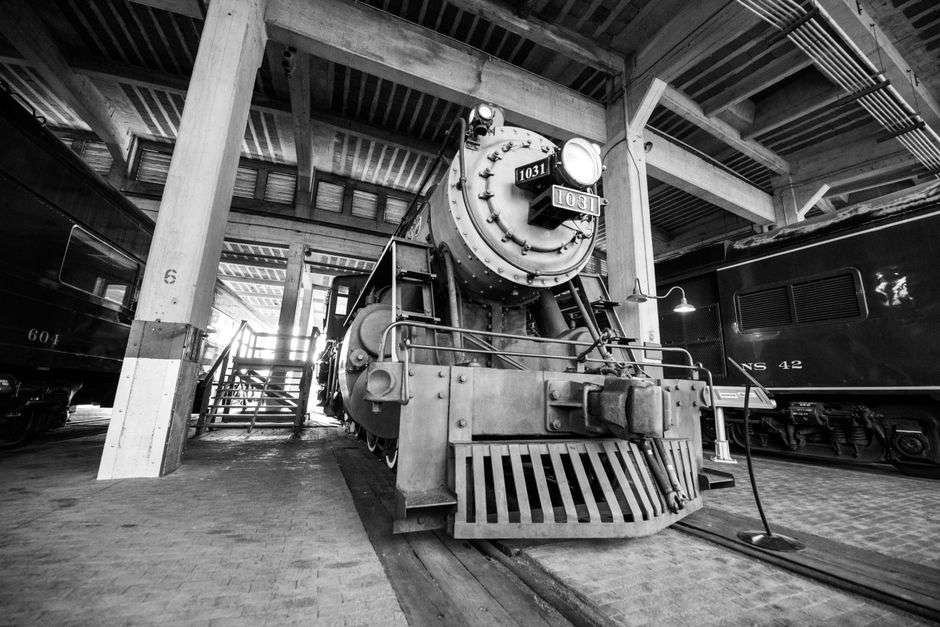
Inside, the museum explains how Foley exists at all. Chicago investor John B. Foley purchased more than 40,000 acres of land and sold it off for farms and homesteads — but the new settlers needed a railroad, and at the time the Louisville & Nashville line stopped at Bay Minette. The final 37 miles of track the L&N pushed south became the lifeline that carried people, timber, farm goods and mail into the community, which now approaches an official population of 25,000.
Adjacent to the museum sits one of its biggest draws: the Model Train Exhibit, an elaborate layout owned by the city and run by the Caboose Club, a dedicated corps of volunteers whose work attracts thousands of visitors a year.
Planes, Too: The Barin Field Story
Trains may anchor the museum, but a newer exhibit honors Foley’s surprising aviation history. During World War II, Barin Field — an auxiliary training center for Pensacola Naval Air Station — sat on Foley’s east side, land bisected today by the Foley Beach Express. The airfield opened almost exactly a year after Pearl Harbor.
“To give you an idea, they had 2,000 people assigned to the base and Foley had a population at the time of about 800,” says Foley Marketing Communications Manager Guy Busby. “It had a huge impact on the city throughout the 1940s and indeed the 1950s. A great many of the pilots who fought in the Pacific trained here or in Pensacola. It was a very intensive training program.”
Between 1942 and 1958, as many as 400 trainer planes filled the skies over Foley. Many of the young officers, like railroad namesake John B. Foley before them, saw potential in the area and stayed to raise families. Busby knows the story personally: his father-in-law, the late Albert J. Rea, came from Canton, Ohio, took his officer’s commission, and was sent to Foley in the 1950s, where he married local Joan Carter and raised three children — the oldest being Busby’s wife, Liz.
The khaki jacket Rea wore as a young officer hangs in the exhibit, not far from a WAVES uniform belonging to chaplain’s assistant Jane Smith Peterson Coleman, a Louisiana native who went on to run a local marine and hardware store with her husband and teach Sunday School. Enlarged black-and-white photographs and narrative panels fill out the era.
The Barin Field exhibit opened Dec. 5 — the 82nd anniversary of the base’s 1942 opening. Revived attention to the base’s history grew partly out of the National Park Service’s World War II Heritage City program, which designates one city per state. “We found out about this program in 2023, that they were looking for a city in Alabama, so we applied for it, and it’s a great honor,” Busby says.
City officials hope eventually to give the naval aviation story a museum of its own, large enough to display a piece the city already owns: an 83-year-old yellow Naval Aircraft Factory N3N bi-plane acquired in October, housed at Foley Municipal Airport and flown twice a month to maintain its airworthiness.
Plan Your Visit
The Foley Railroad Museum and Model Train Exhibit stand in Heritage Park near the junction of U.S. 59 and U.S. 98, the heart of a park that also hosts the city’s seasonal events. Admission is free, hours are posted on the city’s website, and the model train volunteers are usually on hand to talk shop.
A 115-year-old depot that survived fire, a one-dollar sale and two decades of exile has ended up exactly where Snook predicted it would: back at the center of Foley, telling the city’s story to anyone who walks in.