Honoring the Gulf Coast’s Historic Lighthouses on National Lighthouse Day
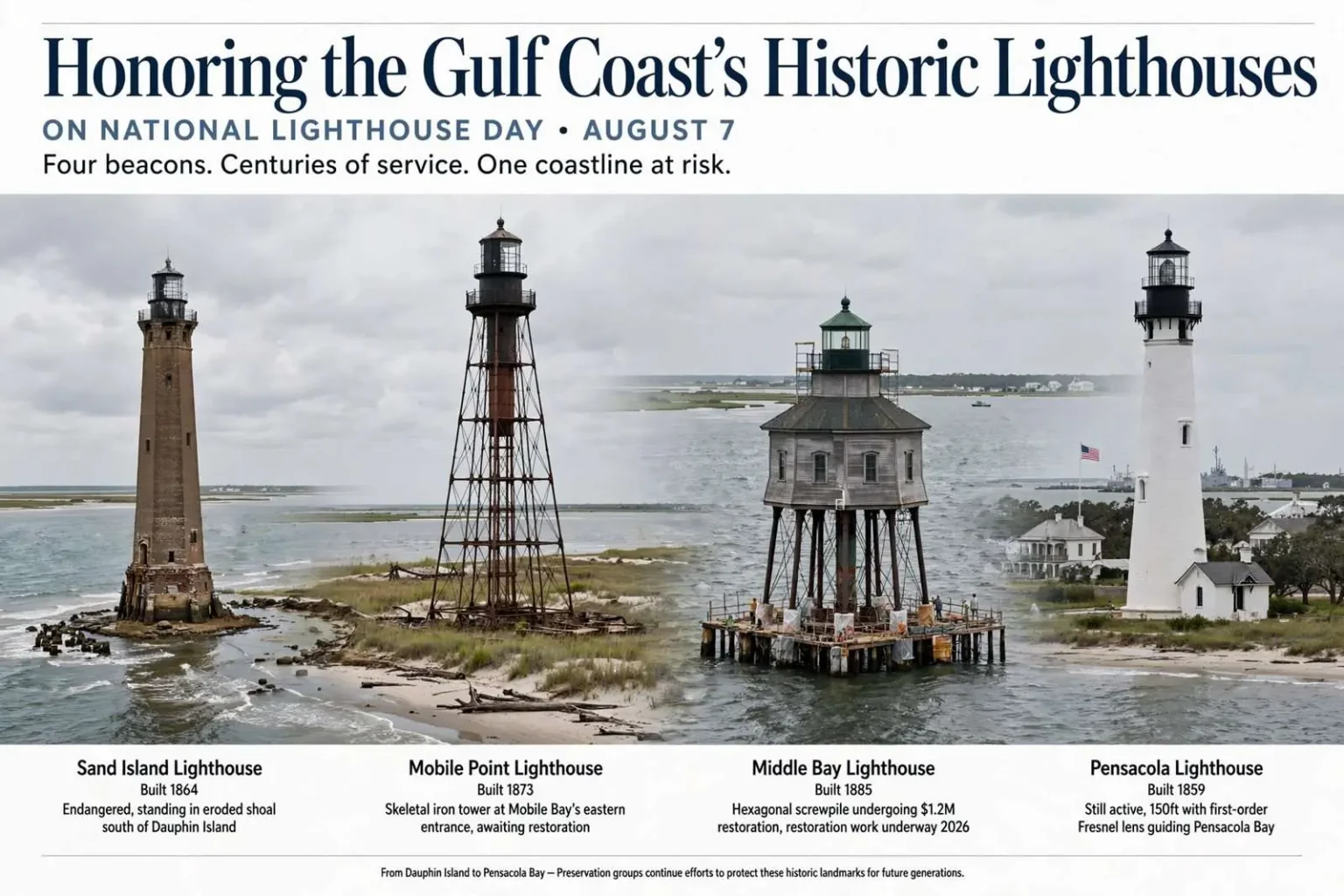
National Lighthouse Day spotlights four historic Gulf Coast beacons -- Sand Island, Mobile Point, Middle Bay and Pensacola lighthouses -- and the preservation efforts keeping them standing.
National Lighthouse Day is a chance to recognize the historic beacons that have guided sailors along the Alabama and Florida Gulf Coast for generations. Each Aug. 7, the anniversary of the federal government’s first act providing for lighthouses in 1789, communities across the country honor the towers that once marked every dangerous shoal and harbor entrance — and few regions hold onto that heritage like the northern Gulf, where four lighthouses in particular stand out as symbols of the region’s maritime history and resilience.
Sand Island, Mobile Point, Middle Bay and Pensacola together trace the story of navigation on the Gulf Coast from the early nineteenth century to the present day. Two guard the approaches to Mobile Bay, one stands in the middle of it, and one keeps watch over the entrance to Pensacola harbor. Their fates — erosion, decommissioning, restoration and continued service — mirror the changing ways the coast has managed its waters, from oil lamps and keepers’ logbooks to automated beacons and volunteer preservation groups.
For the communities around them, the lighthouses are more than navigational history. They appear on logos, anchor festivals and draw visitors to waterfronts from Dauphin Island to Pensacola Beach, and each one carries a preservation story that local residents have fought to keep alive.
Sand Island Lighthouse
Sand Island Lighthouse was originally built in 1839, then destroyed during the Civil War and later reconstructed. The current 125-foot tower was completed in 1864 and remains one of the tallest lighthouses on the Gulf Coast. Built on a low island south of Dauphin Island at the mouth of Mobile Bay, the light marked the deepwater entrance that oceangoing ships had to find before any vessel could reach the port of Mobile.
The tower’s surroundings have shifted almost as much as its history. Sand Island itself has steadily washed away as currents and storms rearranged the barrier landscape, leaving the lighthouse standing in the water where an island — complete, in earlier eras, with keepers’ quarters and outbuildings — once supported it. What was a staffed station is now a tower reached only by boat, standing on a shoal that barely breaks the surface at high tide.
Today, the structure faces severe erosion threats and is ranked among the nation’s most endangered lighthouses, a reminder of how vulnerable coastal historic sites can be to shifting shorelines and storms. Preservation groups have worked for years to stabilize the base and document the tower’s condition, and its plight has become a case study in the challenges facing historic structures built on dynamic coastlines — the same forces that threaten roads, homes and habitats across the region.
Mobile Point Lighthouse
Mobile Point Lighthouse has helped guide vessels into Mobile Bay since 1822, making it one of the longest-serving navigational landmarks in the region. Positioned at the tip of the peninsula that forms the bay’s eastern entrance — directly across the channel from Fort Morgan — the station watched over the very water where Adm. David Farragut’s fleet fought its way past the Confederate defenses in August 1864.
Its current cast-iron skeletal tower was built in 1873, a late-century replacement in the industry’s standard postwar pattern: a prefabricated iron framework, shipped in sections and erected at the site, supporting a lantern room high above the dunes. The skeletal design stood up well to wind and could be seen through the storms that frequently swept the point.
The light was decommissioned in 1963 and still awaits restoration, though it remains a historic fixture near the entrance to the bay. Modern navigation has moved seaward — range lights, buoys and electronic charts now do the work the old beacon performed — but the tower’s future has lingered on the agendas of preservationists and state officials, who have weighed relocation, stabilization and funding options for a structure exposed to surf, salt and hurricanes at one of the busiest channel entrances on the coast.
Middle Bay Lighthouse
Known as the hexagonal “Screwpile Lighthouse,” Middle Bay Lighthouse was built in 1885 on iron pilings driven into the floor of Mobile Bay. Standing in open water between Mobile and the barrier islands, the cottage-style beacon served the fleets of oyster boats, schooners and steamers that worked the bay’s shallows and shipping lanes in the late nineteenth and early twentieth centuries.
The screwpile design was a Gulf and Chesapeake specialty: rather than a masonry tower on land, the light sat on a framed cottage raised above the water on screw-turned pilings, allowing it to occupy shoals no island or point could cover. Keepers lived in the structure itself, rowing or sailing to duty and enduring hurricanes with nothing between them and the bay but the pilings below.
It was decommissioned in 1967 but has remained a beloved landmark ever since. Boaters crossing the bay use it as a waypoint, photographers chase it against storm skies and sunsets, and its silhouette has become one of the defining images of Mobile Bay’s maritime identity.
The lighthouse is currently undergoing a $1.2 million restoration project that began in early 2026 and is expected to wrap up by late October, preserving the structure for future generations. The work addresses the accumulated toll of nearly a century and a half in open water — pilings, framing and the structure’s exposed finish — and represents the most significant investment the screwpile has received in decades, funded through the partnerships that have formed around saving it.
Pensacola Lighthouse
Standing 150 feet tall, Pensacola Lighthouse has guided sailors since 1859 and remains an active aid to navigation today. The tower rises near the entrance to Pensacola Bay on the grounds of what is now Naval Air Station Pensacola, in sight of the forts and beaches that share the bay’s military history, and its lamp still shines over one of the busiest harbors on the northern Gulf.
It houses one of the rare first-order Fresnel lenses still in use in the United States, a distinction that sets it apart from many of its Gulf Coast counterparts. The first-order lens, the largest class the great French optician Augustin Fresnel’s design produced, concentrates a lamp’s light into a beam visible for miles, and the Pensacola lens remains a working example of the technology that defined the golden age of lighthouses.
The former keeper’s house at the site has since been converted into a museum, giving visitors a window into the daily lives of the families who staffed the light. Exhibits cover the keepers’ routines — trimming wicks, winding clockwork mechanisms, polishing brass and keeping the watch logs — along with the tower’s Civil War history, when Confederate forces removed the lens apparatus and Union troops later restored it.
Visitors today can climb the tower’s 177 steps for one of the best views on the Gulf Coast, looking out over Pensacola Bay, the navy base’s flight lines and the barrier islands beyond. The lighthouse is among the few in the region that offers regular public access, making it a centerpiece of National Lighthouse Day observances along the northern Gulf.
Why the Coast’s Lights Still Matter
Together, the four lights tell the story of how navigation changed on the northern Gulf. Sand Island and Mobile Point marked the deepwater approaches that made Mobile a port; Middle Bay served the working boats of the bay itself; Pensacola guided warships and merchantmen into a harbor that became the cradle of naval aviation. Each was built with the technology of its era — masonry, cast iron, screwpile — and each survives, or struggles to survive, on the strength of the people who decided it should.
Preservation on the water is a different discipline than preservation on land. Salt, wind, storms and rising seas attack structures that have no buffer, and the region’s hurricanes have damaged or destroyed lighthouses across the Gulf in every generation. That is why the recent work at Middle Bay, the stabilization efforts at Sand Island and the long-discussed plans for Mobile Point are tracked so closely by local history groups: each project is a race between preservation and the same coastline dynamics that reshape the islands and beaches around them.
National Lighthouse Day offers those groups their annual moment in the public eye. Museums, lighthouse associations and historic sites across the country mark the day with tours, talks and fundraisers, and along the Alabama and Florida coasts the observance gives residents a reason to visit lights they may have passed a hundred times without stopping.
For travelers building a Gulf Coast itinerary around the observance, the lights form a natural circuit: the Pensacola tower, open for climbs and its museum; Mobile Point at the edge of Fort Morgan’s grounds; Middle Bay visible from the water or from shore across the bay; and Sand Island, seen best from a boat out of Dauphin Island, rising where an island used to be. Each stop carries its own story of storms, keepers, wars and the slow work of preservation.
The region’s lighthouses no longer guide the ships that built the Gulf’s ports — satellites and electronic charts have long since taken over. What they guide now is memory: of the keepers who maintained the lights through hurricanes, of the maritime economy that made the coast what it is, and of the communities that keep deciding, generation after generation, that these towers are worth saving. On National Lighthouse Day, four of them — Sand Island, Mobile Point, Middle Bay and Pensacola — stand for all the rest.