Horror Film ‘Oculus’ to Film in Fairhope This Fall
The supernatural thriller Oculus, starring Doctor Who's Karen Gillan, is set to film in the Mobile and Fairhope area during October 2012.
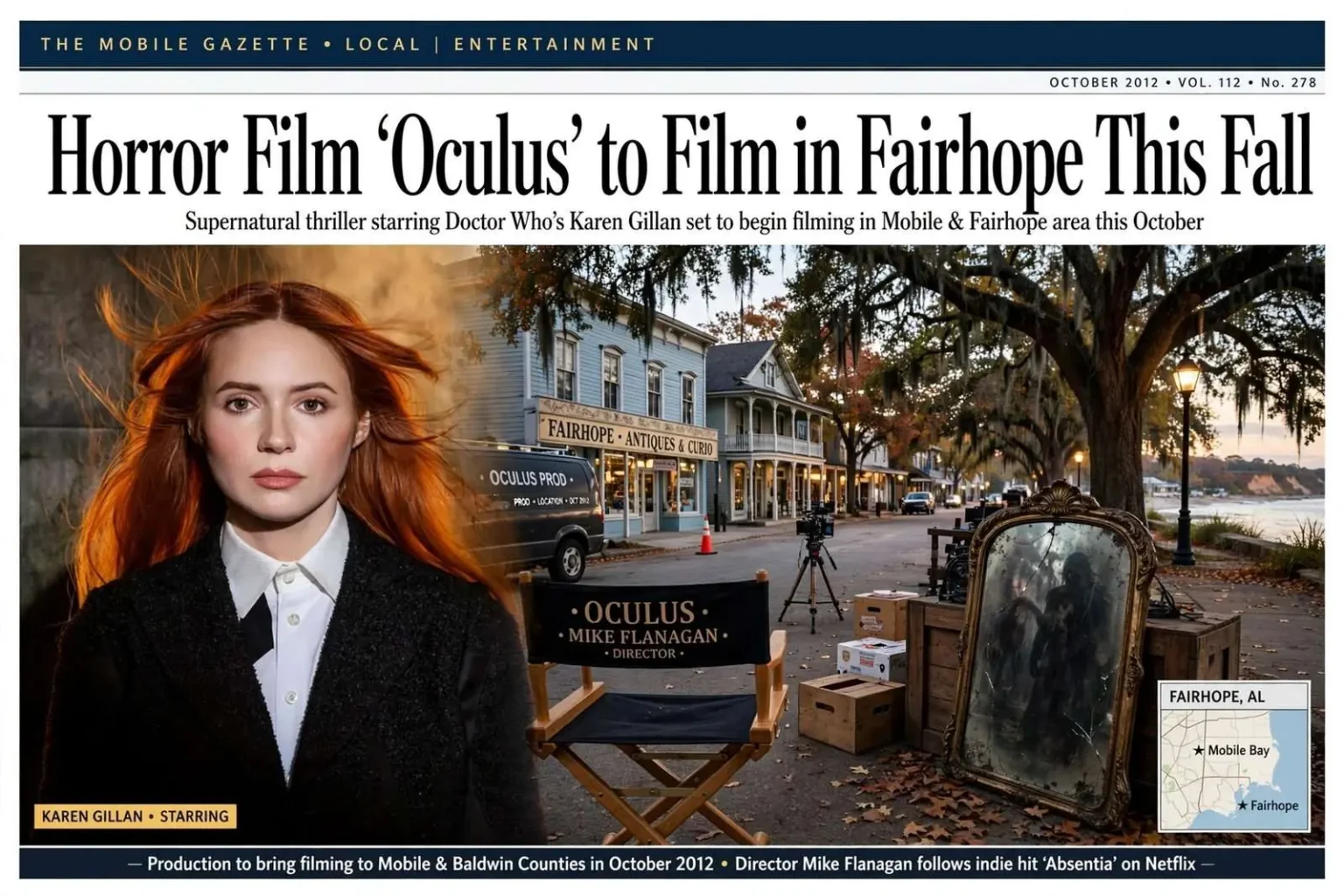
The supernatural thriller “Oculus,” starring Karen Gillan of “Doctor Who,” is set to begin filming in the Mobile and Fairhope area during October 2012, according to production announcements. Director Mike Flanagan’s earlier horror effort, “Absentia,” is available on Netflix. Gillan’s final series of “Doctor Who” premiered Sept. 1 on BBC America, alongside a new “Doctor Who” spinoff prequel web series that began Aug. 27 on the official “Doctor Who” website.
The announcement put the Mobile area on a map it had appeared on only occasionally: the map of destinations where Hollywood productions choose to shoot. “Oculus,” a supernatural thriller built around a haunted antique mirror, planned to bring its cameras to Fairhope and surrounding Mobile County and Baldwin County locations in October 2012, with Karen Gillan — then one of the most recognizable faces on television thanks to her role as Amy Pond on “Doctor Who” — attached to star.
Fairhope, the picturesque Baldwin County city perched on the eastern shore of Mobile Bay, has long been a favorite of artists and writers, and its tree-lined streets, boutiques, and bluff-top park give it a look that translates well to film. The town has hosted literary figures for more than a century, and a production settling in for weeks of autumn filming promised a small economic pulse — lodging, catering, location fees, and local hiring — along with the novelty of seeing familiar streets stand in for settings on the big screen.
A director on the rise
For Mike Flanagan, “Oculus” represented a decisive step forward. His earlier feature, “Absentia,” a low-budget horror film about a woman whose husband vanishes and a tunnel that seems to swallow people, had been made for a fraction of the cost of a studio picture and had found its audience on Netflix, building the director a reputation for atmosphere and emotional weight rather than cheap shocks. Horror fans who discovered “Absentia” through streaming were primed to follow Flanagan to his next project, and the jump to a larger production with a name star was exactly the trajectory independent horror directors hope for.
Flanagan’s approach on “Absentia” — long, uneasy silences, family grief as the true monster, and dread that builds in daylight as often as in the dark — signaled the sensibility he would carry into “Oculus.” The new film centered on two siblings, one just released from a psychiatric facility, who are convinced that an antique mirror in their possession is responsible for the destruction of their family years earlier, and who set out to destroy it. A premise built on an ordinary household object gave the production plenty of reasons to seek out real homes and neighborhoods rather than soundstage sets, which is where communities like Fairhope enter the picture.
Karen Gillan trades the TARDIS for a haunted mirror
The casting of Karen Gillan gave the project a built-in international profile. Gillan had spent several seasons as Amy Pond, the companion to Matt Smith’s Eleventh Doctor on “Doctor Who,” the long-running British science fiction series that airs in the United States on BBC America. Her final series in that role premiered Sept. 1 on BBC America, with her departure from the show scheduled to play out on screen — a transition that made an American film role a natural next chapter.
Around the premiere, the “Doctor Who” machine was running at full speed. A new spinoff prequel web series began Aug. 27 on the official “Doctor Who” website, extending the show’s storytelling onto the web and giving fans additional material between episodes. For viewers in the Mobile area who had never followed the program, the arrival of its most prominent supporting actress to film locally was an introduction to a fandom far larger than the genre’s reputation suggests.
Gillan’s move from television companion to horror lead also tracked with a broader pattern in the industry, as “Doctor Who” alumni routinely found work in American film and television after leaving the TARDIS. For a production like “Oculus,” the value was obvious: a star known to millions of genre fans on two continents, bringing attention to an independently financed thriller shooting on the Gulf Coast.
Filmmaking on the Gulf Coast
The choice of the Mobile and Fairhope area for an October 2012 shoot reflected both practical and aesthetic considerations. Southern Alabama in autumn offers warm weather, long shooting days, and locations — antebellum and Victorian homes, waterfronts, small-town main streets — that can stand in for many parts of the country. State film offices compete for productions of this size because the spending ripples outward: crews hired locally, hotels filled for weeks, restaurants and hardware stores serving a production company’s daily needs.
Alabama has cultivated that business with incentive programs designed to offset a portion of production costs for films that shoot in the state, and nearby Louisiana’s aggressive film tax credit program had already turned New Orleans into a major production hub. For Mobile and Baldwin counties, hosting “Oculus” was a chance to demonstrate that the region could support a professional feature shoot, from lodging to local crew availability to the logistical work of closing streets and dressing locations.
Productions of modest budget do not transform a local economy, but they do leave traces. Residents notice the trucks, the dressing of a house on a familiar street, the crew members eating lunch in town. Local actors and extras get their first film credits. And the community gets a story to tell when the finished film eventually reaches theaters — the rare moment when a small Gulf Coast city can point at the screen and say a scene was shot there.
The haunted mirror tradition
“Oculus” joined a long line of horror films built around cursed objects, a premise that has served the genre for decades because it turns the familiar domestic world into a threat. Mirrors in particular carry deep reservoirs of superstition — broken mirrors and bad luck, covered mirrors in houses of mourning — and the film’s central premise leaned on that inherited dread. What distinguished the project from the era’s parade of remakes and found-footage entries was its structure: rather than a single linear haunting, the story moved between past and present, showing how the mirror’s influence had dismantled one family years before and was now being confronted by the surviving children as adults.
That dual timeline gave the production reasons to shoot in an area with older housing stock, where a single location could plausibly serve both eras of the story. Gulf Coast neighborhoods full of historic homes — precisely what Fairhope and parts of Mobile offer — fit that requirement well, and October’s softer light suited a film that traded on ordinary spaces turning sinister.
The shoot also came at a moment when independent horror was enjoying a commercial resurgence. Studios had learned that modestly budgeted fright films could deliver outsize returns, and specialty distributors were competing for titles that built buzz on the festival circuit. A well-reviewed thriller with a charismatic lead and a director with a following was exactly the kind of property buyers were watching for, and the filming on the Gulf Coast was the first visible step in that journey.
What the production meant locally
For residents of Fairhope and Mobile, an October shoot meant the unusual spectacle of a film crew at work among them. Productions in small communities typically hire local people for background roles, security, and support positions, and they spread real money through the businesses they use. They also leave behind goodwill and curiosity in roughly equal measure, as residents watch a house on their street become a movie set for a few weeks and then revert to being just a house again.
Local film supporters had long argued that the Mobile area offered everything a mid-size production needed — varied locations, experienced tradespeople, an airport, and affordable logistics — and each visit by a working production tested that argument. A successful, uneventful shoot made the case for the next production better than any brochure could.
By the time October 2012 arrived, the pieces were in place: a director whose debut had found its audience on Netflix, a star arriving from her final season on “Doctor Who,” which had premiered its new series Sept. 1 on BBC America just as a “Doctor Who” spinoff prequel web series began Aug. 27 on the show’s official website, and Gulf Coast communities ready to play host. “Oculus” would go on to travel far beyond the streets where it was filmed, but its starting point was here, on the eastern shore of Mobile Bay, where a small city spent an autumn helping to make a horror film.
It is worth remembering, too, how stories like this one circulate in a community. Word of a film shoot spreads through downtown shops and school carpools long before anything official appears, and the mixture of excitement and skepticism that greets it — will they really come, will they really hire here — is part of the local ritual. When trucks actually arrive and lights actually go up on a Fairhope evening, the skepticism dissolves into the pleasure of watching a place one knows intimately be treated as worth filming.