Few dishes are as tied to Mobile’s table as West Indies Salad, and no name is more tied to the dish than William “Bill” Bayley. The restaurateur is credited with starting a dining craze that swept the Gulf Coast — first with his chilled crab salad and then with fried crab claws — recipes that spread from a one-room roadside joint to tables across the South and the nation.
Today, versions of West Indies Salad appear on menus from the Eastern Shore to the Florida panhandle, served cold over ice with saltines alongside, as much a part of a coastal Alabama spread as gumbo or fried shrimp. But the dish has an origin story, and it traces back to a seaman’s galley and a crossroads south of Mobile.
From Grocery to Gulf Coast Institution
Bayley’s path ran through the sea long before it reached the kitchen. A native of Alvin, Texas, who grew up in Massena, New York, he served in the U.S. Merchant Marine as a steward and spent fifteen years as port steward and later chief chef with Alcoa Steamship Co. It was on voyages to the West Indies that he invented the salad that would make him famous.
The Merchant Marine years gave Bayley both the ingredients and the audience for his creation. Shipboard cooking demanded thrift and simplicity — a handful of ingredients that could hold up for days without refrigeration tricks — and island ports exposed him to the crab, citrus and oil traditions of Caribbean kitchens. What he distilled from those voyages was deceptively plain: crab meat, onion, oil, vinegar and water, marinated until the flavors married.
After World War II, Bayley and his wife, Ethel Peterson Bayley, opened a tiny grocery in 1946 with $500 worth of groceries bought on credit. A year later they left the grocery business behind and opened the restaurant.
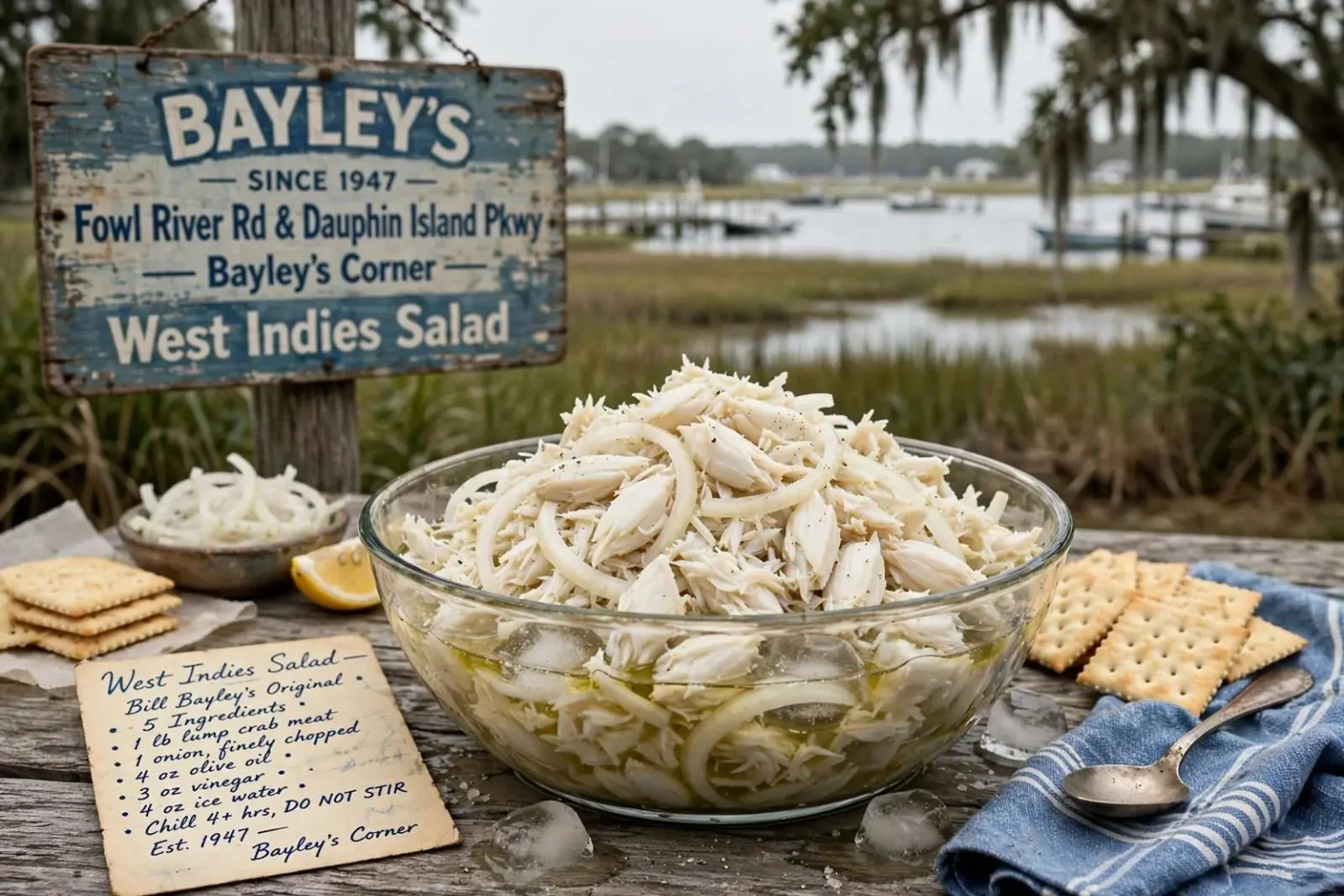
Bayley’s at Fowl River Road and Dauphin Island Parkway became a Gulf Coast fixture from its founding in 1947 until it closed in 1986. His son reopened it in 1993 at the intersection locals had long dubbed Bayley’s Corner, reviving the name and the recipes that had made the original a pilgrimage site for crab lovers.
The location itself tells a story about how the Gulf Coast ate in the mid-century years. The corner sat along the route travelers took toward Dauphin Island’s ferry and beaches, and the restaurant grew by serving that passing traffic — commercial fishermen, families headed to the water, and locals who knew exactly what to order. The one-room roadside joint eventually drew visitors from across the region who came for a dish most had never seen anywhere else.
A Menu That Changed Coastal Dining
The West Indies Salad was only half of Bayley’s legacy. He is also credited with popularizing fried crab claws, a dish that turned the meaty claws of the Gulf blue crab into a finger food that spread across coastal Alabama restaurants and beyond. Before Bayley, crab claws were more often a byproduct; after him, they became a signature appetizer that generations of Gulf Coast diners have ordered by the platter.
Together, the two dishes helped define what a Gulf Coast seafood house looked like. Chilled, marinated crab for the ladies-who-lunch crowd; fried claws and cold beer for the deck crowd. The combination proved so durable that restaurants still build menus around it, and the phrase “West Indies Salad” itself — generic as it sounds — remains a tribute to the man who coined it.
Bayley operated restaurants at Bayley’s Corner and at Mobile’s airport, and his catering took him across the country. When Alabama’s senators and representatives planned parties in Washington, aides knew there was only one caterer they wanted: Bill Bayley. The state’s political establishment flew its favorite dish north whenever the occasion demanded it, making the salad an informal ambassador for Mobile’s table.
The Original Recipe
The salad itself remains famously simple: one pound of lump crab meat and one finely chopped onion, seasoned with salt and pepper, dressed with four ounces of olive oil, three ounces of vinegar and four ounces of ice water added in that order. The mixture is not stirred; it is covered, refrigerated for at least four hours, then tossed just before serving.
That refusal to stir is the recipe’s defining instruction. Layering the dressing over the crab and letting cold do the work keeps the lump meat intact — the prized, whole flakes of jumbo crab that separate a true West Indies Salad from ordinary crab salad. The ice water chills the marinade immediately, and the long rest lets the vinegar and oil permeate the onion, mellowing its bite until it tastes less like an ingredient than a seasoning.
The proportions have been copied, adjusted and argued over for decades, but home cooks and restaurant kitchens that stay faithful to the original swear the ratios matter. Too much vinegar and the crab sharpens; too much water and the marinade goes thin. The dish contains no mayonnaise, no celery, no pepper flakes — just the five components Bayley settled on in his shipboard kitchen, unchanged on the menus that bear the name today.
Lump blue crab remains the standard, and Alabama’s waters still supply much of it. The Gulf’s blue crab fishery, centered in the bays, rivers and estuaries around Mobile Bay, has long produced the sweet meat that makes the salad work, and local crab processors remain the backbone of the dish’s supply chain from the-catching to the-table.
A Legacy on the Gulf Coast Table
Bayley’s original restaurant closed in 1986, but the institution he built never really left. The 1993 reopening by his son at Bayley’s Corner restored the landmark to the intersection where regulars had always said it belonged, and successive generations of Gulf Coast chefs have cited the restaurant as the wellspring of the region’s crab traditions.
The dish’s spread beyond Alabama is a measure of its portability. Because the salad is served cold, it travels well — to supper clubs, to catered parties, to seafood markets selling it by the pint. Versions now appear as far from Mobile as mountain resorts and inland dinner houses, usually with a line on the menu acknowledging where the recipe came from.
In Mobile itself, the salad has become a shibboleth. Local restaurants serve it at Mardi Gras season, on holiday tables and at seafood joints along the causeway, and debates about whose version is most faithful to Bayley’s are as perennial as the dish itself. What is not in dispute is the provenance: one man, one recipe, one corner by the river.
Bayley’s story is also a story about how regional food traditions form. A Merchant Marine steward from Texas by way of New York landed in postwar Mobile, opened a five-hundred-dollar grocery on credit, and built a culinary landmark out of a recipe he perfected at sea. Nearly eight decades later, the Gulf Coast still tastes the result.
The Corner That Became a Landmark
The intersection of Fowl River Road and Dauphin Island Parkway sits in the stretch of south Mobile County where the city thins into marsh, marinas and fish camps. In the years after World War II, it was a working corner — a place where crab boats unloaded, where families stopped on the way to the island, and where a small restaurant could live on the traffic between Mobile and the Gulf. Locals shortened the location’s name long ago: Bayley’s Corner, as if the family and the crossroads were the same thing.
For the four decades the original restaurant operated, that equation was close to true. Bayley’s was among the first stops for travelers who had crossed the ferry from Dauphin Island, and a required stop for Mobilians who wanted the salad for a Sunday table. The building’s one-room origins never quite wore off — generations of customers remembered counter service, paper products and a line out the door on summer weekends — and that unpolished character became part of the dish’s legend.
The airport restaurant extended Bayley’s reach into the city’s front door. Travelers passing through Mobile could taste the region’s signature dish without ever leaving the terminal, an early form of the restaurant-as-ambassador that Gulf Coast destinations later formalized. The catering business, meanwhile, carried the salad to Washington dinner parties and events far from any coastline, often for the Alabama congressional delegation’s own gatherings.
When the original closed in 1986, the interruption proved temporary. The son’s 1993 reopening at Bayley’s Corner restored both the recipes and the address, and the family’s continuity is a large part of why the dish’s provenance has stayed a matter of record rather than of folklore. Few regional dishes can trace themselves to a single restaurant, a single family and a single set of measurements; West Indies Salad can.
Why the Dish Endures
Part of the salad’s staying power is its seasonlessness. Fried seafood crowds the summer menu, gumbo belongs to winter, but a chilled crab salad suits a July porch and a Christmas buffet equally well. Mobile hosts have long treated it as a make-ahead dish for Mardi Gras open houses, since the four-hour marinade — and, in practice, an overnight rest — only improves the result and frees the cook from last-minute work.
Part of it is the crab itself. The Gulf blue crab’s meat is sweeter and more delicate than most of its cousins, and lump meat from Mobile Bay-area processors is the benchmark the dish was built around. Local seafood houses that serve the salad today still advertise the same selling point Bayley’s did: whole lumps of crab, lightly dressed, nothing to hide behind.
And part of it is simply the story. Diners who learn that the dish was invented aboard a freighter bound for the Caribbean, then carried ashore by a steward-turned-restaurateur to a one-room joint on Fowl River, tend to remember it. The recipe’s five ingredients fit on an index card; the history fills a book’s worth of Gulf Coast lore, and every bowl of it served between here and the West Indies carries a little of both.