How Mary G. Montgomery Turned Around Its Football Program by Keeping Local Talent Home
Mary G. Montgomery's football turnaround under coach Zach Golson is being driven by a deliberate strategy to keep Semmes-area youth talent from transferring elsewhere, with two freshmen already drawing Division I offers.
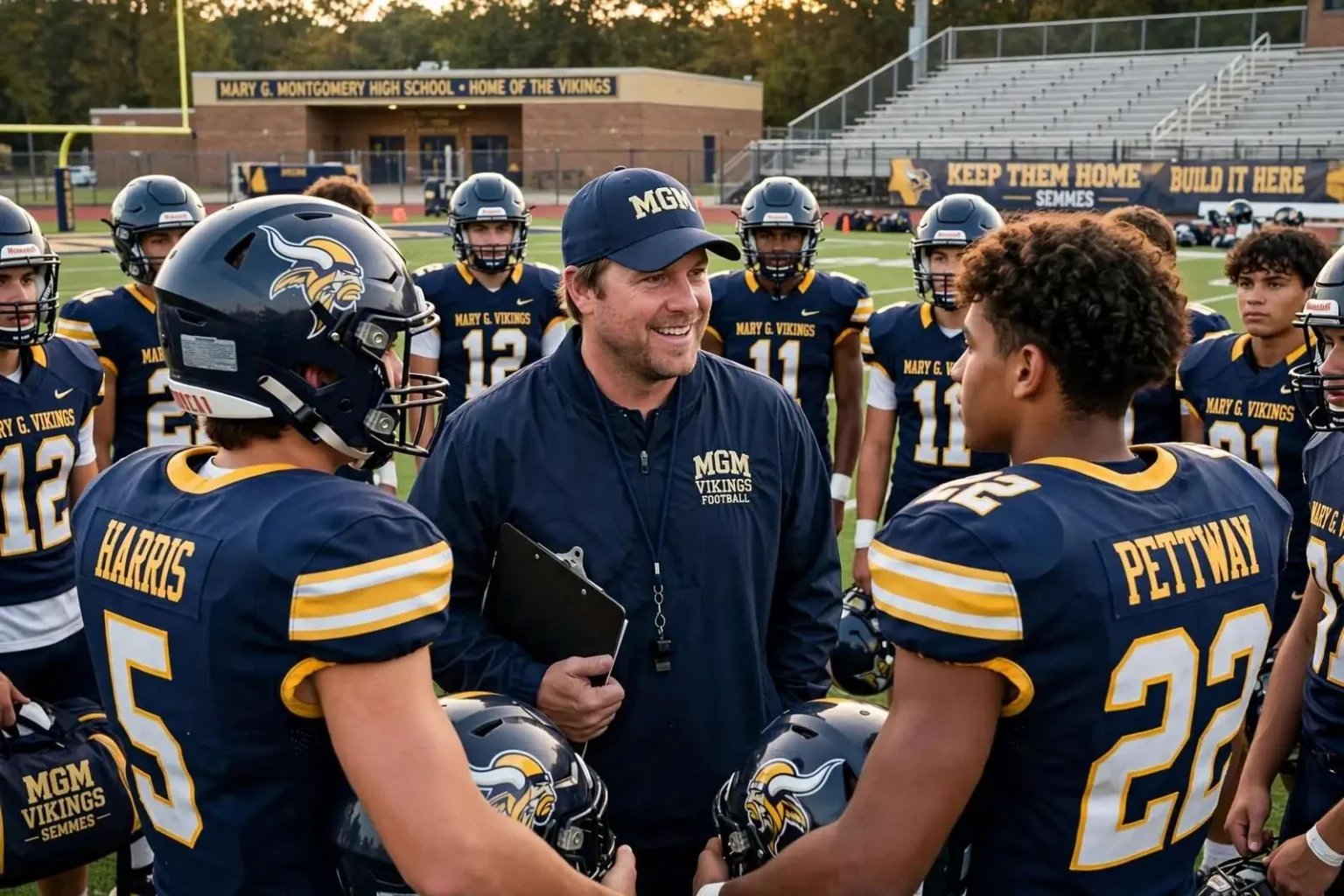
For two decades, Mary G. Montgomery’s football program had a familiar and painful pattern: talented kids from the Semmes park system and Semmes Middle School would grow up dreaming of playing for the Vikings, then quietly slip away to other public and private schools that offered more wins and better exposure to college recruiters. Since Zach Golson took over as head coach, that cycle has been reversed, and the turnaround offers a case study in how a struggling program can rebuild by strengthening its own backyard pipeline rather than looking elsewhere.
The scale of the previous dysfunction is hard to overstate. In the nearly 20 years before Golson arrived, Mary G. Montgomery churned through eight different head coaches and lost 137 games without ever putting together a winning season. Of those 137 losses, 105 came by double digits, with an average losing margin of four touchdowns, or 27 points. It was a self-reinforcing cycle: the team lost, coaches turned over, players left or stayed away entirely, and the losing continued.
“We’ve had some great coaches come through here but in the past, we didn’t keep the kids home,” MGM principal Chip Menton said. “They’d be at Semmes Middle and then they’d go somewhere else. He’s doing a good job getting those kids in our backyard and keeping them. We’ve got to put that fence up and not let them go anywhere else.”
Golson has approached the job with equal parts strategy and relationship-building. While his offensive and defensive schemes have helped the Vikings win, colleagues credit him just as much with ending what had become an unofficial MGM tradition: promising players leaving before they ever got to make an impact for the varsity team. At one particularly low point, the dysfunction reportedly extended to game day itself.
“It’s the only place I’ve been where before a game kids would try to sneak out and go home,” former MGM coach Chris Wilson said. “It was a culture of craziness.”
That culture has changed. Instead of players looking for the exits, Golson said the program is now fielding interest from players who want to join.
“I wouldn’t be shocked if we see guys move in this summer,” Golson said. “We haven’t lost any kids to other schools. We’ve got to try and hold on to our guys in Semmes. Not only that, we’re starting to see kids from all over the city who want to be here and we’re going to go through that process the right way. It’s a transfer portal world.”
Part of Golson’s appeal, according to those around the program, is his commitment to finding a role for every player on the roster, not just the stars.
“I don’t want to lose a single kid,” he said. “It hurts me when it happens. We try to find a role for them, special teams or rotational. We try to play fast and keep them fresh, so it forces you to develop guys. We want to try and develop them all the way to the last guy.”
Bridging the Middle School Disconnect
Vikings assistant coach Scott Plair, a retired U.S. Coast Guardsman who has coached in the Semmes park leagues since 2017 and led the freshman team to an 8-0 finish last season, said the disconnect between MGM’s coaching staff and its youth feeder programs used to be glaring.
“I saw a real disconnect between the high school and middle school and even the high school to the park,” Plair said. “The private school coaches would be at the youth championship games. You’d never see the Mary Montgomery coaching staff there. When I got here, it was like, ‘We’re the 10th or 11th biggest high school in the state’ and I guess they assumed they would get them.”
That assumption routinely backfired.
“We’d have four or five park teams playing for the youth football title in Mobile and the middle school would be playing in the championship game, then the high school would go 1-9 and 2-8,” Plair said.
Wilson, who had made the playoffs in each of his seven seasons at Washington County and Straughn before arriving at MGM, never got the chance to fix the disconnect — he was fired after going 0-10 in his only season in 2017, even though the middle school team went 7-1 that same year.
“There is not one middle school in Mobile that is a true feeder school,” Wilson said. “Kids from four different addresses can go to Semmes Middle School and then when they go to high school, they can choose any one of those.”
A New Freshman Development Program
Golson’s fix started with the freshman program. Rather than rushing younger players onto varsity before they were ready, he built out a dedicated freshman structure, adding 80 freshmen to the program last year and expecting roughly 75 more this season.
“I told Scott we were going to play all the freshmen,” Golson said. “They were going to stick together and learn to win together. We created an eight-game schedule where they had been playing two, three or four games. And we are committing the resources to develop the kids in our program the right way. We could have easily pulled them up to the varsity but we didn’t.”
Plair, in his first year as freshman coach, made a point of attending every Semmes Middle School game to build relationships early.
“I made sure I knew who the kids were and knew who their parents were and loved up on them,” he said. “It helped the parents know, ‘He’s out here talking to our son and wanting him to come to Mary Montgomery and not assuming anything.’ Last year, we kept the entire (middle school) team, which was about 80 players, except for two boys who were districted to Blount. This year, it’s about the same number, about 75 who have signed up. We had them come over for an early spring practice and let them see how the varsity works.”
Early Results: A Marshall Scholarship Offer
The approach has already produced tangible results. Rising sophomore defensive back Shondell Harris, the freshman team’s MVP last season, has already received a scholarship offer from Marshall. Harris played on an 8-0 Semmes Middle School team in eighth grade before the group decided to stay together for high school.
“We went 8-0 and we decided to stay together,” Harris said. “We got a new coaching staff. They came to the middle school and introduced themselves.”
Harris said Golson’s coaching style is a big part of why he never considered transferring.
“I like the way he coaches,” Harris said. “He’s hard on us, then he comes back and loves on us. It’s not just a coach saying he loves you, he calls every day and makes sure you’re all right. He takes care of you. He makes me want to be a better player. Before, I listened but not as well. He slowed things down for me.”
A College-Style Signing Day for Freshmen
Golson also introduced a welcoming ceremony for incoming freshmen modeled loosely on a college signing day, complete with players dressed up and photographed in front of cameras.
“We never had anything like that,” Harris said. “It felt like they actually cared about us.”
Plair described the scene in more detail.
“That was coach Golson’s idea,” Plair said. “They got in front of the cameras and they were dressed up. They will have a picture when they came in as freshmen and you bring it back around when they’re signing out of high school.”
Scott Lesley, the last MGM coach before Golson to have a winning season, back in 2002, said he expects other programs to copy the idea.
“That was brilliant,” Lesley said.
The early returns from the strategy are already visible at the college recruiting level. Harris and linebacker Devin Pettway, both part of the same freshman class, have each received scholarship offers from Marshall — a rarity for freshmen anywhere in the Mobile area.
“You don’t often hear about freshmen getting D-I offers in Mobile, much less two from Mary Montgomery,” Plair said. “It shows we’ve got the talent in Semmes. … There’s a ton of talent coming in and the sky’s the limit their junior and senior years.”
Harris and Pettway’s class went 8-1 as eighth-graders at Semmes Middle School, then 8-0 as freshmen at MGM. Harris, in particular, made it clear early on that Golson would have a hard time keeping him off the field in any role.
“Last spring, he came out and wanted to be a quarterback,” Golson recalled. “One practice we called for the kickoff coverage team and he ran out there and I stopped him and told him he was a quarterback. He said, ‘Coach, I’m gonna be the first one down there.’ I said, ‘No, you’re a quarterback, go work on some quarterback drills.’ So, he did what I told him. The next day, he’s out there on kickoff coverage again. We couldn’t keep him off the field. He started every game for us on defense.”
Deepening Ties With the Semmes Park System
Golson said the program’s next priority is deepening its relationship with the Semmes park system, which has already started paying dividends.
“The last five or six years, they’ve done a great job,” Golson said. “Scott coached over there and knows a lot of those kids. They’re probably the best park in Mobile now.”
Still, Golson said there’s more work ahead to fully unify the pipeline feeding into MGM.
“Eventually, everybody here is a Viking,” Golson said. “Everything within what I call the square, the walking trail around the school, there are four entities: There are Mary Montgomery Vikings, Semmes Bulldogs, Semmes Colts and Semmes Cardinals. That’s an issue. We want to create a culture where we’re all fighting for each other. We’re close to the middle school being Vikings and we hope to get the elementary schools to be Vikings.”
Former MGM principal Marlon Firle, who hired Golson, said his attention to relationship-building was evident from the start.
“I was 100 percent confident he could turn the program around as quickly as he did,” Firle said. “He hit the ground running and established a relationship with the middle school and the community right off the bat. He worked 14 to 16 hours a day. He had the work ethic. He wanted to change the perception of the school.”
The story of MGM’s turnaround reflects a broader challenge facing many public school athletic programs in Mobile County, where open enrollment, private-school options and shifting neighborhood boundaries can make it difficult for any single high school to hold onto its natural base of young athletes. Golson’s approach — investing early in relationships with middle school and youth park coaches, building a robust freshman program, and creating visible, celebratory moments for incoming players — offers a model other Mobile-area programs may look to as they try to solve similar retention problems of their own.