In March 1979, Jim McAleer mortgaged his house to buy a stack of desks. He had spent years working construction sites around Mobile, listening to the same complaint from builders and clients: a building was ready to open, but there was nowhere local to buy the furniture to fill it. Rather than keep hearing the problem, he decided to solve it. He came home, talked it over with his wife, Camilla, and set out to become the answer himself.
That decision became McAleer’s Office Furniture, a company that started with one full-time employee, a stack of catalogs and a young family, and has since grown into one of the largest office furniture and design operations on the Gulf Coast.
The gap he aimed at was real and oddly durable. Mobile’s builders could finish a medical office, a bank branch or a school wing and hang the sign over the door, but outfitting the interior meant ordering from distant catalogs or driving to New Orleans for a showroom that carried commercial-grade furniture. In a city whose economy ran on construction, shipping and institutional growth, furniture was the missing local link between a finished building and an open one.
A Family Business Built at the Kitchen Table
For its earliest years, McAleer’s didn’t have a corporate headquarters so much as a kitchen table. The McAleer children did their homework in the back office, absorbing early lessons about running a business built on keeping promises to customers. Jim delivered chairs himself out of the back of a van and even appeared in local television ads as the company slowly built its reputation across the Mobile area.
The delivery van and the television spots were the company’s first marketing department. In a market where builders talked to each other daily, word of a contractor who showed up on schedule with exactly what was ordered traveled faster than any ad — and McAleer’s early years were spent converting that word into repeat business, one delivered chair at a time.
Nearly half a century later, one of those kids who once spread her schoolwork across a showroom desk is now running the company.
Melissa Cross Takes the Helm
Melissa Cross didn’t plan on taking over the family business. She left Mobile to attend the University of Alabama, went on to law school at Pepperdine in Malibu, practiced law in California, ran a showroom for a homebuilder in Dallas, and eventually worked for an office furniture manufacturer in Iowa. Looking back, she says that winding career path ended up preparing her for exactly the job she has now.
The résumé reads like a curriculum for the chair business. Law school taught contracts and negotiation; running a builder’s showroom taught how furniture decisions are actually made inside a construction project; the Iowa manufacturer taught the supply side — how lines are built, priced and shipped. Each step in a different industry, she has said, turned out to be a prerequisite for the one she eventually took over.
She returned to Mobile in 2012 and, a decade later, bought the company from her father. In 2025, she expanded the business further by acquiring Seating Source, a Texas-based import company, and now sells her own line of executive and conference chairs nationwide, shipped in through the Port of Mobile.
The move to larger quarters also mirrors a pattern playing out across Baldwin County, where nearly every municipality has had to stretch a public building beyond its original intentions. Daphne, Fairhope, Spanish Fort, Gulf Shores and Orange Beach have all added schools, community centers or expanded civic buildings as their populations climbed, and the common question in each case is the same one Foley answered this week: when does a town build for what it has become rather than patch what it was?
The Seating Source acquisition moved the company from buying chairs to building them — at least on paper. Owning an import operation means controlling a product line’s specification, pricing and branding rather than reselling someone else’s, and shipping through the Port of Mobile puts the goods a short drive from the Spring Hill Avenue showroom. A Gulf Coast furniture dealer with its own national product line is a different kind of company than the one Jim McAleer started with a stack of catalogs; the family kept the name and rebuilt the model around it.
Three Siblings, Three Cities
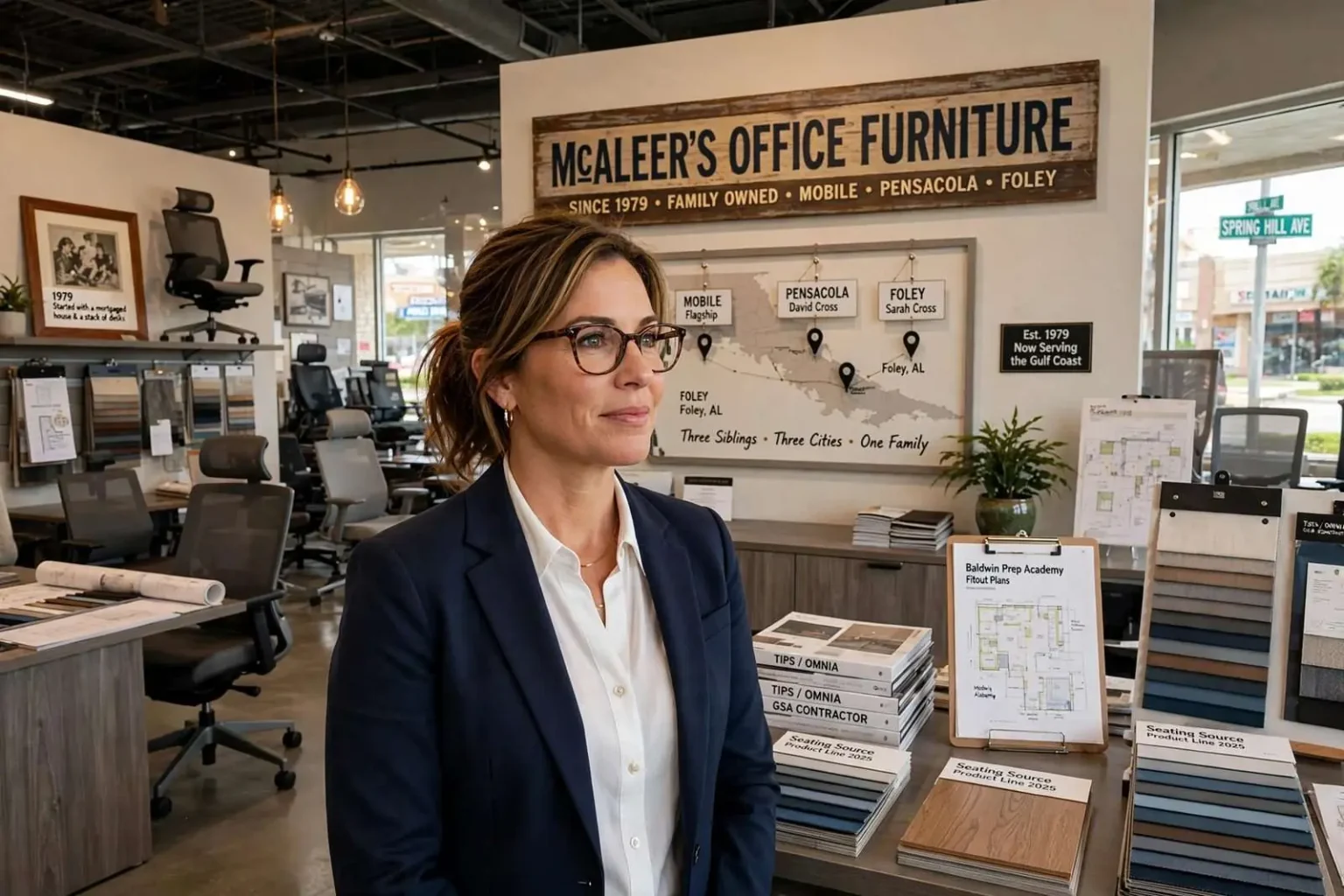
Today, McAleer’s Office Furniture operates as a true family enterprise. Cross runs the flagship Mobile showroom, her brother David runs the Pensacola location, and her sister Sarah runs the Foley showroom — three siblings, three cities, one family name still over the door.
The footprint traces the Gulf Coast’s commercial geography. Mobile is the anchor, serving the city’s banks, hospitals, schools and downtown offices. Pensacola reaches the western Florida Panhandle’s growing professional market. Foley puts the company in the middle of Baldwin County’s expansion — the medical offices, municipal buildings and small businesses that have multiplied along the Highway 98 and Foley corridors as the county has grown. Three showrooms let the family serve the Interstate 10 corridor end to end without a customer driving more than an hour.
More Than a Furniture Showroom
Most people who walk into McAleer’s expect to find chairs and desks, and they do — the company carries the largest in-stock selection of new and used office furniture on the Gulf Coast, which allows it to move quickly when a client needs to furnish dozens of offices on short notice.
But the core of the business is its design team. When a client arrives with a floor plan and a budget but no clear starting point, a McAleer’s designer works through the practical details that shape how a space will actually function: where the afternoon light falls, who needs to sit near shared equipment, and whether a team will make use of a huddle room or avoid it altogether. By the end of that process, clients can picture the finished space — walls, windows, finishes and fabrics — before a single box is delivered.
The same designer who sits down with a client on day one is typically still there the morning the furniture trucks arrive.
McAleer’s growth also tracked the region’s institutional economy. A Gulf Coast city’s furniture demand comes disproportionately from institutions — banks adding branches, hospitals adding wings, schools adding classrooms — and those buyers reward exactly the qualities the company built early: on-time delivery, installed and ready, with a designer reachable by name. The family’s long hold on that niche is less a marketing story than an operations one.
From Single Offices to Statewide Contracts
McAleer’s takes on projects of every size, from a single home office for a retired attorney to full-scale institutional buildouts. Recent clients include Merchants & Marine Bank, Baldwin Preparatory Academy, the Alabama School of Math and Science, Spring Hill College, Bryant Bank, the University of South Alabama, and Outokumpu.
The client list itself maps the region’s economy. Banks from the Mississippi line to Baldwin County; schools and a university furnishing classrooms, labs and dorms; a college campus in Spring Hill; and Outokumpu, the stainless steel producer whose Calvert mill on the Mobile-Tensaw delta is one of the largest industrial operations on the Gulf Coast. Furniture contracts at that scale are not shopping trips — they are months-long projects involving spec books, delivery sequencing around operating schedules, and installations that cannot interrupt a working bank or school.
The company also holds contracts with the U.S. General Services Administration, the states of Alabama and Florida, and cooperative purchasing programs including TIPS, Omnia and HealthTrust. Those contracts let schools, cities and hospitals work with a local furniture and design partner rather than navigating a lengthy procurement process on their own.
Cooperative purchasing has become the quiet backbone of public-sector furniture buying. Programs like TIPS and Omnia pre-negotiate pricing and terms through a public competitive process, so a county school system or a hospital district can buy through the umbrella contract without running its own bid. For a local dealer, holding those agreements means a small city’s conference room order and a university’s building-wide fit-out both arrive through the front door with the paperwork already done.
Forty-Seven Years Later
The projects have gotten bigger, the design software has gotten more sophisticated, and what was once a single showroom has grown into three. But the day-to-day involvement hasn’t changed much: Cross still works directly with clients, her brother still walks the sales floor in Pensacola, and her sister still helps assemble conference rooms herself in Foley.
Jim and Camilla McAleer bet their house on a hunch in 1979. Nearly half a century later, their daughter is still building on that bet, one office, school and hospital wing at a time.
McAleer’s Office Furniture is located at 3305 Spring Hill Ave. in Mobile.
The succession completed a circle that began at the kitchen table. The children who did homework in the back office absorbed the business before they ever chose it, and two of the three who stayed chose it anyway — not as inheritance accepted by default but as a company they had watched their parents run through lean years and good ones. In Gulf Coast commerce, where family firms routinely fade with the founder, a third-generation-stable operation with three showrooms and national contracts is the exception, and it started with a mortgaged house and a stack of desks.