How Seniors Could Sign Up for COVID-19 Vaccines in Northwest Florida This Week
Publix pharmacy appointments expanded for Florida seniors 65-plus, with Escambia, Santa Rosa and Okaloosa counties each handling vaccine sign-ups.
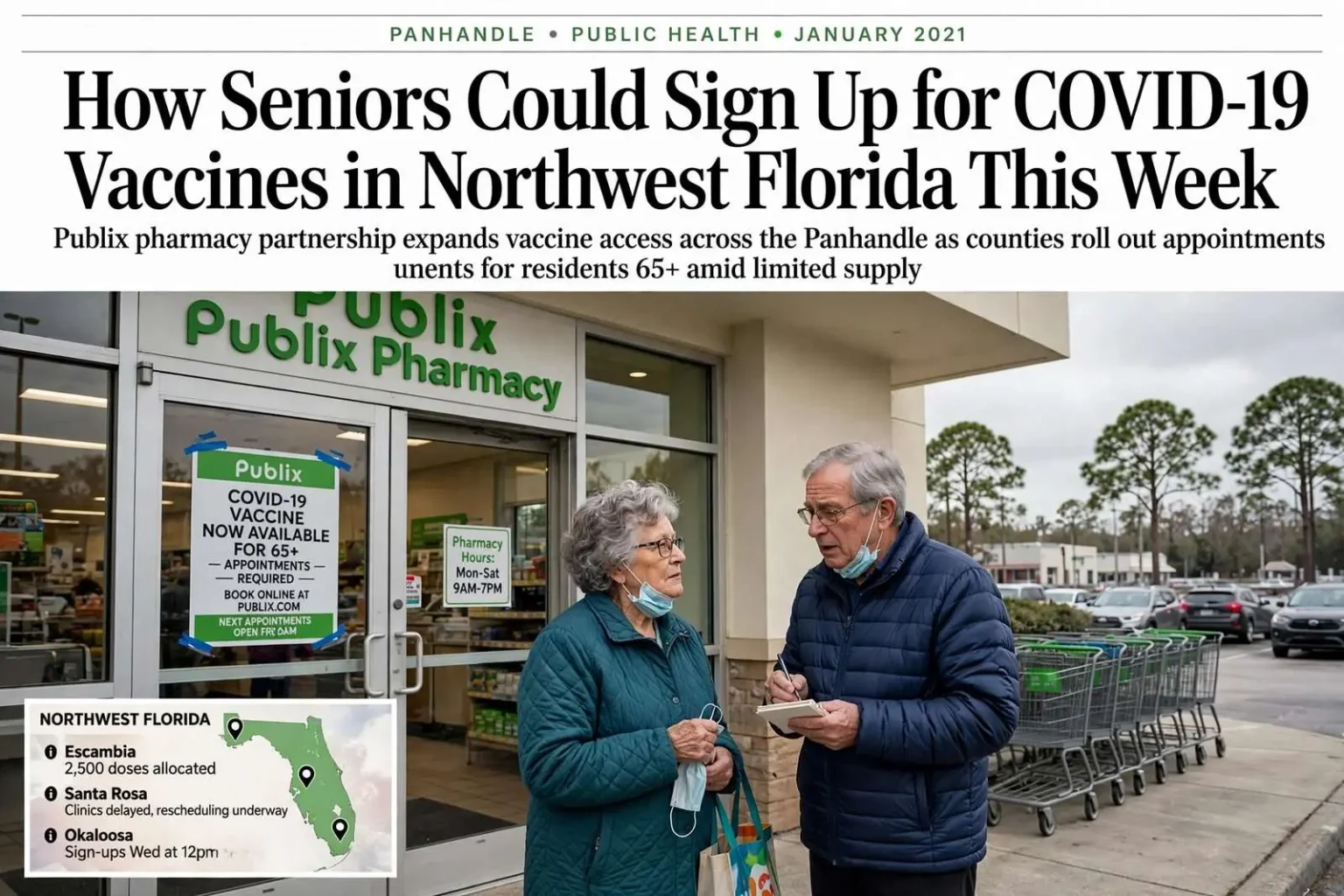
While Alabama wrestled with early vaccine distribution hurdles, Florida was finding success funneling shots to seniors 65 and older through Publix pharmacies — and Gov. Ron DeSantis announced more locations across the state. The pharmacy partnership became the centerpiece of Florida’s early rollout, putting vaccine appointments within reach of retirees along the Panhandle without requiring them to navigate crowded county health department phone lines.
“We’re excited about this,” DeSantis said. “We now have this really in all corners of the state and it’s something we very well may do state wide if we’re able to have enough vaccine on hand.” The governor’s caveat — enough vaccine on hand — captured the central constraint of the era: demand far outstripped supply, and every new location meant more competition for a limited number of doses.
He also noted that Operation Warp Speed planned to steer more doses toward states with larger elderly populations. That federal allocation logic favored Florida, whose retirement communities made seniors the clear priority group, and it signaled that participating pharmacies could expect larger shipments in the weeks ahead.
How the Publix Sign-Up Worked
Appointments went fast. Online sign-ups at Publix opened at 6 a.m., with residents selecting Florida, scrolling to their county, and grabbing a slot before they filled. The site then closed until the next shipment, after which it would reopen for bookings Friday morning. For seniors without reliable internet access, the scramble for slots was frustrating, and family members across the Gulf Coast spent mornings refreshing the page on behalf of parents and grandparents.
The system rewarded speed and luck. Appointments that opened at 6 a.m. were often gone within minutes, leaving many hopeful residents to wait for the next window. Still, the pharmacy model delivered thousands of shots to seniors who might otherwise have waited far longer, and Publix stores across Northwest Florida became familiar waypoints in the pandemic’s second winter.
The partnership made practical sense for both sides. Publix had pharmacies embedded in communities across Florida, from Pensacola to Key West, with staff already trained in handling injections for flu season each fall. That existing infrastructure could absorb vaccine shipments without the state building anything new, and the grocery-store setting felt familiar and comfortable to older customers who already shopped there weekly.
For DeSantis, the expanding pharmacy network also offered a political and logistical win at a difficult moment. Early criticism of Florida’s rollout focused on long lines and crashed websites, and every announcement of new Publix locations let the administration show tangible progress. The governor framed the program as proof that a state-run distribution effort could work when it leaned on partners who already knew how to serve customers at scale.
Escambia County’s 2,500 Doses
Elsewhere in the Panhandle, the Escambia County Health Department received 2,500 doses, most earmarked for hospitals, and planned to contact people who had submitted online interest forms about scheduling. The department’s approach relied on that interest list, allowing health officials to match available doses with residents who had already raised their hands rather than relying on walk-up traffic.
The hospital allocation reflected the strategy of the moment, which prioritized frontline medical workers and the oldest residents first. By routing most of its supply through hospitals, the health department aimed to vaccinate the people at greatest occupational risk while keeping its own clinics focused on seniors and other eligible groups.
For residents on the interest list, the promise was a call rather than a scramble. Instead of competing for slots on a crowded website, those who had registered could expect the health department to reach out directly as doses became available — a slower but more orderly path to a shot.
Santa Rosa County’s Delayed Shipment
In Santa Rosa County, a delayed shipment forced the cancellation of clinics at the Milton Community Center, with registrants to be contacted for rescheduling. The delay was a reminder of how fragile the early supply chain was: a single late delivery could upend days of appointments and leave hundreds of residents without the shots they had signed up for.
County health officials urged registrants to keep their information current and to wait for the rescheduling notice rather than attempting to book elsewhere, since appointments were being tracked against the delayed shipment. The Milton Community Center had become a familiar site for drive-through and walk-up clinics serving the county seat and surrounding communities.
Residents responded with a mix of patience and frustration. Everyone understood the vaccine was scarce, but a canceled clinic still meant another week of uncertainty for seniors who had arranged transportation and cleared schedules for a shot that never arrived.
Okaloosa County Sets Vaccination Days
Okaloosa County’s health department scheduled vaccination days Friday, Saturday and Monday, opening sign-ups Wednesday at noon. The three-day block gave the county a predictable rhythm, and the midweek sign-up opening gave residents a fair, announced window to claim an appointment instead of a rolling scramble.
For residents of Fort Walton Beach, Crestview, Niceville and the rest of the county, the schedule offered something Florida’s rollout often lacked: certainty. Anyone who secured a Friday, Saturday or Monday slot knew exactly when and where to show up, and the health department could plan staff and doses around a fixed calendar. Predictability, in those early weeks, was nearly as valuable as the doses themselves.
The county’s approach also spread appointments across multiple days, reducing the lines and crowding that single-day clinics produced. Seniors arriving at a vaccination site in the middle of a pandemic appreciated short waits, organized check-in and a schedule that did not collapse because one shipment ran late.
Two States, Two Strategies
The contrast with Alabama, just across the state line, was striking. While Florida leaned on Publix and other partners to move doses quickly through the private sector, Alabama’s early rollout stumbled over scheduling systems and supply constraints, leaving many seniors in Mobile and Baldwin counties waiting longer than their counterparts in Escambia and Santa Rosa counties. Residents of Northwest Florida followed their local health departments closely, and Gulf Coast families with relatives on both sides of the line compared notes week by week.
Florida’s early advantage did not guarantee a smooth ride. Delayed shipments, limited doses and high demand meant that eligibility did not equal availability. But the state’s willingness to enlist pharmacies gave seniors more doors to knock on, and each new Publix location DeSantis announced widened the map of opportunity across the Panhandle and beyond.
The week’s developments — new pharmacy locations, a large Escambia allocation, a Santa Rosa setback and a predictable Okaloosa schedule — showed both the promise and the fragility of the largest vaccination campaign in American history, playing out one county and one pharmacy counter at a time.
What Seniors Needed to Know
For the week’s sign-ups, the details mattered. Publix appointments required online booking, a Florida county selection and quick fingers at 6 a.m. Escambia residents needed only to have submitted an interest form and to answer the phone when the health department called. Santa Rosa registrants had to sit tight for a rescheduling notice, and Okaloosa residents had to be ready at noon Wednesday to claim one of the Friday, Saturday or Monday slots.
Across the region, one piece of advice held true everywhere: keep checking official county health department channels rather than relying on rumors or secondhand information. Early in the rollout, misinformation about eligibility and availability spread quickly, and county health departments worked to keep their websites and phone lines updated with accurate details.
The Weeks Ahead
Everyone involved understood that the early chaos would ease as supply grew. Each week brought new shipments, and each shipment brought more appointments, more pharmacies and more counties eligible to expand. The officials managing the rollout — from the governor’s office down to county health administrators — were building a distribution machine in public, in real time, under intense scrutiny.
For seniors along the Panhandle, the immediate question was simple: when and where could they get their shot? The answer changed week to week, but the trajectory was clear. Publix was scaling up, counties were refining their scheduling systems, and the federal government was signaling that states with large senior populations, like Florida, would see proportionally more doses.
The vaccination campaign would go on to define the year along the Gulf Coast, determining how quickly schools, churches, businesses and festival seasons could return to normal. But in the early weeks, progress was measured in smaller units: a 6 a.m. website refresh, a call back from the health department, a rescheduled clinic, a noon sign-up window that filled in minutes. For the seniors of Northwest Florida, that week was another chapter in the wait — frustrating, orderly, and moving, slowly, in the right direction.