Infirmary Health Secures More Than $5.3 Million to Expand Rural Healthcare Across Southwest Alabama
Infirmary Health received more than $5.3 million in Alabama Rural Health Transformation Program grants to expand women’s health services, build a regional referral and technology network and train physicians across southwest Alabama.
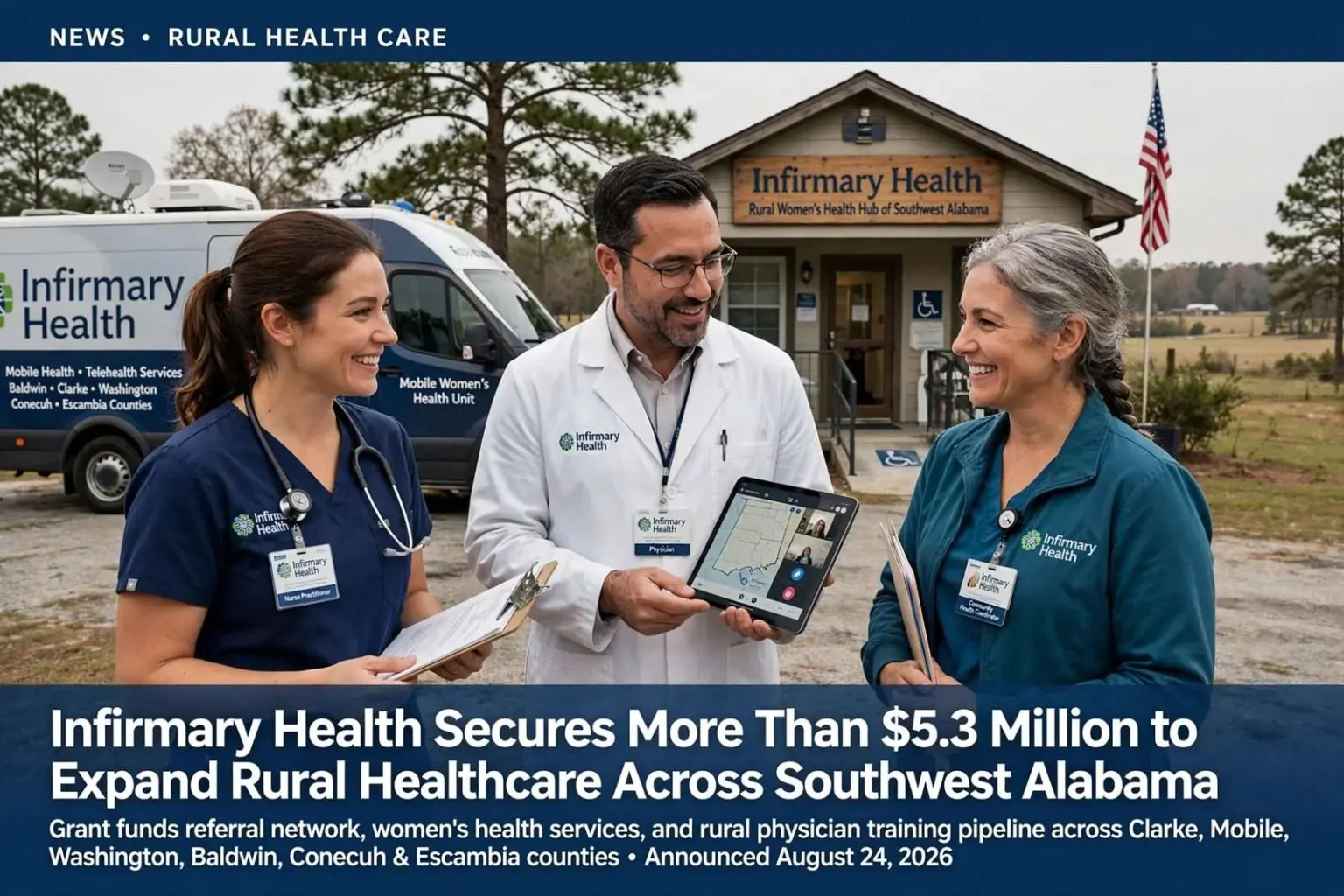
Infirmary Health has received more than $5.3 million through the Alabama Rural Health Transformation Program to expand women’s health services, improve coordination between rural and regional healthcare providers, and train physicians in rural communities across southwest Alabama.
The grants are among 138 awards totaling more than $144 million announced Aug. 24, 2026, by Gov. Kay Ivey.
A $3.5 million referral and technology network
The largest single award, $3.5 million, will fund a regional referral and technology network connecting Infirmary Health with rural hospitals and clinics in Clarke, Mobile and Washington counties. The project is designed to strengthen secure information sharing, referral coordination and cybersecurity as patients move between local providers and regional specialty care.
Rural patients often face delays and barriers when seeking specialized care that is not available at a small local clinic. Strengthening secure information sharing between providers can shorten the time it takes for a rural patient to be referred to and seen by a specialist, while better cybersecurity protects sensitive medical records as they move between systems.
More than $1.5 million for women’s health
Two grants totaling more than $1.5 million target women’s health across the region. A $386,000 grant will establish the Rural Women’s Health Hub of Southwest Alabama in Clarke and Washington counties. A separate $1.12 million grant will launch the Women’s Access to Care Close to Home Initiative in Baldwin, Clarke, Conecuh and Escambia counties.
Planned services include a weekly women’s health clinic in Millry, expanded prenatal services in Jackson and a mobile, telehealth-enabled program operated through North Baldwin Infirmary — all aimed at letting women receive care closer to home instead of traveling long distances for routine or preventive services.
Building a rural physician pipeline
A third award of $342,147 will fund the Infirmary Rural Physician Workforce Pipeline, establishing structured rural clinical rotations for internal medicine residents in Baldwin, Clarke, Escambia, Mobile and Washington counties. The program is designed to strengthen the physician pipeline and expand supervised clinical capacity in communities that often struggle to recruit and retain doctors.
By exposing young physicians to rural practice early in their training, the program aims to increase the chances that some will choose to build careers in the communities where they trained — a persistent challenge nationally, where rural systems compete for a limited pool of medical professionals willing to practice outside major metro areas.
‘Investing in the future of our communities’
“Investing in rural healthcare means investing in the future of our communities,” said Scott Fenn, senior vice president of strategy and government relations at Infirmary Health. “Southwest Alabama has a strong healthcare foundation, and this funding allows Infirmary Health to build on it by expanding services and meeting the growing needs of the communities we serve.”
How the program is funded
The Alabama Rural Health Transformation Program is administered by the Alabama Department of Economic and Community Affairs and supported by the Centers for Medicare & Medicaid Services of the U.S. Department of Health and Human Services, with 100% of funding provided by CMS/HHS. The program reflects a broader federal and state push to shore up rural healthcare systems that have faced closures, staffing shortages and rising costs in recent years.
Alabama’s approach has favored targeted grants tied to specific service gaps — a referral network, a women’s health clinic, a residency rotation pipeline — rather than distributing funds evenly across every rural provider in the state. That project-based structure is intended to produce trackable outcomes rather than simply supplementing operating budgets.
Rural hospital closures have been a persistent trend across the American South over the past decade, driven by a combination of low patient volumes, high rates of uninsured and underinsured patients, and the higher fixed costs of operating a hospital in a sparsely populated service area. In Alabama, the aging of the existing physician workforce and the growing complexity of medical needs in an aging population have added to the pressure — a situation public health officials say requires sustained investment and strategic planning rather than one-time fixes.
State health officials have described what distinguishes Alabama’s version of the model as its emphasis on connecting rural providers directly to regional specialty networks rather than treating rural clinics as standalone operations. That reflects a growing consensus among rural health policy experts that isolated rural clinics fare better, both financially and clinically, when they are tightly integrated with larger regional systems that can absorb referrals, share electronic health records and provide backup specialty coverage during staffing gaps.
Who competes for transformation dollars
Winning multiple distinct grants within the same funding round also reflects the sustained grant-writing and community-needs-assessment work that health systems increasingly have to invest in simply to remain competitive for this type of funding. Smaller, independent rural clinics without a larger health system’s grants administration staff can struggle to compete for the same dollars.
That dynamic has led some rural health advocates to argue that transformation funding should include more direct set-asides for the smallest and most isolated providers rather than flowing disproportionately to larger regional systems.
What comes next
Infirmary Health has not announced a specific timeline for when each of the three funded initiatives will be fully operational, though officials have indicated the referral network, women’s health hub and physician pipeline are all expected to begin standing up services in the coming months. Officials say their focus for now is on launching the three initiatives and documenting early results.
Sustaining the programs beyond the initial funding period will likely depend on whether they can demonstrate enough impact — in patient volume, health outcomes or cost savings — to justify continued state or federal support once this tranche of Rural Health Transformation Program money is spent. The durability of the state’s approach also depends on continued state appropriations and on CMS’s ongoing willingness to fund the federal share in future budget cycles.
Infirmary Health officials say they expect to use the early results both to justify continued funding and to help other Alabama health systems build their own future Rural Health Transformation Program applications.
About Infirmary Health
Infirmary Health is the largest not-for-profit, non-governmental healthcare system in Alabama. It comprises four hospitals, two post-acute care facilities, four ambulatory surgery centers, more than 60 physician practice locations and two freestanding emergency departments, along with other affiliates, and serves all counties along the Gulf Coast.