
Inmate Once Convicted in Baldwin County Charged With Murder in Staton Prison Stabbing
Demarcus Baker, previously convicted in Baldwin County, faced a murder charge after a fatal 2019 inmate stabbing at Staton Correctional Facility.
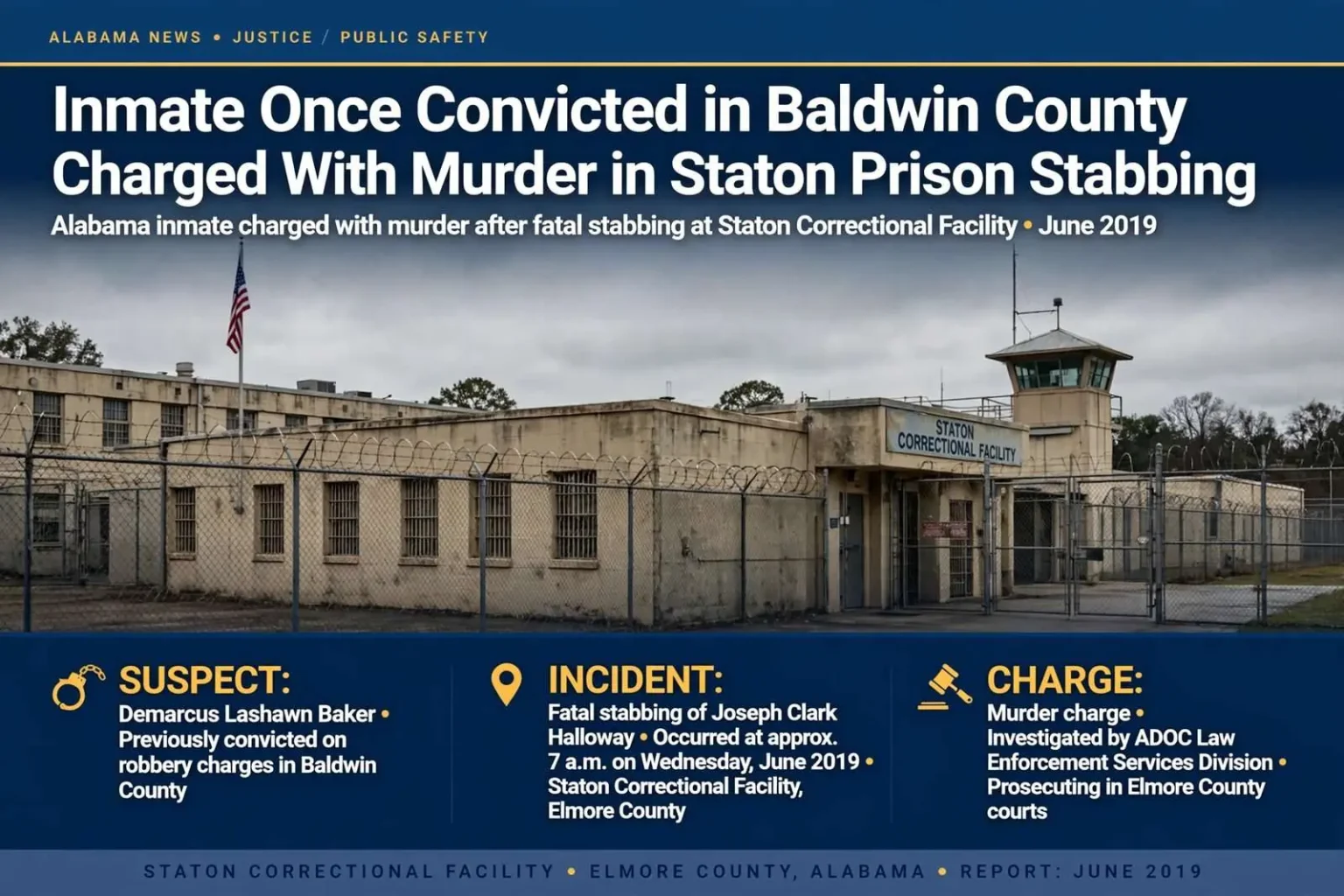
An inmate at Staton Correctional Facility in Elmore County faced a murder charge after authorities said he fatally stabbed another inmate inside the prison in June 2019. The Alabama Department of Corrections identified the accused man as Demarcus Lashawn Baker, who had previously been convicted on robbery charges out of Baldwin County. Investigators said Baker stabbed Joseph Clark Halloway several times around 7 a.m. on a Wednesday morning inside the facility. Halloway was taken to a hospital, where he later died of his injuries.
The attack happened during a morning period inside the medium-security prison, which sits in Elmore County among the cluster of state correctional facilities in central Alabama. According to the Department of Corrections, Halloway was transported from the prison for emergency treatment after staff responded to the assault, and he died after being admitted to the hospital. Investigators with the department’s Law Enforcement Services Division handled the case, as they do for deaths and serious assaults inside state facilities, interviewing witnesses and collecting evidence before presenting the case for prosecution.
A System Under Long-Term Scrutiny
The killing added to longstanding scrutiny of violence inside Alabama’s state prisons, where advocacy groups and federal investigators have repeatedly raised concerns about inmate-on-inmate assaults. The state’s prison system has operated for years under intense examination over staffing levels, overcrowding, and the pace of violence investigations, and homicides inside Alabama facilities have drawn particular attention from the U.S. Department of Justice, which has documented high rates of inmate deaths and assaults in its reports on the state’s men’s prisons.
Staton Correctional Facility, opened in the 1980s, houses inmates in a mix of security levels and has periodically appeared in the department’s own incident reporting after disturbances and assaults. Advocates who monitor the system have argued for years that understaffed dormitories and housing units allow conflicts to escalate without intervention, while the department has pointed to its efforts to recruit correctional officers and to add technology aimed at detecting weapons and contraband.
Under Alabama law, charges arising from attacks behind bars are prosecuted like any other homicide. That means Baker would face the murder allegation in addition to the sentence he was already serving from his Baldwin County case, and the prosecution would proceed in the courts of Elmore County, where the prison is located. Defendants charged with killing another inmate are entitled to the same process as any defendant: an initial appearance, bond proceedings under the applicable rules, and the full range of defenses available in a homicide trial.
How Prison Homicides Are Investigated
Investigations of deaths inside Alabama prisons follow a structure similar to street homicides, with some institutional differences. The department’s investigators secure the scene, account for the staff and inmates present in the area, and work to reconstruct the sequence of events from witness statements and physical evidence. An autopsy performed under the direction of the state’s forensic authorities establishes the cause and manner of death, and the resulting file is turned over to a district attorney to present to a grand jury for an indictment.
In this case, investigators concluded that the assault happened in the early morning hours, around 7 a.m., and that Halloway suffered multiple stab wounds. Hospital staff were unable to save him after the transport from the prison. The murder charge against Baker followed the department’s identification of him as the suspected attacker, based on the investigation conducted at the facility.
Homicides among inmates are, statistically, a small fraction of prison incidents, but each one raises the same questions that reform advocates and federal reviewers have pressed for years: how a weapon made it into the housing area, how much supervision was on the floor at the time of the assault, and whether warning signs existed between the two men. Those questions typically remain unanswered publicly until court proceedings produce a record, and in cases resolved by plea, some of them never do.
What the Charge Means for the Defendant
For Baker, the murder charge compounds an already lengthy legal exposure. He was serving time on a Baldwin County robbery conviction, and a conviction on the new charge would add a sentence to be served consecutively in the practical operation of Alabama’s sentencing structure. Murder in Alabama carries a punishment range of twenty years to life, with the potential for an even longer term under the state’s habitual offender provisions, which enhance sentences for defendants with prior felony convictions.
Prosecution of prison crimes also carries procedural wrinkles that civilian cases do not. Witnesses are almost all inmates, which requires the court to weigh testimony from people with their own legal motivations, and the defense and prosecution both must work within a correctional system that controls access to the defendant and to potential witnesses. Transporting an incarcerated defendant to and from court appearances in Elmore County, housing him separately from other inmates pending trial, and coordinating security for the proceedings all add layers that a typical homicide case does not involve.
The Baldwin County origins of the underlying sentence point to how Alabama’s prison population is drawn from every corner of the state. Baldwin County’s courts send convicted felons into the state system like every other county, and once committed, inmates are assigned to facilities based on security classification, bed space, and program needs rather than geography. That is how a man convicted on the other side of Mobile Bay came to be housed in a prison more than two hundred miles from the county where he was sentenced.
Elmore County’s Prison Corridor
Staton is one of several major state facilities concentrated in Elmore County, north of Montgomery, where the Department of Corrections has long maintained a cluster of prisons that includes nearby Elmore and Draper, along with the Kilby intake facility. The concentration places an unusual load on the local court system, because crimes committed inside the fences — assaults, contraband cases, homicides — are prosecuted in the counties where the prisons sit, and Elmore County’s district attorney handles a steady share of cases that most prosecutors elsewhere never see.
The county’s relationship with the prisons is a familiar one in Alabama’s rural correctional corridors. The facilities are major employers in the area, drawing correctional officers and support staff from across the river counties, and their presence shapes the local economy even as the violence inside them periodically becomes local news. When an inmate is killed at Staton, the case lands in the same courthouse that handles every other Elmore County homicide, with the added logistics of an incarcerated defendant and a witness pool drawn from inside the prison.
The Federal Backdrop
The federal scrutiny of Alabama’s prisons provides the context in which this killing was reported. The Department of Justice’s investigation of the state’s men’s facilities, launched years earlier, found that inmate-on-inmate violence and staff-on-inmate abuse occurred at rates that violated the constitutional prohibition against cruel and unusual punishment, and the state has been in negotiations with the department over remedies ever since. Homicides inside the system — including stabbings during morning movements like this one — have featured in the public record of that dispute, cited by advocates as evidence that the problems are systemic rather than incidental.
The department, for its part, has struggled with correctional officer attrition that has left shifts below authorized strength across the system, a shortfall that critics connect directly to the ability to supervise housing units and interrupt assaults. Successive administrations have requested pay raises and expanded recruiting classes, and the legislature has funded increases, but the gap between authorized and actual staffing has persisted through the period in which killings like this one have continued to occur.
Against that backdrop, the murder charge filed in this case proceeds through the courts like any other, while the institutional questions it raises — about weapons, supervision, and the pace of reform — remain the subject of the larger argument between the state and its federal monitors.
Victim Services and Notification
When an inmate dies in custody, the Department of Corrections is responsible for notifying the family, and the death of an inmate at the hands of another inmate opens a second, parallel process: the criminal case on one track, and the department’s own administrative review on the other. Families in this position often describe the experience as disorienting, because the usual channels of information — a detective who calls with updates, a district attorney’s office with an open door — are mediated by the prison system, and hearings take place in courtrooms far from the family’s home county.
For Halloway’s family, the news that his killing was being treated as a homicide meant, at minimum, a court process that could take months or longer to reach a resolution. Homicide cases in Alabama’s circuit courts routinely take a year or more from indictment to trial, and cases involving incarcerated defendants can stretch further as security logistics and witness complications accumulate. Advocates for victims’ families within the prison system have pressed the department for clearer communication about the status of these cases, and some counties have dedicated victim services officers who coordinate with the Department of Corrections on notifications and court dates.
Weapons and Contraband in State Facilities
The fact that the assault was carried out with a blade, according to investigators, places it within the category of incidents that the department’s contraband interdiction efforts are meant to prevent. Homemade weapons — sharpened metal, pieces of sharpened plastic, improvised blades assembled from institutional materials — are a persistent problem in every prison system, and Alabama’s facilities are no exception. The department has periodically announced sweeps, searches, and technology purchases aimed at reducing the flow of weapons and phones into dormitories, but the improvised nature of the weapons makes interdiction fundamentally difficult: the raw materials are, in many cases, the ordinary stuff of the institution itself.
Federal reviewers examining Alabama’s system have connected the weapon problem to the same staffing shortfalls that impede supervision. Searches of housing units,pat-downs, and shakedowns all depend on officer availability, and when shifts run short, the preventive work is the first to slip. The result, critics argue, is that weapons circulate and conflicts that might once have been interrupted are instead allowed to reach a violent conclusion — as investigators concluded happened in the early morning at Staton.
The murder charge now pending gives the courts the task of fixing individual responsibility for the killing. The larger questions — how the weapon got in, what the staffing looked like that morning, what the department has changed since — belong to the ongoing public argument over the future of Alabama’s prisons, an argument that this case will now, in a small way, become part of.


