Inside the Birmingham Foundry That Helped Build Hoover Dam
Founded in 1895, Birmingham's Hardie-Tynes Company built ship engines, utility equipment and the valves and gates used in Hoover Dam before closing in 2016.
Long before Birmingham earned its nickname as the “Magic City,” a foundry and machine shop on 28th Street North was quietly building the heavy iron and steel components that powered industries far beyond Alabama’s borders. The Hardie-Tynes Company, founded in 1895 by William Hardie and William Tynes, operated for more than a century in the shadow of Sloss Furnaces, turning out equipment that found its way into everything from ocean-going ships to one of the most famous engineering projects in American history.
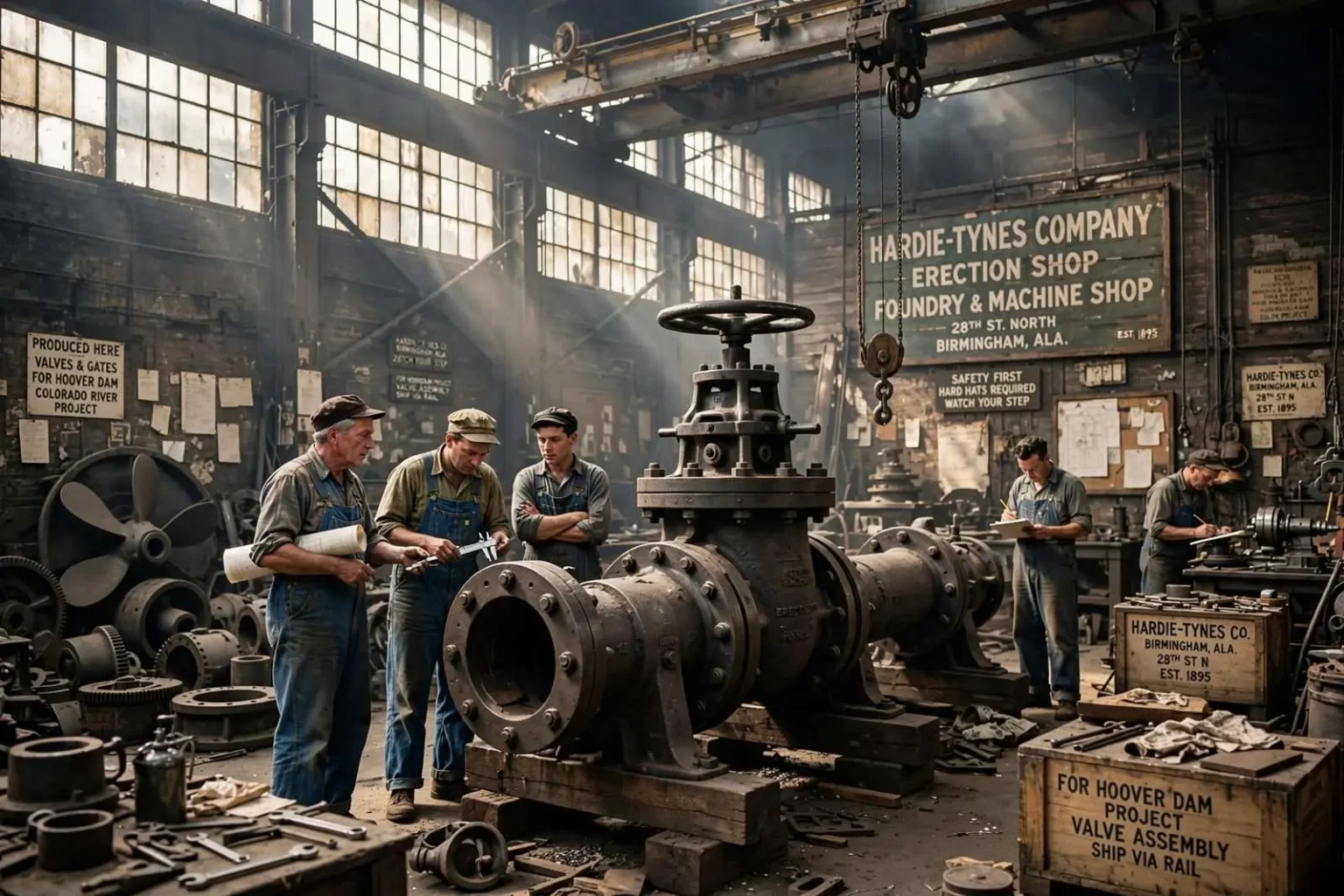
A photograph from the company’s erection shop, undated but clearly showing the scale of the operation, captures workers and massive iron castings inside the plant. It’s a glimpse into an era when Birmingham’s iron and steel industry was among the largest in the South, and when companies like Hardie-Tynes supplied the heavy machinery that other industries depended on to function.
An industrial city built on three raw materials
The very existence of a firm like Hardie-Tynes in inland Alabama was no accident of geography. Birmingham was founded after the Civil War in the Jones Valley, where deposits of iron ore, coal and limestone — the three essential ingredients of smelting iron — all sit within a short distance of one another, a combination so convenient that promoters billed the young city as the one place in the world where an iron company could gather all its inputs inside a single circle. Red Mountain’s seams of hematite ore fed the furnaces, the coal fields of Jefferson County and neighboring Walker County fueled them, and the limestone ridges supplied the flux that separated impurities from molten iron. Railroads stitched it all together, and the city grew so fast around the furnaces and mills that locals coined the Magic City nickname in admiration of the boom.
Into that ecosystem came the foundries and machine shops that converted raw iron into working machinery. A foundry melts metal and pours it into molds to form castings; a machine shop then cuts, bores and grinds those castings into precise finished components; and an erection shop assembles the largest pieces into equipment ready for shipment. It was heavy, hot, exacting work performed by generations of skilled molders, patternmakers, machinists and boilermakers, and Birmingham’s districts around the rail lines filled with plants doing exactly that.
From ship engines to Hoover Dam
Over its decades in operation, Hardie-Tynes built a reputation for large-scale, precision ironwork. According to published company records, the firm manufactured ship engines and propeller screws, supplying parts used in maritime construction. It also produced air compressors and equipment for public utilities, work that tied the company directly into the growth of American infrastructure during the 20th century.
Perhaps most notably, Hardie-Tynes produced valves and gates used in the construction of the dam now known as Hoover Dam, on the border of Arizona and Nevada. The dam remains one of the largest public works projects ever undertaken in the United States, and the fact that components manufactured in Birmingham helped make it function is a point of pride for those who track the city’s industrial history.
The Hoover Dam connection is worth sitting with. The project required massive gates, valves and control mechanisms capable of restraining the Colorado River and routing water through the dam’s works for generations, and contracts for such components went only to foundries with the capacity to cast, machine and test ironwork of enormous weight and exacting tolerance. That a shop from a Southern city a continent away from the Colorado River won that kind of trust says much about the reach of Birmingham’s industrial reputation in the early twentieth century. Water and wastewater utilities, meanwhile, relied on the same cast-iron expertise for the pumps, compressors and fittings that kept growing American cities supplied, making companies like Hardie-Tynes quiet but essential partners in daily life far from Alabama.
The maritime work carried its own improbability. Birmingham has no seaport, yet its foundries shipped engines and propeller hardware to shipbuilders, a reminder that in the age of rail a precision manufacturer could compete for national contracts regardless of where it stood. Southern industrialists took pride in proving that heavy machinery of the first order could be designed, cast and finished in Alabama rather than ordered from Northern plants.
A neighborhood built on iron
The Hardie-Tynes plant’s location near Sloss Furnaces was no coincidence. That stretch of Birmingham grew up around the iron and steel industry, with foundries, machine shops and furnaces clustered together to take advantage of shared rail access, labor and raw materials. Sloss Furnaces itself operated as a pig iron blast furnace for nearly a century before closing, and the surrounding district became one of the defining industrial corridors of the American South.
Companies like Hardie-Tynes were part of the broader ecosystem that made Birmingham a manufacturing hub, employing generations of iron workers, machinists and engineers. The heavy castings and precision machining done inside shops like this one required skilled labor and specialized knowledge that was passed down over decades.
The clustering mattered in practical ways. A foundry needed rail sidings to receive coke and scrap and to ship finished castings; it needed a steady supply of workers trained in the trades; and it benefited from nearby plants that could supply patterns, repairs and subcontracted work on short notice. Families in the surrounding neighborhoods — many of them drawn to Birmingham by furnace and mill wages — often worked the same trades across generations, with a father’s molding skills passed to a son and the shop floor serving as an informal technical school. Union halls, churches and neighborhood businesses in the iron districts all grew up around that payroll, giving the industry a civic footprint that lasted long after the plants themselves.
Sloss’s own afterlife underscores how central the industry remains to Birmingham’s identity. After the furnaces went cold, the site was preserved rather than demolished, and today it stands as an industrial heritage site where visitors can walk among the blast furnaces, steam boilers and casting sheds that once roared around the clock. Historians and preservationists point to surviving companies like Hardie-Tynes as the working counterpart to that story — the places where iron left the furnace and became something useful.
The end of an era
The Hardie-Tynes Company ceased operations in 2016, closing the book on more than 120 years of continuous manufacturing. Its closure mirrored the broader decline of heavy iron and steel manufacturing across Birmingham and much of the industrial South, as production shifted, technology changed and many of the region’s historic plants shut their doors for good.
The pressures that accumulated over those final decades were familiar to manufacturing communities across the country. Offshore competition undercut the market for cast components; computerized fabrication changed what customers expected from a machine shop; and the enormous, aging plants of the early twentieth century became costly to maintain and difficult to adapt. Birmingham’s economy, meanwhile, transformed around the empty floors, pivoting toward medicine, banking and research at UAB and in downtown’s towers, even as the skyline still owes its early skyscrapers to iron and furnace fortunes.
Yet the trade has not wholly vanished. Smaller foundries and fabrication shops continue to operate in and around the city, and the community colleges and technical programs that train welders and machinists report steady demand for their graduates, a sign that the skills Hardie-Tynes carried for more than a century still have a market. What has faded is the scale — the vast workforces and round-the-clock casting floors captured in photographs of the erection shop.
The people who remember the shops describe a culture as much as an industry. Apprentices learned by doing under the eye of veteran molders who could judge a pour by its color and sound. Blueprints hung above workbenches, tolerances were checked by hand, and a casting that failed inspection meant starting over rather than shipping the flaw. That insistence on quality was the currency by which a Birmingham shop won national contracts, and it is the part of the legacy that survives most clearly in the region’s machining and fabrication businesses today. It is also the reason archival photographs of shops like this one still draw interest from historians and descendants of the men who worked them.
Photographs like this one offer a rare window into that vanished industrial world, a reminder of the scale of the work once done in Birmingham’s foundries and machine shops, and of the far-reaching impact that Alabama-made equipment had on projects across the country. Every time water rushes through the turbines and spillways of the dam on the Colorado, a small piece of that Birmingham story is still at work — iron poured and machined by Alabamians more than a century after two men named Hardie and Tynes opened their doors on 28th Street North.