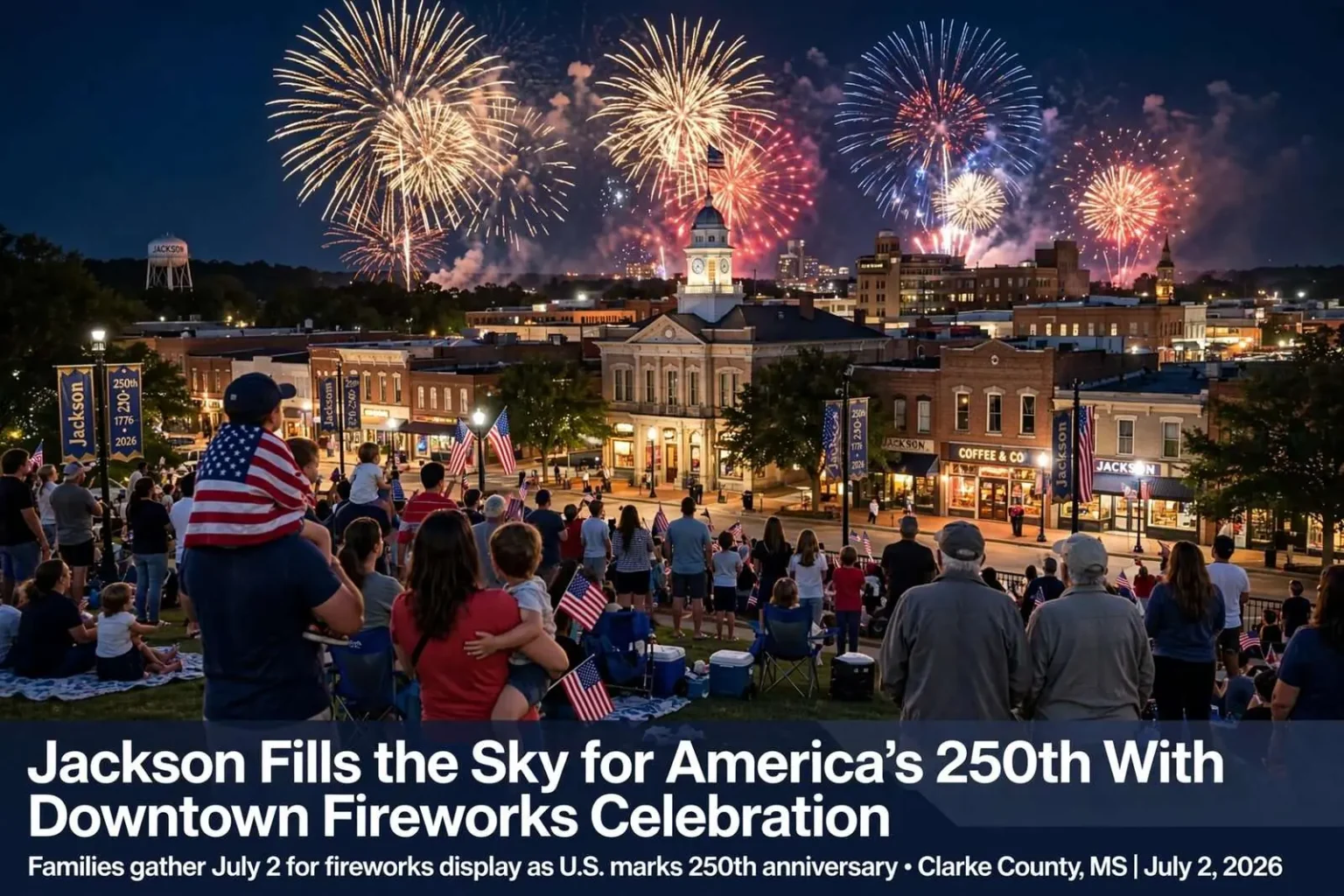
Downtown Jackson glowed on the evening of July 2 as families and friends gathered across the city and surrounding areas to watch the annual Independence Day fireworks display — an observance carrying unusual weight this year as the United States marked the 250th anniversary of its independence.
A Familiar Tradition, a Historic Year
Residents lined streets, parks and other viewing areas throughout the Clarke County city to take in the show. The gathering followed a pattern Jackson has kept for years: the fireworks come a couple of days ahead of the Fourth itself, giving families the chance to attend the hometown display and still travel or host on the holiday proper.
What set 2026 apart was the milestone. The semiquincentennial — the 250th anniversary of the signing of the Declaration of Independence in 1776 — is an anniversary no living American has witnessed before and none will witness again. Communities across the country have marked it with expanded observances, and Jackson was among them.
The United States Semiquincentennial Commission, established by Congress in 2016, has encouraged states and localities to develop programming that reflects the full arc of American history — not only the founding era but the centuries of struggle, expansion, and renewal that followed. Alabama’s own Semiquincentennial Commission, chaired by the director of the Alabama Department of Archives and History, has coordinated with local historical societies, schools, and municipal governments to ensure that the commemoration reaches every corner of the state. In Clarke County, that has meant exhibits at the Clarke County Historical Museum, special programming at the Jackson Municipal Library, and this expanded fireworks display, funded in part by a state grant designated for semiquincentennial community events.
The City’s Reflection
In a statement, the City of Jackson framed the evening in terms of the nation’s founding ideals.
“On this Fourth of July, we celebrate 250 years of the freedom, unity and independence that defines our great nation,” the city said.
The Jackson Area Chamber of Commerce offered its own reflection, turning the focus toward the community itself.
“Today, we celebrate the birth of our nation and the freedoms that unite us,” the chamber said. “As we gather with family, friends and neighbors, we’re grateful for the incredible community that makes Jackson such a special place to live, work and do business.”
These dual statements — one civic, one commercial — capture the two strands of small-town Fourth of July observance. The city’s language invokes the national narrative; the chamber’s invokes the local reality. In a town of roughly 4,700 people, the Chamber of Commerce functions as both a business advocacy group and a de facto community foundation, organizing the Christmas parade, the spring festival, and the summer fireworks. Its membership rolls include the family-owned retailers on College Avenue, the industrial employers at the edge of town, the bankers, the insurers, and the restaurateurs who collectively underwrite the civic calendar.
What Goes Into a Small-City Fireworks Show
Displays like Jackson’s look effortless from a lawn chair, but they represent months of preparation and coordination among municipal departments. A typical municipal show requires:
- A licensed pyrotechnician and permitting through state and local fire authorities
- A launch site with adequate fallout zones, cleared and secured
- Fire department standby crews on scene throughout the display
- Police management of traffic and crowd flow before and after the show
- Public works staff for setup, barricades and post-event cleanup
Municipalities the size of Jackson typically fund these displays through a combination of city budget allocations and contributions from local businesses and civic organizations. The chamber of commerce’s visible participation reflects the standard arrangement in small Alabama cities, where the business community and city government share the cost of the traditions that hold a town together.
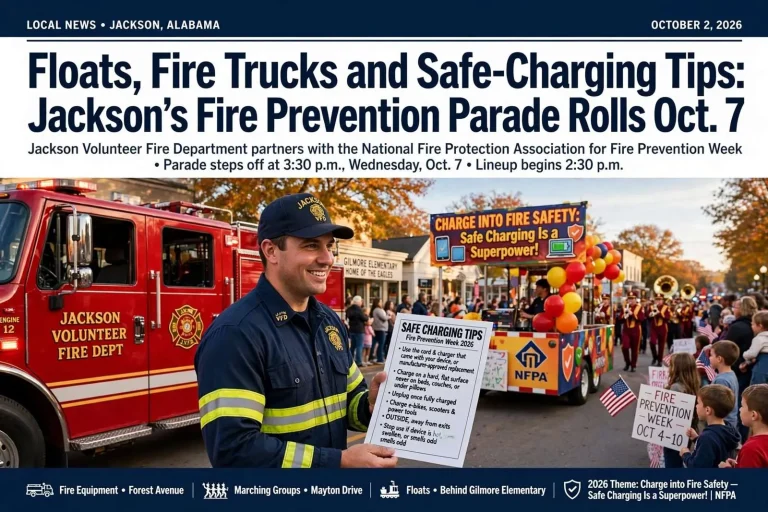
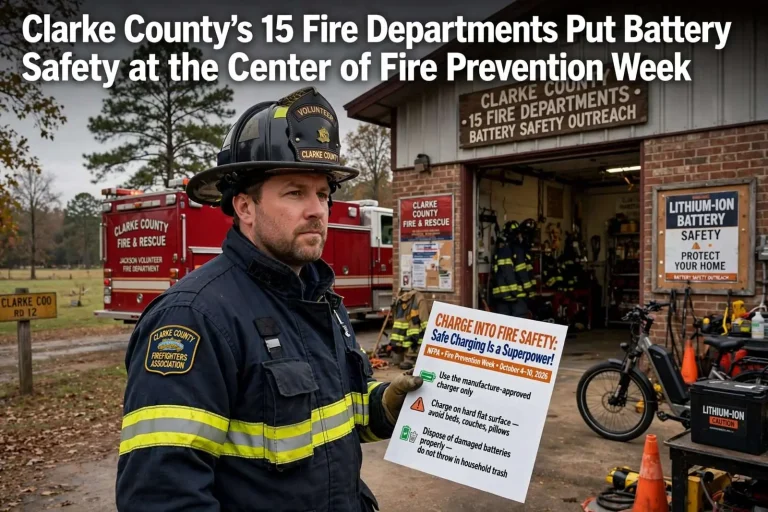
In Alabama, the State Fire Marshal’s Office regulates public fireworks displays under the Alabama Fireworks Safety Act. A licensed pyrotechnician must submit a detailed shoot plan, proof of insurance, and a site diagram showing fallout radii for each shell size. The Jackson Fire Department, a combination department with both career and volunteer personnel, provides the on-site fire watch — a requirement that stems from hard experience. Summer in southwest Alabama means high humidity, dry spells, and the ever-present risk that a falling ember ignites dry grass or a roof. The fire watch carries extinguishers and a charged hoseline throughout the show and remains on scene for a mandatory cooldown period after the finale.
The Value of Showing Up
There is a tendency to treat community fireworks as a pleasant frivolity. In towns the size of Jackson, they function as something more substantial: one of a handful of occasions each year when the entire population, across every neighborhood and age group, occupies the same public space at the same time and looks in the same direction.
Sociologists who study civic life describe these as “collective effervescence” events — shared experiences that build the social trust and mutual familiarity that communities rely upon during less pleasant times. A town where neighbors have stood shoulder to shoulder on a warm July evening is a town better prepared to help one another when a storm comes through.
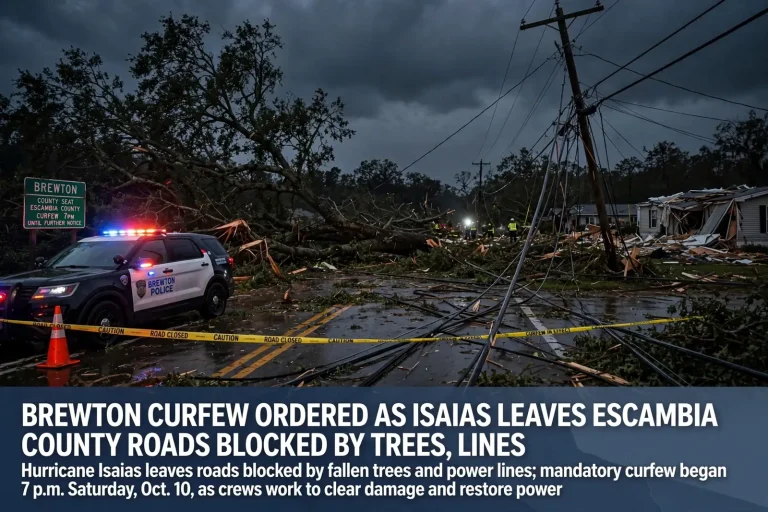
The concept, coined by Émile Durkheim and revived by contemporary scholars like Robert Putnam, describes the measurable social capital generated by synchronous public rituals. In Jackson, that capital is not abstract. When Hurricane Sally battered the Gulf Coast in 2020, when the tornado outbreak of March 2021 clipped the northern edge of Clarke County, when the supply-chain disruptions of 2022 left grocery shelves thin, the networks forged at the Christmas parade, the high school football games, and yes, the Fourth of July fireworks, were the same networks that organized welfare checks, chainsaw crews, and food distribution. The fireworks are the visible tip of an invisible infrastructure of reciprocity.
Looking Toward Next Year
The 250th will not come again, but Jackson’s Independence Day tradition will. Residents interested in supporting future displays can typically do so through the city or the Jackson Area Chamber of Commerce, both of which help sustain the celebration year to year.
For one evening in early July, the sky over Clarke County belonged to everyone who came out to look at it.
That continuity is the point. The semiquincentennial was a once-in-a-nation’s-lifetime marker, but the annual fireworks are the metronome that keeps the community’s rhythm. Next year’s show will not carry a 250th-anniversary grant or a presidential proclamation. It will carry the same expectation: that the city will budget for it, the chamber will raise the matching funds, the fire department will staff the watch, the police will direct the traffic, the public works crew will sweep the debris, and the people of Jackson and the surrounding countryside will show up. In a region that has seen its share of plant closures, population loss, and the quiet erosion of the institutions that once anchored rural life — the textile mill, the county hospital, the passenger rail depot — the persistence of this particular tradition is itself a small declaration of independence: a statement that Jackson intends to remain a place where people gather, belong, and look up at the same sky.