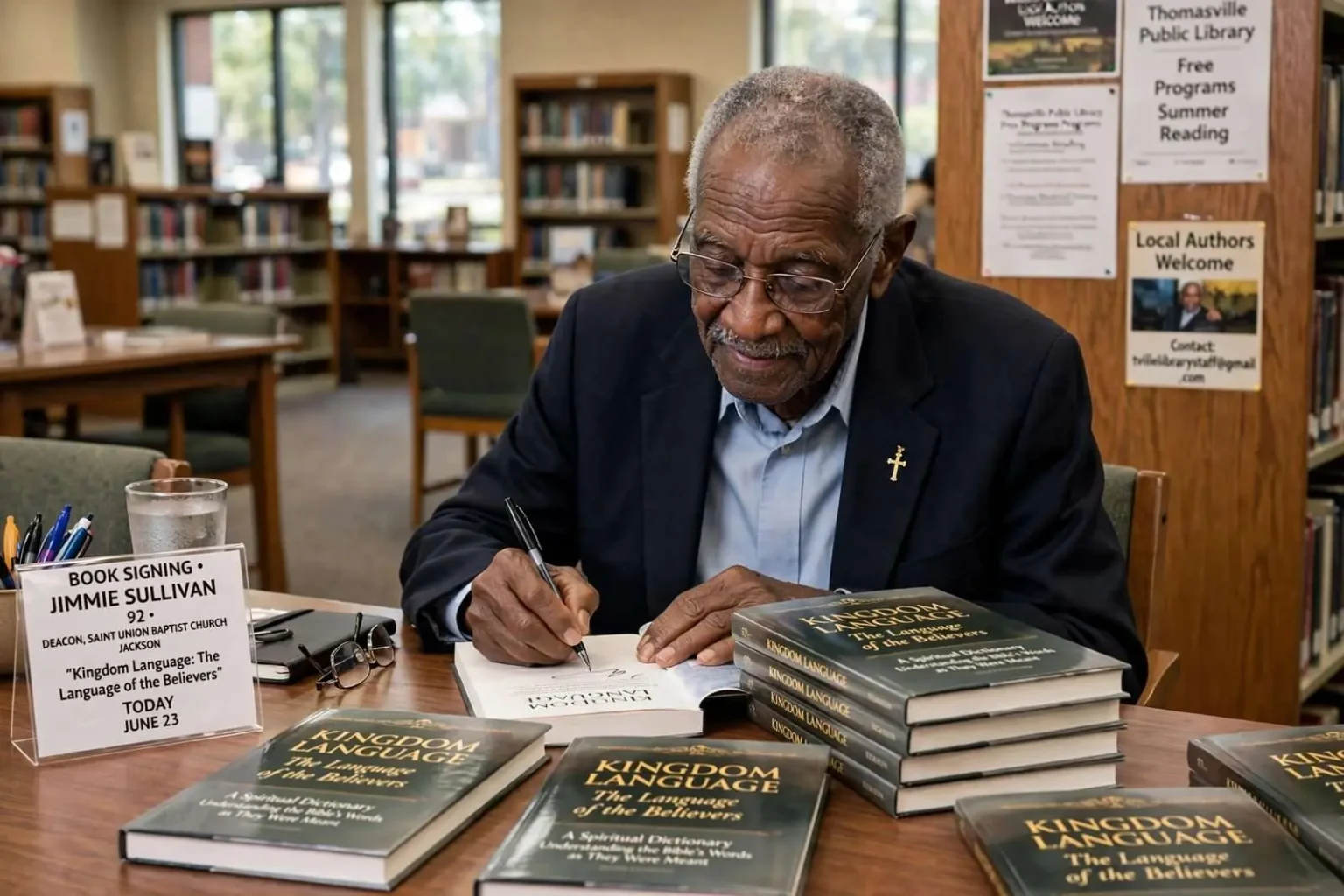
At 92 years old, with a deacon’s tenure stretching back more than six decades, Jimmie Sullivan has published a book. And on June 23, he sat down at the Thomasville Public Library to sign copies of it.
Sullivan, a deacon at Saint Union Baptist Church in Jackson, hosted a book signing at the library featuring “Kingdom Language: The Language of the Believers.” The work is a spiritual dictionary, and its premise is deceptively simple: that many of the words readers encounter in the Bible do not mean what a standard English dictionary says they mean. The Idea Behind the Book Sullivan’s argument is that misreading scripture often begins at the level of individual words, and that readers import modern, everyday definitions into a text where those definitions do not apply.
“I want them to learn that some meanings of words in the Webster dictionary are not the same in the spiritual dictionary,” Sullivan said. “There are so many words that have different meanings in the Bible, so that’s why I focused on the words. Words like hear, see and fear have different meanings, so that’s what motivated me to write the book so that people can understand the Bible better.”
The three examples he offers are well chosen, and they illustrate the point better than any abstract explanation could:
Hear in biblical usage often carries the weight of obedience, not merely auditory perception. To hear is to heed. See frequently denotes understanding or spiritual perception rather than the operation of the eye. Fear, perhaps the most commonly misread of the three, is generally rendered as reverence or awe rather than terror, which changes the meaning of a great many familiar passages.
A reader who substitutes the plain modern definitions in each case will arrive at a materially different, and often much narrower, reading of the text. That gap between the everyday word and the scriptural word is the entire territory Sullivan’s book sets out to map. A Ministry Behind the Manuscript Sullivan became a deacon at 28, meaning he has served in that role for roughly 64 years. He said the outreach ministry of the church has always been closest to his heart, and he has spent years carrying that work into jails and other places in the community rather than waiting for people to come to him.
He describes the book as an extension of that same effort, a way of continuing the work of explanation and encouragement in a form that outlasts any single visit.
His account of what has sustained him is unsparing.
“I am a believer, as simple as that,” he said. “I have been through a lot. I have sleep apnea, have had two heart attacks and have had cancer but none of that bothers me because I was already healed before I got it. I learned how to lean and depend on Jesus and that is the key that everyone is missing. You can’t do it by yourself. You will never win a battle against Satan by yourself but you got to know that if you go to (Jesus), you can win.” The Library as a Local Stage The signing points to a role that small-town public libraries fill quietly and well. A first-time author from a neighboring community, without a publisher’s publicity budget or a bookstore tour, needs somewhere to meet readers. In Clarke County, that place is often the library.
Sullivan’s book is available for checkout at the Thomasville Public Library, which means readers can encounter it without buying a copy. That is a meaningful distinction. Local authors who place their work in the library collection reach a far broader audience than sales alone would deliver, particularly among readers on fixed incomes.
The library also invites other authors to do the same. Writers interested in scheduling a book signing can contact the library staff by phone or by email at [email protected]. A Note on Local Authorship Clarke County has a longer literary tradition than its size would suggest, and it sits within a corner of Alabama that has produced a disproportionate share of the state’s writers. Community book signings, library readings and locally published work are the ground floor of that tradition, and they persist because institutions like the Thomasville Public Library keep the door open.
A 92-year-old deacon from Jackson, signing a spiritual dictionary he spent years assembling, is exactly the sort of thing that door is for. A Lifetime of Service, Set Down in Writing Sullivan’s book is the product of a long life of ministry rather than a sudden project. His six decades as a deacon at Saint Union Baptist Church in Jackson span a period in which the role of the rural Alabama church remained central to the social and spiritual life of its community. Deacons in congregations of this kind traditionally serve not only in worship but in the quiet, practical care of members, from hospital visits to outreach in places like the jails Sullivan described.
That the book found its way to a library in neighboring Thomasville speaks to the way small communities in Clarke County support one another. The Thomasville Public Library, by hosting the signing and adding the title to its circulating collection, extended the reach of Sullivan’s work well beyond his own congregation. For readers across the county, the result is a locally written book available to borrow free of charge, the kind of access that keeps community authorship alive in places far from the publishing centers of the country.
At 92, Sullivan has done what few first-time authors manage at any age: he turned a lifetime of study and service into a book, and then he sat down to sign it for the people of his corner of Alabama.
The signing also reflects the enduring place of faith and the church in the daily life of Clarke County. Congregations such as Saint Union Baptist Church in Jackson have long served as more than houses of worship; they are gathering places, mutual-aid networks and the keepers of local memory. A deacon who has served for 64 years connects his congregation to a continuity that spans generations of families in the community.
For readers curious about Sullivan’s work, the path is straightforward. “Kingdom Language: The Language of the Believers” is available to check out at the Thomasville Public Library, and the author can be reached through the library for those who wish to obtain a copy of their own. In a county where a bookstore visit can mean a drive to a neighboring city, the library remains the most accessible stage a local author could ask for.
Thomasville, the seat of Clarke County in southwest Alabama, has long been a quiet community with deep religious roots. The town has produced a number of ministers, deacons and lay leaders over the years who have served churches across the region.
A spiritual dictionary, the kind of reference book the Jackson resident has compiled, can serve as a useful resource for ministers, Sunday school teachers and lay readers. Such books typically include definitions of theological terms, biblical names and concepts that come up in church study.
Book signings in small-town Alabama often serve as community events, with friends and neighbors gathering to support the author and to celebrate the accomplishment of seeing a long project through to publication. Local bookstores and libraries have hosted many such events over the years.
Local governments and community partners are working through the implications of the situation, and several follow-up meetings have been scheduled for the coming weeks. Members of the public who want to weigh in on the matter can find the meeting dates on city and county websites, and written comments can be submitted through the standard channels used by the relevant agencies. Local news outlets will continue to cover the story as it develops.
Across south Alabama, similar issues are being addressed in other communities, and the lessons learned here are likely to inform how those communities approach their own challenges. Local officials have indicated they are in regular contact with counterparts in neighboring cities and counties, and they expect to share best practices as the situation continues to evolve.
The agencies involved in the matter have committed to keeping the public informed as the work progresses, and residents who want to receive updates directly can sign up for email or text alerts through the relevant city or county websites. Local community organizations have also agreed to share information as it becomes available, and several have scheduled public forums in the coming weeks to give residents a chance to ask questions of the officials involved.
For background, readers can consult the official websites of the relevant agencies, the local newspapers that have covered the story, and the public-meeting archives that document the prior deliberations on related topics. The combination of those resources should give residents a thorough understanding of how the current situation developed and how the agencies and elected officials are approaching the decisions that remain.