

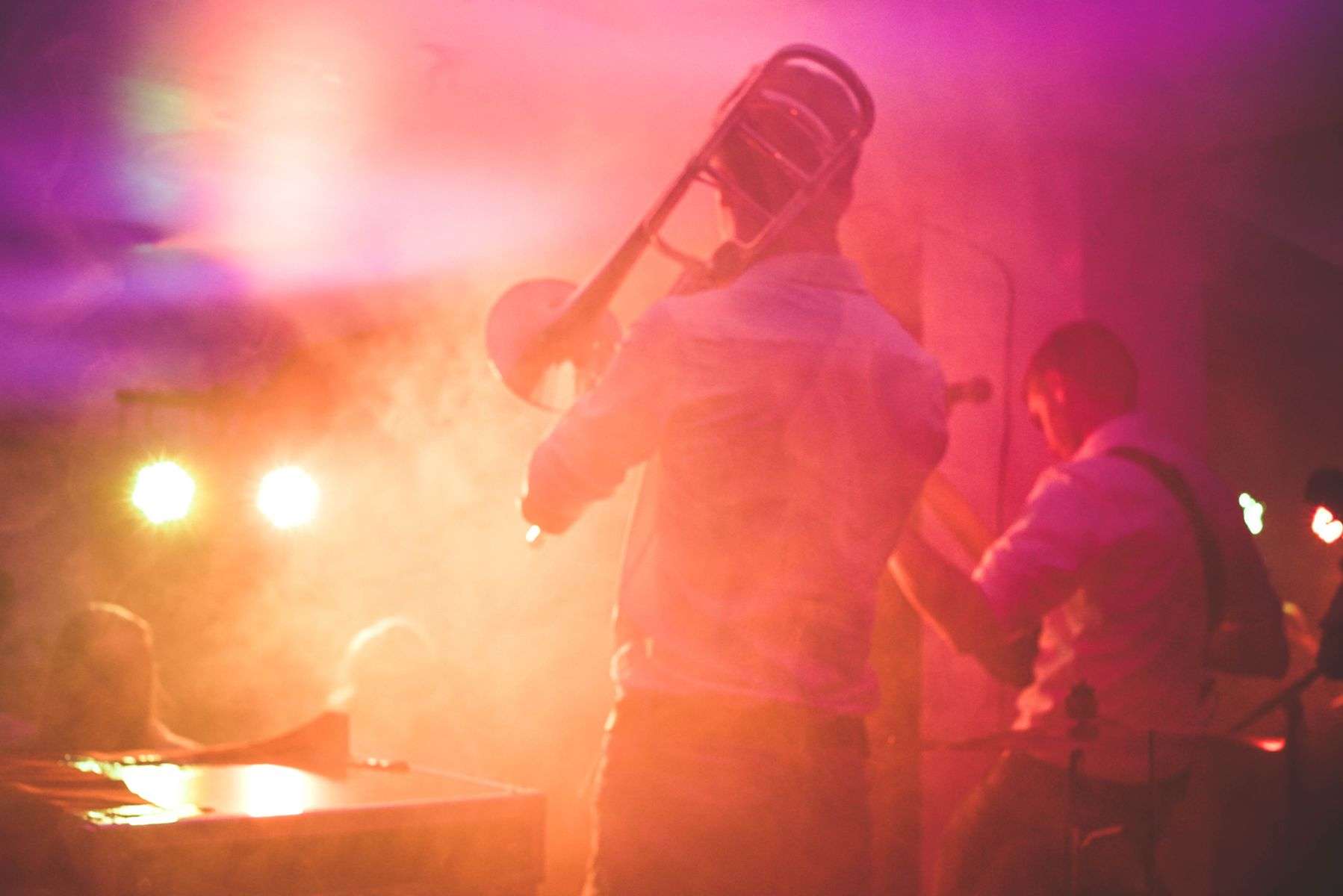
Every April, jazz lovers across the country pause to celebrate an art form born in America and shaped, in no small part, by musicians who came up in small Southern cities far from the genre’s better-known capitals. Mobile is one of those cities. Over the decades, it has quietly produced a remarkable number of players who went on to shape the sound of American popular music at the highest level. Among the most influential are two men whose names may not be as widely known to casual listeners as the artists they backed, but whose fingerprints are all over some of the most important recordings in soul and funk history: trombonist Fred Wesley Jr. and bassist Bernard Odum.
Both men played with James Brown, the singer and bandleader often called the “Godfather of Soul,” during pivotal stretches of his career in the 1960s and 1970s. Both were part of the tight, disciplined bands that turned Brown’s live shows and studio sessions into some of the most rhythmically influential music ever recorded. And both trace their roots back to Mobile, a city whose contributions to jazz and its offshoots have earned it a recurring spot in any serious survey of the genre’s history.
A Trombonist Raised on Mobile’s Bandstands
Fred Wesley Jr. grew up in Mobile, where music was effectively the family business. His father, Fred Wesley Sr., taught music at Mobile Central High School and led a big band of his own, giving the younger Wesley an early, front-row education in ensemble playing, arranging, and the discipline required to lead a group of musicians night after night. That background would serve him well: within a matter of years, Wesley would be doing much of that same work — arranging horn parts, leading bands, shaping a sound — for one of the most demanding bandleaders in American music.
Wesley’s professional career began early. In 1962, while still a young man, he joined the Ike and Tina Turner Revue, one of the era’s most electrifying live acts and a proving ground for musicians who could keep pace with a notoriously rigorous show. From there he spent time with Hank Ballard and the Midnighters, the vocal group whose recordings helped popularize what would become rock and roll, before a stint in the U.S. Army interrupted his career, as it did for many musicians of his generation.
It was after his military service that Wesley’s career reached its best-known chapter. He worked with James Brown from 1968 to 1970, left briefly, and returned from 1971 to 1975 — a run during which he became one of the most important figures in Brown’s organization. As bandleader and musical director of the J.B.’s, Brown’s famed backing band, Wesley did far more than play trombone. He handled much of the group’s composing and arranging, translating Brown’s rhythmic ideas and vocal cues into the tightly wound horn charts and grooves that defined the era’s funk sound. Musicians and historians have long pointed to the J.B.’s as one of the most influential rhythm sections in American popular music, and Wesley’s arranging work sat at the center of that influence, helping shape recordings that would later be sampled and studied by generations of hip-hop and funk musicians.
From Funk to the Basie Band
When Wesley left Brown’s organization in 1975, he didn’t step away from high-level ensemble work — he simply changed rooms. He spent several years touring and recording with George Clinton’s sprawling Parliament-Funkadelic collective, one of the defining forces in 1970s funk, and led the Horny Horns, a group built around veteran horn players from the Brown and Clinton camps, releasing albums under that banner.
In 1978, Wesley made a move that underscored his range as a musician: he joined the Count Basie Orchestra, one of the most storied big bands in jazz history. Basie’s orchestra had spent decades setting the standard for swing-era ensemble playing, and a chair in that band represented a different kind of credential than anything Wesley had earned in funk and soul — proof that his skills translated across genres that, on the surface, could seem worlds apart.
Wesley went on to release a string of albums as a bandleader in his own right, including To Someone, New Friends, Comme Ci Comme Ca, Swing and Be Funky, and Amalgamation. In the early 1990s, he reunited with two other veterans of Brown’s bands, saxophonists Pee Wee Ellis and Maceo Parker, touring as the JB Horns. When Ellis eventually departed the group, it continued on as the Maceo Parker Band, with Wesley serving as its featured trombonist until 1996, when he struck out to form the Fred Wesley Group.
Wesley later turned to writing as well as performing. In 2002, he published Hit Me, Fred: Recollections of a Sideman, an autobiography chronicling his decades as a supporting player behind some of the biggest names in American music — a perspective that offers a rare, close-up account of what it took to hold together the bands behind stars like Brown and Clinton. He also recorded Cuda Wuda Shuda with the Fred Wesley Band and, drawing on the same family tradition of teaching that shaped his own childhood in Mobile, served as an adjunct professor in the Jazz Studies Department at the University of North Carolina at Greensboro, passing along decades of bandstand experience to a new generation of players.
Bernard Odum: The Bassist Behind the Beat
If Wesley’s horn arrangements gave the J.B.’s their punch, it was bassists like Bernard Odum who gave Brown’s earlier bands their foundation. Odum, also a Mobile native, was a bass guitarist who became one of James Brown’s key sidemen during the formative years of Brown’s sound in the late 1950s and 1960s, a period that predates the J.B.’s era most casual listeners associate with Brown’s music but that was every bit as important in establishing the rhythmic vocabulary that would come to define funk.
Odum spent years locked into Brown’s evolving band, playing bass on some of the singles that turned Brown from a regional R&B performer into a national star. The interplay between a steady, propulsive bass line and Brown’s famously demanding rhythmic sense was a hallmark of these recordings, and bassists in Brown’s orbit were expected to lock in with a drummer and horn section with almost military precision — a standard that reportedly cost more than one musician their job over the years. Odum’s ability to meet that standard for an extended stretch says a great deal about his skill and reliability as a player.
Odum maintained his ties to Mobile throughout his life and eventually returned to the city, where he lived out his later years. His story, like Wesley’s, illustrates a pattern that shows up again and again in the history of American popular music: a young Southern musician trained on local bandstands and in school music programs goes on to play an outsized role in a national sound, often while receiving far less individual recognition than the star out front.
Why Sideman Stories Matter
Frontmen and headline vocalists tend to dominate the popular memory of any musical era, but the musicians who fill out a band — the horn players, bassists, drummers, and arrangers — are frequently the ones actually building the sound audiences remember. James Brown’s records are remembered for their rhythmic tightness and forward drive as much as for his vocals, and that tightness was the product of bandleaders, arrangers, and sidemen like Wesley and Odum working out the details, night after night, on stages across the country and in recording studios.
Music historians and funk scholars have long emphasized how much of what became identifiable as “the funk sound” — syncopated bass lines locked with kick drums, horn stabs used almost percussively, tightly disciplined ensemble playing — was worked out collaboratively by musicians like the ones who passed through Brown’s bands. Wesley’s autobiography, written specifically from a sideman’s point of view, was in part an attempt to correct the record on how much creative labor those musicians contributed, work that rarely came with songwriting credit or the kind of recognition afforded to a band’s namesake.
Jazz Appreciation Month and Mobile’s Musical Legacy
Jazz Appreciation Month, observed each April, began as a Smithsonian Institution initiative launched in 2001 by John Edward Hasse, a curator at the National Museum of American History, building on an earlier regional effort — Jazz Awareness Month — that the Louisiana Jazz Federation had established in New Orleans two decades earlier. The observance was designed to treat jazz as both a living art form and a historical one, encouraging schools, museums, and community organizations nationwide to host concerts, educational programs, and retrospectives honoring the genre’s musicians. It typically culminates on April 30 with International Jazz Day, a global celebration that extends the observance well beyond U.S. borders.
For a city like Mobile, with its long and often under-recognized history of producing serious jazz and R&B talent, the observance offers a natural occasion to revisit the careers of local musicians whose influence reached far beyond the Gulf Coast. Wesley and Odum are part of a broader lineage of Mobile-connected musicians who found their way into some of the most consequential bands in American popular music, a lineage that reflects the strength of the city’s school music programs, church music traditions, and local bandstands in the mid-20th century — the same kind of grassroots musical infrastructure that shaped countless Southern musicians of that generation before they ever set foot on a national stage.
Their stories are a reminder that a city’s musical legacy isn’t only measured by the stars it produces, but by the working musicians whose names may not headline a marquee, yet whose playing became part of the permanent vocabulary of American music.